
Ellora Caves and the basalt cliff line
Published on 09/19/2026 at 13:09 | Editorial responsibility: Rafael Müller, Editor-in-Chief AD HOC NEWS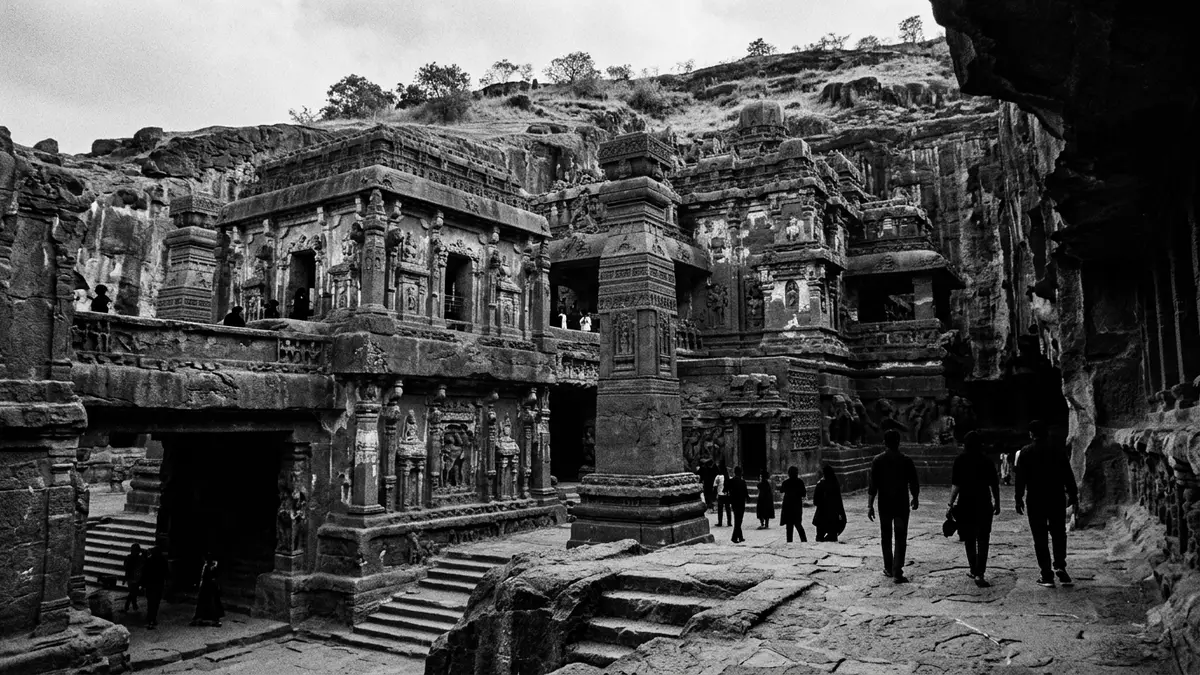
Ellora Caves near Aurangabad form a long line of rock-cut monasteries and temples cut into a high basalt cliff. The site spans more than 2 km and carries a UNESCO World Heritage listing from 1983.
Basalt, rock-cut halls and the cliff line
The caves stretch along the Charanandri hills in Maharashtra, with the monuments arranged side by side in the cliff face. That setting gives Ellora its clearest visual feature: a sequence of excavations rather than a single enclosed complex.UNESCO World Heritage
The complex contains monasteries and temples linked to Buddhism, Hinduism and Jainism. Their carved facades and interior chambers belong to a sequence that runs from AD 600 to 1000, and the Kailasa temple is the best-known individual monument within that span.rock-cut temples
Three traditions in one sacred landscape
The religious range is one of Ellora’s defining features. Buddhist monasteries stand alongside Hindu shrines and Jain temples, all cut directly into the same cliff line and all part of the same archaeological site.Buddhism, Hinduism and Jainism
The best-known monument is the Kailasa temple, also known as Kailasanatha, which belongs to the Hindu group of caves. It is a monolithic rock-cut temple, and its carved mass gives the southern end of the site a stronger vertical presence than the smaller chambers around it.Kailasa temple
Ellora Caves as an archaeological landscape
Ellora is often treated as a single destination, but it reads as a succession of separate cave groups linked by the cliff. The arrangement allows Buddhist, Hindu and Jain spaces to be seen within one continuous archaeological landscape, rather than as isolated monuments.sacred site
The site belongs to a wider history of rock-cut architecture in India. Its scale, the use of basalt, and the long period of activity from the seventh to the tenth century give it a place among the major carved complexes of the Deccan.deccan
Visiting Ellora Caves: what travellers from Western Europe should know
- The site lies near Aurangabad in Maharashtra. Road access is the normal approach from the city, and the caves run along a basalt escarpment rather than around a compact courtyard.
- The terrain is uneven, with carved steps, rock-cut fronts and long stretches between cave groups. A single route links the monuments along the cliff.
- The official language is Marathi and the currency is the Indian rupee.
- Entry requirements depend on your nationality; UK travellers can check the FCDO travel advice at gov.uk/foreign-travel-advice, Irish travellers the Department of Foreign Affairs at ireland.ie.
Searching for Ellora Caves on social platforms
These links open searches for Ellora Caves on each platform.
Frequently asked questions about Ellora Caves
Where are Ellora Caves?
Ellora Caves lie near Aurangabad in Maharashtra, India. They extend along a basalt cliff in the Charanandri hills.
What appears on a visit?
The site presents a sequence of carved caves, temples and monasteries linked by the cliff line. The monuments belong to Buddhist, Hindu and Jain traditions.
What makes Ellora Caves distinctive?
The combination of three religious traditions, a long chronological span and a basalt cliff setting gives Ellora its distinctive character. The Kailasa temple adds a major monolithic monument to that sequence.


