
Ellora Caves and the basalt cliff at Aurangabad
Published on 08/29/2026 at 16:39 | Editorial responsibility: Rafael Müller, Editor-in-Chief AD HOC NEWS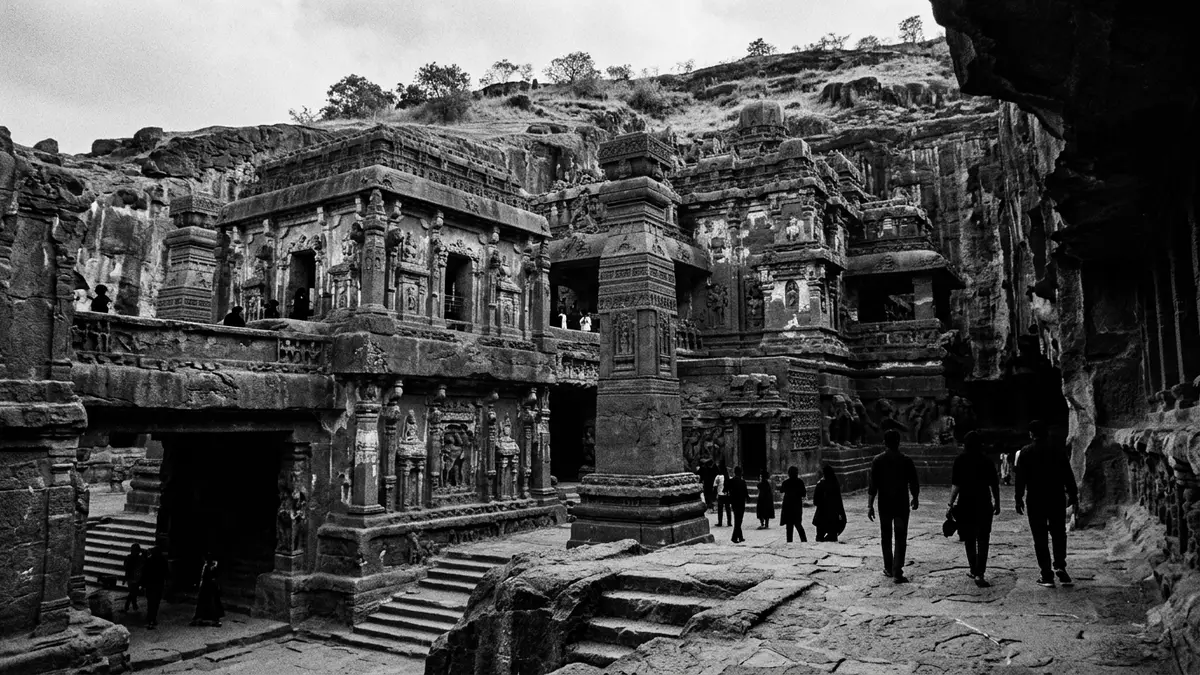
Ellora Caves near Aurangabad present 34 rock-cut monasteries and temples in a long basalt cliff. The site combines Buddhist, Hindu and Jain monuments from the time of ancient India. 34 monasteries and temples
Ellora Caves on the basalt wall
The first impression is scale. The caves stretch for more than 2 km, cut side by side into the cliff face rather than scattered across separate outcrops. 2 km
The setting is rugged and direct. Basalt forms the rock, and the architecture takes the form of excavated halls, monasteries and temple fronts that open straight into the hillside. The ensemble includes both simple chambers and more elaborate carved façades.
Three faiths carved into one site
Ellora is divided among Buddhist, Hindu and Jain monuments. That sequence gives the place its clearest historical thread, with monuments belonging to a broad span from the sixth century to the tenth century and beyond in some readings. A.D. 600 to 1000
The religious range matters because it is visible on the ground, not abstract in a label. Cave groups differ in image, scale and spatial arrangement, while the overall setting remains one continuous rock-cut complex. UNESCO lists the site for its cultural value and for the long sequence of monuments preserved here. UNESCO World Heritage
Kailasa and the scale of excavation
Among the monuments, Kailasa Temple in Cave 16 is the best-known single structure. It belongs to the eighth century and is linked with the reign of Krishna I of the Rashtrakuta dynasty. Krishna I
Kailasa is a monolithic temple cut from the rock mass itself. Britannica describes it as a downward excavation from the slope, and the temple preserves layered façades, halls, stairways and sculpted figures within a single rock-cut composition. The result gives Ellora its most recognisable architectural centrepiece. Kailasa Temple
Visiting Ellora Caves: what travellers from Western Europe should know
- The caves lie near Aurangabad in Maharashtra. Reaching them by road from the city is the usual approach, and the complex stands in the Charanandri Hills.
- The site is carved into basalt, and the ground includes steps, uneven rock and long stone-cut passages. Several parts are open to the sky, including the major temple courts.
- The complex brings together Buddhist, Hindu and Jain monuments in one continuous setting. That mix is central to the place and visible in the cave groups.
- Ajanta Caves lies to the southwest, and the region also includes other rock-cut heritage sites. Ellora belongs to a wider landscape of Deccan cave architecture.
Searching for Ellora Caves on social platforms
These links open searches for Ellora Caves on each platform.
Frequently asked questions about Ellora Caves
Where are Ellora Caves?
Ellora Caves are near Aurangabad in Maharashtra, western India. The site lies in a basalt cliff within the Charanandri Hills.
What does a visit involve?
The complex is a spread-out rock-cut site with caves, steps and carved façades. The experience is shaped by walking through different cave groups rather than a single enclosed building.
What makes Ellora Caves distinctive?
The strongest feature is the combination of Buddhist, Hindu and Jain monuments in one rock-cut ensemble. The long sequence of carving from the sixth to the tenth century gives the site its historical depth.


