
Elephantine and its stone terraces in Assuan
Published on 08/08/2026 at 15:07 | Editorial responsibility: Rafael Müller, Editor-in-Chief AD HOC NEWS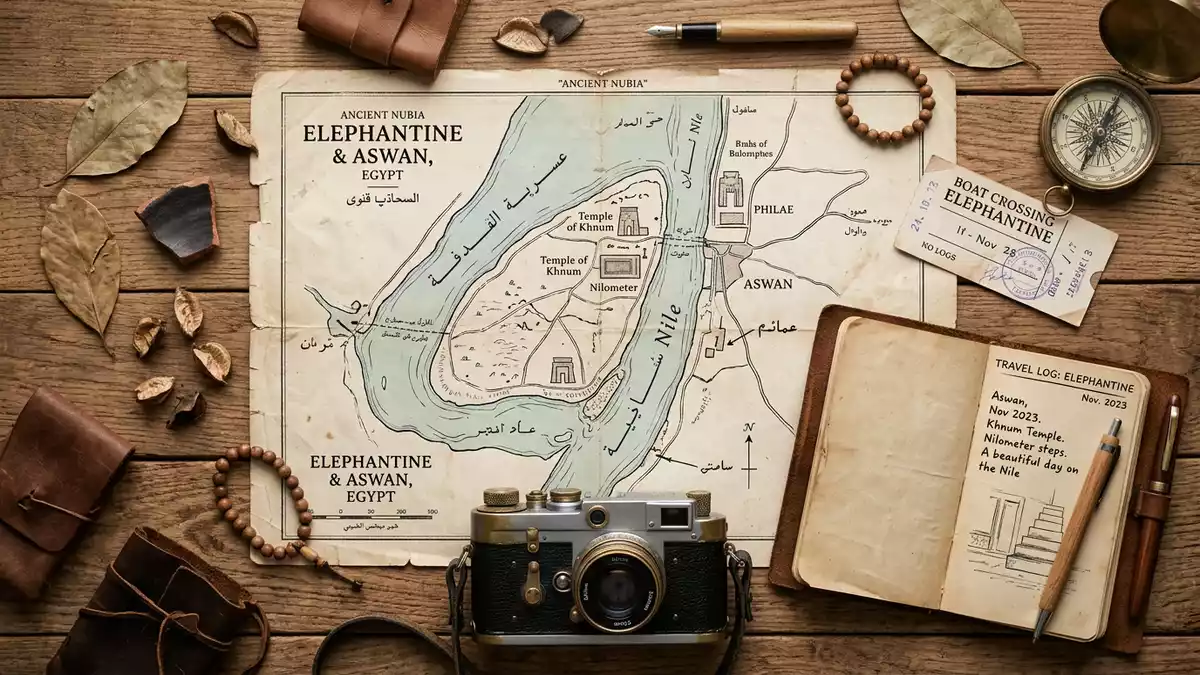
Elephantine in Assuan is a compact Nile island where granite, mudbrick and ruined sanctuaries sit close together. The island’s visible layers include ancient temples, later houses and traces of long occupation that reach back to pharaonic Egypt.
Elephantine’s layered island landscape
The island lies in the Nile beside Assuan and forms part of the old frontier zone of Upper Egypt. It is associated with Khnum, the ram-headed god linked to the cataract region, and with the temple complex that once stood here.
Elephantine also carries the mark of ordinary settlement. Remains of domestic buildings, walls and streets show an inhabited island rather than a single isolated monument.
Temples, houses and granite on the Nile
The most visible archaeological impression comes from the contrast between temple ruins and later habitation. Granite blocks, mudbrick walls and low foundations create a landscape that reads as both sacred and lived-in.
Among the island’s known monuments are the Temple of Khnum and archaeological traces from the Old Kingdom and later periods. The island’s long sequence of use places it within the broader history of ancient Assuan and the southern borderlands of Egypt.
Elephantine in the history of Assuan
Elephantine has long mattered because it sits at a strategic point on the river. Its position made it part of trade, administration and religion in ancient Upper Egypt, and those functions left different kinds of remains on the island.
The name Elephantine is used for the island itself, while the German form Elephantine-Insel points to the same place. The site preserves an unusually readable mix of stone, mudbrick and river-edge archaeology that rewards slow looking.
Visiting Elephantine: what travellers from Western Europe should know
- The site is on Elephantine Island in Assuan, reached by boat from the riverfront.
- Admission arrangements and opening hours are set by the site's operator and change with the season; the official website is the only binding source.
- Late afternoon brings softer light across the stone remains and the river.
- The ground includes uneven archaeological surfaces, low walls and paths between ruins.
- Carry small local currency for incidental purchases, and expect Arabic as the main language on site.
- Entry requirements depend on your nationality. UK travellers should check the FCDO travel advice at gov.uk/foreign-travel-advice; Irish travellers the Department of Foreign Affairs at ireland.ie; EU and EEA citizens their own national foreign ministry.
Searching for Elephantine on social platforms
These links open searches for Elephantine on each platform.
Frequently asked questions about Elephantine
Where is Elephantine?
Elephantine is an island in the Nile at Assuan in southern Egypt. It lies opposite the city’s riverbank and is reached by boat.
What should visitors expect?
Visitors find archaeological remains spread across an inhabited island landscape. Expect ruins, low walls, temple traces and uneven ground rather than a single enclosed monument.
What makes Elephantine distinctive?
Its distinction lies in the combination of ancient religious remains, domestic archaeology and Nile-side setting. The island preserves a long sequence of settlement in one compact place.


