
Elephantine: an ancient Nile island at Assuan’s southern frontier
Published on 09/07/2026 at 13:12 | Editorial responsibility: Rafael Müller, Editor-in-Chief AD HOC NEWS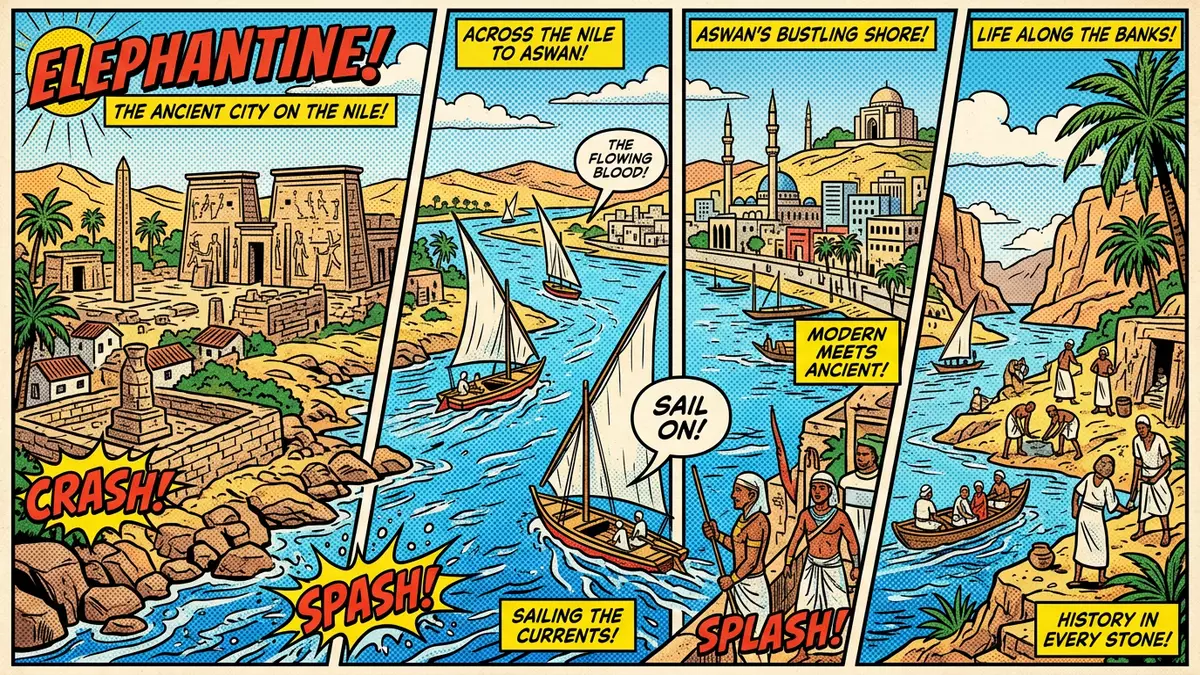
Elephantine in Assuan, Egypt is a Nile island where ancient temples, nilometers and modern Nubian villages share a narrow strip of land in the Nile. Once known to the pharaonic world as Abu, it formed Egypt’s southern frontier and gateway to Nubia, a role still legible in its ruins and river setting.
An island shaped by the Nile and Egypt’s southern border
Elephantine is a river island in the Nile opposite the city of Assuan, forming part of the urban fabric of Upper Egypt along the river’s edge.island in the Nile opposite Asw?n Its ancient name Abu, later rendered as Elephantine in Greek, reflects a long history of interaction between Egypt and lands to the south.Elephantine is the Greek name for pharaonic Abu The island lies just downstream from the First Cataract of the Nile, a natural barrier that made this stretch of river a strategic frontier zone between Upper Egypt and Lower Nubia.located just downstream from the first cataract
Measured along the river, Elephantine is about 1,200 m (3,900 ft) from north to south and about 400 m (1,300 ft) at its widest point, giving it an elongated profile parallel to the Nile’s flow.length of 1,200 metres and width of 400 metres Rock outcrops and boulders fringe parts of the shoreline, with settlement areas and archaeological zones stepping up from the water towards the interior. The island’s position made it a natural checkpoint for goods and people entering Egypt from Nubia, and over millennia it became a densely layered settlement tied closely to the rhythms of the river.
Temples, nilometers and an archaeological landscape
Elephantine is an important archaeological island, with remains spanning from the Old Kingdom through Pharaonic, Ptolemaic and Roman periods.Elephantine Island is an Old Kingdom archaeological site Among the most prominent structures are the ruins of the temple of Khnum, the ram-headed creator god associated with the annual Nile flood, and the temple of Satet, a goddess linked to Egypt’s southern frontier and the same life-giving waters.temple of Khnum and temple of Satet These temples, together with surrounding residential remains, form a compact sacred and administrative landscape at the southern end of the island.
Two ancient nilometers, cut into the rock and lined with marked steps, descend towards the river to measure the Nile’s level and help predict floods and harvests.nilometer in the form of ancient stairs leading into the water Nearby stands the Aswan Museum, which occupies part of the southern tip and displays finds from local excavations, ranging from prehistoric artefacts to objects from Roman times.Aswan Museum on the island displays finds from local excavations Elephantine’s archaeological areas were inscribed on UNESCO’s World Heritage List in 1979 as part of the group of Nubian monuments from Abu Simbel to Philae, reflecting their recognised significance in Egypt’s architectural and cultural history.inscribed on UNESCO's World Heritage List in 1979
Nubian villages and modern life on an ancient island
Alongside its temples and ruins, Elephantine is home to Nubian communities whose villages occupy stretches of the island’s middle section.site of two Nubian villages Narrow lanes run between low-rise houses, some built close to the water, others rising slightly above it, creating a lived-in counterpart to the archaeological zones. Everyday activity here shares space with visitors, feluccas and motorboats moored along the shore.
At the northern, downstream end of Elephantine stands a large modern hotel, a conspicuous landmark that contrasts with the ruins and village houses further south.large, dominating luxury hotel at the downstream, northern end Together, the hotel, the Nubian villages and the museum show how the island functions both as part of Assuan’s cityscape and as a destination centred on its long history and riverside setting.
Visiting Elephantine: what travellers from Western Europe should know
- Elephantine lies in the Nile directly opposite central Assuan, and small motorboats, ferries and traditional feluccas carry passengers across the river between the city’s corniche and the island.
- Paths on Elephantine pass through village streets and archaeological areas, with uneven ground and rock steps in places, especially around the nilometers and temple ruins.
- The island is in Egypt, where the official language is Arabic and the currency is the Egyptian pound.
- Elephantine forms part of a wider cluster of Nile islands near Assuan, with views towards the riverbank, nearby river islands and, in the distance, desert hills beyond the city.
Searching for Elephantine on social platforms
These links open searches for Elephantine on each platform.
Frequently asked questions about Elephantine
Where is Elephantine located?
Elephantine is a Nile island forming part of Assuan in Upper Egypt, lying opposite the city on the river and just downstream from the First Cataract.
What can visitors expect on Elephantine?
Visitors encounter temple ruins, nilometers, the Aswan Museum and Nubian villages, all set within a compact island landscape reached by short boat crossings from Assuan.
What makes Elephantine distinctive among Nile sites?
Elephantine combines its role as Egypt’s ancient southern frontier, its UNESCO-recognised archaeological remains and its continuing Nubian village life on the same stretch of river.


