
El Yunque National Forest and the rainforest peaks above Rio Grande
Published on 09/14/2026 at 15:24 | Editorial responsibility: Rafael Müller, Editor-in-Chief AD HOC NEWS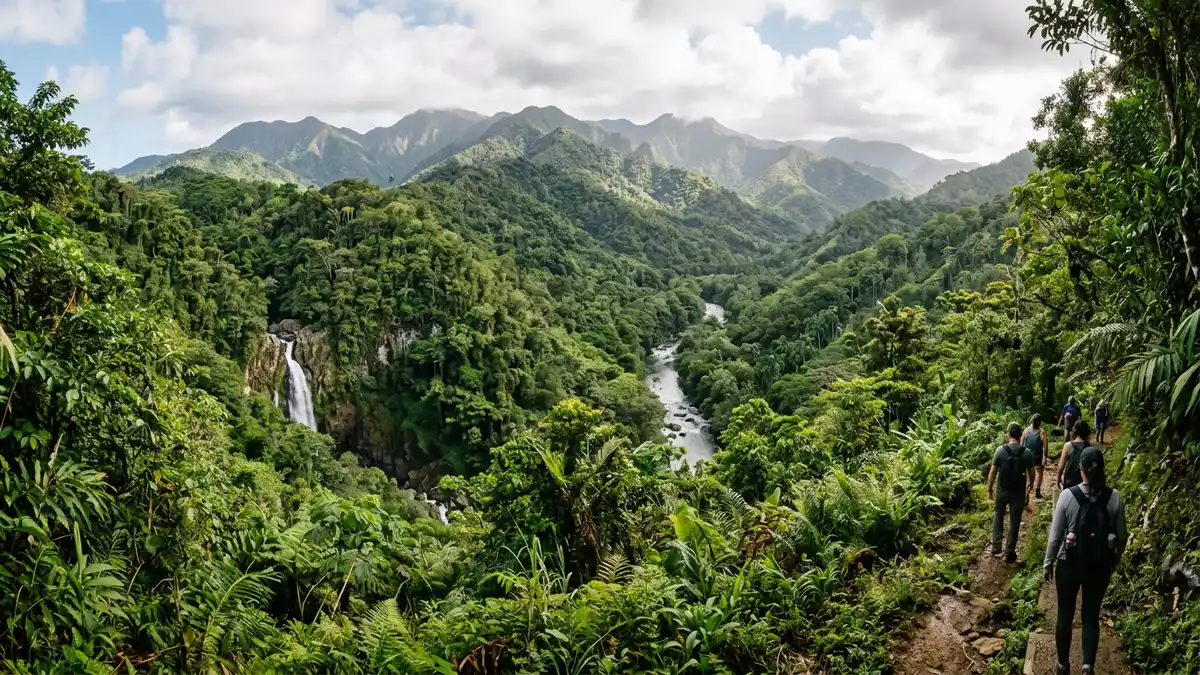
El Yunque National Forest is a compact tropical rainforest rising above the municipality of Rio Grande in north-eastern Puerto Rico, combining steep mountain ridges, dense vegetation and cascading rivers in a relatively small protected area. Its rainforest character and rugged terrain make the forest a rare combination of accessible trails, dramatic peaks and abundant water features within the United States National Forest System.
Rainforest on the slopes of the Luquillo Mountains
El Yunque National Forest lies on the eastern side of Puerto Rico, centred on the Luquillo Mountains, with Rio Grande as the nearest major settlement and gateway town on the northern flank of the range.Nearest city Rio Grande The protected forest area extends across several municipalities, but the main massif and visitor approach sit within the Rio Grande municipal boundary, where the mountain slopes rise sharply from lowland plains into cloud-covered summits.Northeast Region
The forest covers an area of just under 29,000 acres (around 11,000 ha), making it relatively small compared with other national forests in the United States, yet the combination of steep gradients, deep valleys and high rainfall concentrates a wide variety of habitats into a compact space.nearly 29,000 acres Peaks in the Luquillo Mountains reach elevations of over 1,000 m (3,281 ft), and slopes rise quickly, creating a marked transition from coastal lowland to mountainous rainforest within a short horizontal distance.Luquillo Mountains elevation
A century of protection for a tropical national forest
El Yunque National Forest holds a distinctive place in conservation history as the only tropical rainforest within the United States National Forest System, a designation that reflects both its climate and long-standing protection.only tropical rainforest The area entered the formal conservation record in 1903, when President Theodore Roosevelt proclaimed the Luquillo Forest Reserve, creating a public forest reservation on land ceded to the United States after the Treaty of Paris in 1898.Luquillo Forest Reserve 1903
The forest was later known as the Caribbean National Forest, before receiving the name El Yunque National Forest through an executive order by President George H. W. Bush, aligning the official title with the local name for the mountain massif.renamed by executive order Over the twentieth century and into the twenty-first, management by the United States Forest Service has maintained the area as a protected landscape, safeguarding river catchments, forest ecosystems and high-elevation habitats in the Luquillo range.administered by US Forest Service
Waterfalls, river valleys and steep forest trails
Among El Yunque’s most tangible features are its waterfalls and river valleys, which cut through the forested slopes and provide natural focal points along the main recreation corridor. La Coca Falls, for example, lies beside the northern access road at around 450 m (1,476 ft) above sea level, where water flows down exposed rock into a stream below.La Coca Falls elevation Other named waterfalls and cascades are reached by footpaths that follow river courses and cross smaller streams, reflecting the forest’s high rainfall and dense drainage network.waterfall trails
Visitors moving away from the road traverse steep, uneven trails through thick vegetation, with roots, rocks and constructed steps providing footing on inclines that can gain more than 100 m (328 ft) of elevation over relatively short distances.elevation gain on trails River pools and viewpoints often sit at the end of these paths, where forest clearings reveal sections of the surrounding mountains or the structure of individual waterfalls against the bedrock of the Luquillo range.rugged, mountainous terrain
Visiting El Yunque National Forest: what travellers from Western Europe should know
- El Yunque National Forest lies in the north-east of Puerto Rico, with the main northern entrance reached by road from San Juan through Río Grande along highways PR-26, PR-66 and PR-191.
- The terrain inside the forest is mountainous, with steep gradients, constructed steps and uneven natural surfaces on many trails, so movement away from the road involves sustained walking on inclines.
- River valleys and waterfalls are key features, and approaches to these areas follow paths beside streams that may require crossing wet rock or shallow water on foot.
- The official language is Spanish and the currency is the United States dollar (USD).
- Entry requirements depend on your nationality; UK travellers can check the FCDO travel advice at gov.uk/foreign-travel-advice, Irish travellers the Department of Foreign Affairs at ireland.ie.
Searching for El Yunque National Forest on social platforms
These links open searches for El Yunque National Forest on each platform.
Frequently asked questions about El Yunque National Forest
Where is El Yunque National Forest located?
El Yunque National Forest is in north-eastern Puerto Rico on the slopes of the Luquillo Mountains, with Rio Grande as the nearest main town and access point for the northern entrance.
What can visitors expect on a visit?
Visitors encounter steep mountain terrain, dense tropical vegetation, river valleys and waterfalls, with road-accessible viewpoints and marked trails that lead further into the rainforest landscape.
What makes El Yunque National Forest distinctive?
The forest is distinctive as a tropical rainforest managed as part of the United States National Forest System, combining compact size with steep topography, high rainfall and long-established protection dating back to 1903.


