
El Yunque National Forest and the rainforest peaks above Rio Grande
Published on 09/07/2026 at 20:47 | Editorial responsibility: Rafael Müller, Editor-in-Chief AD HOC NEWS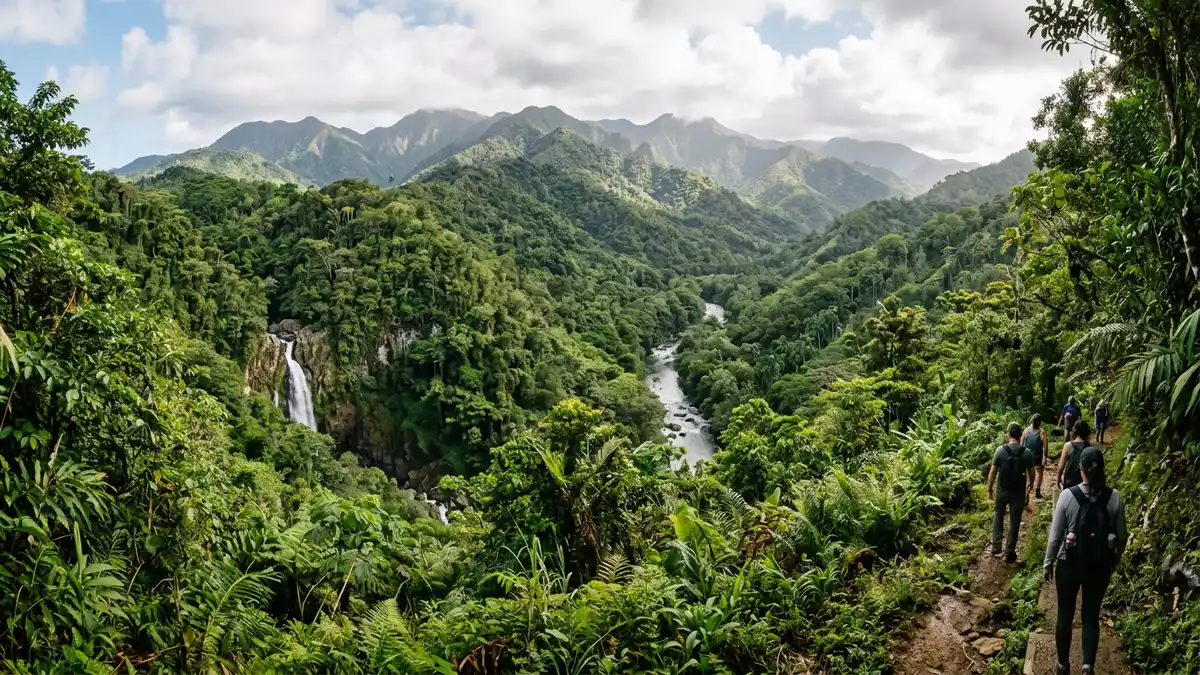
El Yunque National Forest above Rio Grande in northeastern Puerto Rico is a compact tropical rainforest where steep green mountains, constant moisture and fast?falling rivers shape every view. Set in the Sierra de Luquillo, it is part of the United States National Forest System and combines rugged peaks with dense vegetation in a way that feels almost sculptural.
A tropical rainforest within the U.S. National Forest System
El Yunque National Forest is located in the mountainous northeast of Puerto Rico, in the Sierra de Luquillo range that rises abruptly from the coastal plain inland from Rio Grande. The forest forms the only tropical rainforest in the United States National Forest System, a designation that sets it apart from the temperate forests managed elsewhere in the country.only tropical rainforest It occupies more than 28,000 acres (around 11,000 ha) of public land and is administered by the U.S. Forest Service from its headquarters near Rio Grande.more than 28,000 acres
The forest’s terrain centres on peaks such as El Toro, which reaches about 1,076 m (3,533 ft) above sea level, and on deeply incised valleys that carry water down towards the coast.El Toro peak elevation Elevations within the forest range from just over 100 m (around 330 ft) up to these higher summits, creating marked changes in vegetation over relatively short horizontal distances.elevation range Steep slopes and narrow ridges, locally known as cuchillas, define the skyline and give walking routes a strong sense of vertical movement.
Rainfall, rivers and biodiversity on the Luquillo peaks
Rainfall is a defining feature of El Yunque National Forest. Average annual totals reach around 120 in (304 cm), with higher elevations recording even greater amounts in some years.average annual rainfall This sustained moisture supports cloud forest conditions near the peaks and feeds a network of rivers that radiate away from the central mountains. Several major rivers rise within the forest, and water from these channels supplies a significant part of Puerto Rico’s fresh water, reaching communities far beyond Rio Grande.fresh water supply
The combination of steep terrain and constant humidity has produced rich biodiversity. Researchers have documented more than 240 native tree species inside the forest, with a subset that does not occur outside El Yunque.over 240 tree species Ferns are particularly abundant, with around 150 species recorded, and the understorey hosts a variety of shrubs and smaller plants adapted to low light and frequent rain.fern diversity Vertebrate life includes amphibians, birds and bats, among them endemic species such as the Puerto Rican parrot, which uses the forest as a crucial refuge.vertebrate species occur
A long history of protection and research
Human engagement with the mountains around El Yunque long predates formal protection, but the area’s modern status as a reserve began in the nineteenth century. In 1876, King Alfonso XII of Spain designated forest land in the Luquillo range as a crown reserve for conservation of soils, timber and water, establishing one of the earliest forest reserves in the Western Hemisphere.crown reserve in 1876 After Puerto Rico became a United States territory, the Luquillo Forest Reserve was formally created in 1903 by proclamation of President Theodore Roosevelt, and in 1906 it received the name Caribbean National Forest.Luquillo Forest Reserve in 1903
In the early twenty?first century the forest’s official name changed again, when an executive order renamed the Caribbean National Forest as El Yunque National Forest, reflecting the long?standing local usage for the mountainous area.renamed El Yunque National Forest Today, the forest combines its role as a protected area with functions as an experimental and research site. Parts of its land are designated specifically for scientific study, including long?term observation of tropical montane ecosystems and hydrology.area dedicated to research Other areas are set aside for recreation on foot and by vehicle within the boundaries established by the Forest Service.
Visiting El Yunque National Forest: what travellers from Western Europe should know
- El Yunque National Forest lies inland from the Atlantic coast in northeastern Puerto Rico, with access points in and around Rio Grande and other municipalities on the slopes of the Sierra de Luquillo.
- The terrain is steep and uneven, with substantial gradients, wet surfaces and stairways in some sections, so visiting on foot involves walking on slopes and paths that can be slippery after rainfall.
- Several major rivers rise in the forest and cross its valleys, and views from higher ground extend across densely vegetated ridges towards the coastal plain and the Atlantic beyond.
- The official language is Spanish and the currency is the United States dollar.
- Entry requirements depend on your nationality; UK travellers can check the FCDO travel advice at gov.uk/foreign-travel-advice, Irish travellers the Department of Foreign Affairs at ireland.ie.
Searching for El Yunque National Forest on social platforms
These links open searches for El Yunque National Forest on each platform.
Frequently asked questions about El Yunque National Forest
Where is El Yunque National Forest located?
El Yunque National Forest is in northeastern Puerto Rico, in the Sierra de Luquillo mountains above municipalities such as Rio Grande, Luquillo and Canóvanas.
What can visitors expect on a visit to El Yunque National Forest?
Visitors encounter steep, forested terrain, rivers and waterfalls, with walking routes that cross humid valleys and slopes under dense tropical vegetation.
What makes El Yunque National Forest distinctive among U.S. national forests?
El Yunque is the only tropical rainforest in the United States National Forest System and combines small overall size with very high biodiversity.


