
El Yunque National Forest and the high rainforest of Puerto Rico
Published on 08/20/2026 at 06:16 | Editorial responsibility: Rafael Müller, Editor-in-Chief AD HOC NEWS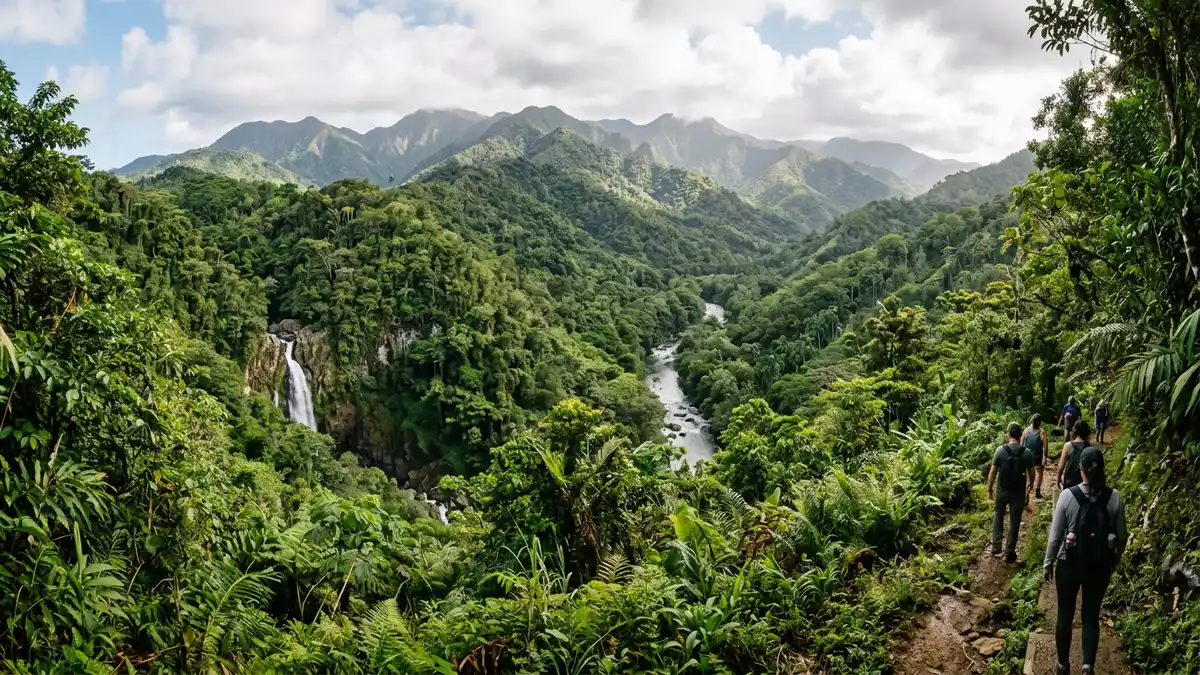
El Yunque National Forest in north-eastern Puerto Rico is a compact high rainforest where steep ridges, dense trees and fast rivers meet above the town of Rio Grande. Set across the Sierra de Luquillo, it is the only tropical rainforest in the United States National Forest System and has been protected as public land since the early twentieth century.
A rainforest built on steep Caribbean mountains
El Yunque National Forest spreads across the Luquillo Mountains in the north-east of Puerto Rico, reaching elevations of more than 1,000 m (3,281 ft) above sea level.Maximum elevation figures describe a compact area of rugged slopes and narrow ridgelines rather than a single isolated summit.Descriptions of rugged, mountainous terrain The forest covers more than 28,000 acres (around 11,300 hectares), making it the largest continuous block of public land on the island.
The climate at El Yunque is warm and humid, with heavy rainfall feeding rivers that plunge down through ravines and over rock ledges. Annual rainfall measured on the higher slopes reaches well over 2,500 mm (around 100 in), and some gauges record much more.Rainfall descriptions for the forest This constant moisture supports cloud forest vegetation and keeps streams running strongly through much of the year.
From Spanish reserve to United States National Forest
Forest protection in the Luquillo Mountains dates back to the nineteenth century, when the area was reserved under Spanish rule in 1876.Information on early Spanish-era protection After the transfer of Puerto Rico to the United States, the Luquillo Forest Reserve was created in 1903 by proclamation of President Theodore Roosevelt, and this reserve later formed the core of what is now El Yunque National Forest.Historical timeline for the forest The forest was known for decades as the Caribbean National Forest before an executive order restored the name El Yunque National Forest in the early twenty-first century.
Administration lies with the United States Forest Service, which oversees both conservation and recreation on the site.Forest Service summary of management Within its boundaries lies the El Toro Wilderness Area, designated in 2005 as the first wilderness area in a tropical rainforest under United States law.Details of the El Toro Wilderness designation El Toro itself, rising to around 1,076 m (3,533 ft), stands as the highest peak within the forest and gives its name to this protected core.
Dense biodiversity and named viewpoints
El Yunque National Forest is known for its biodiversity, with more than 240 tree species recorded and a rich understorey of ferns and other plants.Summaries of tree and fern diversity Many of these plants are endemic to Puerto Rico, and some occur only within this forest. The area also provides habitat for the Puerto Rican parrot, a critically threatened species, alongside a range of other birds, bats, reptiles and amphibians.Listings of wildlife species
Several named viewpoints and short trails give structure to a visit. One well-known landmark is the Yokahu Observation Tower, a concrete tower on a hillside that offers broad views across forested ridges and, on clear days, towards the Atlantic coast.Descriptions of the Yokahu Observation Tower Elsewhere, short paths lead to cascades where clear water drops over rock shelves into shallow pools, framed by dense vegetation on the valley walls.
Rivers, waterfalls and carved ridgelines
Water defines the experience of El Yunque. Numerous rivers rise on the higher slopes and cut down towards the coastal plain, including Rio de la Mina and other streams that form accessible cascades.Information on rivers originating in the forest Their channels slice through bands of rock to create narrow gorges, polished boulders and waterfalls that appear frequently along the road and paths.
Higher up, the mountains are marked by sharp ridgelines, known locally as cuchillas, that run like the teeth of a saw above the valleys.Descriptions of steep ridges and cuchillas Trails and access roads weave along and across these forms, revealing shifts from lower montane forest with taller trees to cloud forest where trunks become shorter and mosses cling thickly to branches. Through these layers, the combination of elevation, rainfall and direct exposure to the trade winds gives the forest a character distinct from other protected areas in Puerto Rico.
Visiting El Yunque National Forest: what travellers from Western Europe should know
- El Yunque National Forest lies in north-eastern Puerto Rico above the town of Rio Grande, on the slopes of the Sierra de Luquillo, and is reached by road from the coastal plain.
- The terrain is steep and humid, with paved and unpaved paths that include steps, exposed roots and sections of slippery rock, especially near waterfalls and along ridge trails.
- Several viewpoints, including the Yokahu Observation Tower and roadside miradors, are reached from short paths that gain height quickly and can feel exposed to wind and rain.
- The official language is Spanish and the currency is the United States dollar.
- Entry requirements depend on your nationality; UK travellers can check the FCDO travel advice at gov.uk/foreign-travel-advice, Irish travellers the Department of Foreign Affairs at ireland.ie.
Searching for El Yunque National Forest on social platforms
These links open searches for El Yunque National Forest on each platform.
Frequently asked questions about El Yunque National Forest
Where is El Yunque National Forest?
El Yunque National Forest is in north-eastern Puerto Rico above the town of Rio Grande, on the slopes of the Luquillo Mountains in the island’s coastal hinterland.
What should visitors expect on a visit?
Visitors encounter steep, humid terrain with paved roads, short trails to viewpoints and waterfalls, and a dense tropical canopy that often wraps the ridges in cloud.
What makes El Yunque National Forest distinctive?
El Yunque is distinctive as the only tropical rainforest in the United States National Forest System, combining high rainfall, sharp ridgelines and rich biodiversity within a relatively compact area.


