
El Castillo at Chichen Itza and its calendar pyramid form
Published on 09/12/2026 at 06:10 | Editorial responsibility: Rafael Müller, Editor-in-Chief AD HOC NEWS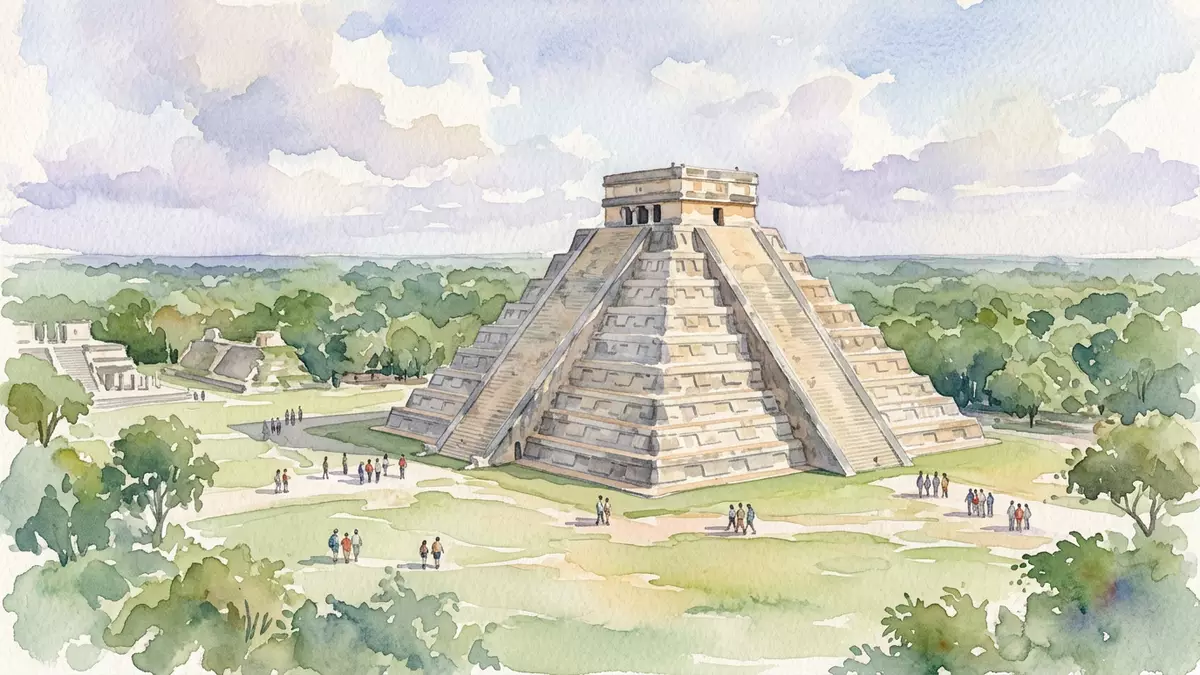
El Castillo at Chichen Itza is a limestone step pyramid whose stacked terraces turn a single building into a vast stone calendar aligned with the Maya solar year. Rising above the northern part of the ancient city in Yucatán, Mexico, this Temple of Kukulcán anchors the archaeological site and concentrates centuries of pre-Hispanic construction into one geometric form dating from the late first millennium AD.Temple of Kukulcán
A stepped pyramid shaped by numbers
El Castillo stands about 30 m (98 ft) from the base platform to the summit temple, with the main stepped pyramid rising roughly 24 m (79 ft).step pyramid stands about 30 metres high The base is square, each side measuring close to 55 m (181 ft), and the visible structure is organised as nine superimposed terraces of limestone blocks topped by a small temple sanctuary.square pyramid about 55 metres on each side
Four staircases climb the faces of the pyramid, one on each side, and the number of steps has become one of the building’s defining properties. Each staircase carries 91 steps, and the shared summit platform adds one more, producing 365 steps in total that correspond to the days of the solar year.temple has 365 steps The limestone surfaces and sharply cut angles make the geometry legible from a distance, so the pyramid reads as a carefully counted progression of platforms rising towards the temple of Kukulcán, the feathered serpent deity.served as a temple to the god Kukulcan
Light, shadow and the feathered serpent
Beyond its dimensions, El Castillo is known for an interplay of light and shadow that ties its stone stairways to the movement of the sun. Around the spring and autumn equinoxes, the setting sun casts triangular shadows along the northern staircase that align with the carved serpent heads at the base balustrade, creating the appearance of a descending serpent formed by alternating bands of light and dark.equinox shadow phenomenon The effect relies on the stepped profile of the terraces and the precise orientation of the pyramid within the plaza.
The serpent motif continues in the sculptural details: at the base of the northeastern staircase, stone serpent heads project from the balustrades, grounding the celestial alignment in carved iconography.carved heads of a serpent El Castillo is also described as a radial pyramid because its four stairways are distributed around all faces, giving the structure a symmetrical relationship to the surrounding plaza and to the sky above.radial pyramid with staircases on all four sides
Layers of construction at a World Heritage city
Archaeological investigations indicate that El Castillo is not a single-build monument but a nested structure incorporating earlier pyramids within the visible shell. Explorations and scanning have revealed at least one substructure, known as Castillo-sub, enclosed within the outer pyramid, along with evidence for a further inner temple constructed in earlier phases.contains two earlier pyramids within it The longest span of construction is placed between roughly the ninth and twelfth centuries AD, during Chichen Itza’s period as a major regional centre on the Yucatán Peninsula.between roughly the 9th and 12th centuries AD
El Castillo forms part of the Pre-Hispanic City of Chichen-Itza, which is inscribed on the UNESCO World Heritage List for its surviving monumental architecture and long urban history.Pre-Hispanic City of Chichen-Itza Within the site, the Temple of Kukulcán dominates the North Platform and stands among other major structures such as the Warriors’ Temple and El Caracol, yet its compact, numerically ordered form has become the emblem of the entire city.dominates the North Platform of Chichen Itza
Visiting El Castillo: what travellers from Western Europe should know
- El Castillo stands in the northern part of the Chichen Itza archaeological zone in Yucatán, Mexico, reached overland from the city of Valladolid and from the wider region’s road network.
- The pyramid rises from a broad, open plaza of compacted ground, and visiting involves walking across exposed terrain with no shade from the structure itself.
- The official language is Spanish and the currency is the Mexican peso.
- Entry requirements depend on your nationality; UK travellers can check the FCDO travel advice at gov.uk/foreign-travel-advice, Irish travellers the Department of Foreign Affairs at ireland.ie.
Searching for El Castillo on social platforms
These links open searches for El Castillo on each platform.
Frequently asked questions about El Castillo
Where is El Castillo located within Chichen Itza?
El Castillo stands on the North Platform of Chichen Itza in Yucatán, Mexico, forming the main pyramid at the centre of the archaeological site.
What can visitors expect when they see El Castillo?
Visitors encounter a tall limestone step pyramid with four staircases, nine terraces and a summit temple, set within a wide ceremonial plaza of the ancient city.
What makes El Castillo distinctive among Maya pyramids?
Its 365-step arrangement linked to the solar year, the equinox serpent-shadow effect and the nested inner pyramids combine geometry, astronomy and layered construction in a single structure.


