
El Castillo and the stone calendar of Chichen Itza
Published on 09/08/2026 at 06:53 | Editorial responsibility: Rafael Müller, Editor-in-Chief AD HOC NEWS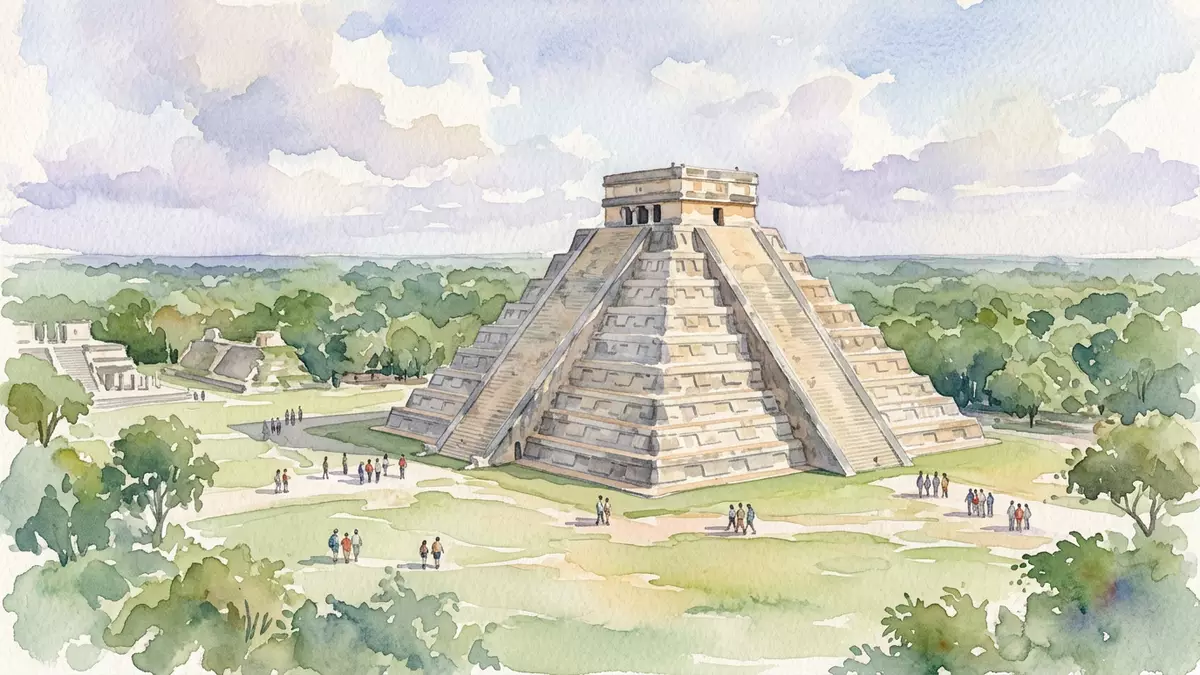
El Castillo at Chichen Itza is a monumental Maya step pyramid that doubles as a vast stone calendar and a temple dedicated to the feathered serpent deity Kukulkan. Rising above the northern part of the ancient city in Yucatan, it embodies the fusion of Maya and Toltec traditions during the late first millennium and remains one of the most studied pre-Hispanic structures in Mexico.
A pyramid shaped as a solar calendar
El Castillo is best known for its precise relationship to the solar year, expressed in the number of its steps and terraces. Each of the four stairways carries 91 steps, and when the summit platform is included the total reaches 365, mirroring the days of the Maya solar count known as the Haab. This numerical structure is described in detail in studies of the El Castillo pyramid and in analyses of the building as a calendar instrument.Maya calendar pyramid
The pyramid is organised as nine stacked terraces, split by each staircase into 18 panels that echo the 18 twenty-day months of the Haab. The structure reaches about 24 m (79 ft) to the temple platform and around 30 m (98 ft) including the temple itself, with each side of the base measuring close to 55 m (181 ft). These dimensions appear consistently in archaeological descriptions of the Temple of Kukulkan and in specialist guides to the Kukulkan pyramid.Kukulkan Pyramid dimensions
Kukulkan’s temple and the Toltec-Maya era
Architecturally, El Castillo is a radial step pyramid of limestone, square in plan, with a broad staircase climbing the centre of each of its four faces to a small rectangular temple at the summit. The stairways are flanked by sculpted balustrades, including serpent heads at the base of the principal staircase that relate directly to Kukulkan, the feathered serpent figure prominent in Yucatec Maya belief. The overall form and sculptural details are described in depth in surveys of the radial pyramid at Chichen Itza and in site overviews of Chichen Itza’s northern platform.Chichen Itza El Castillo description
The construction of El Castillo falls in the late Classic and early Postclassic periods, with many studies placing its main building phase between roughly the ninth and thirteenth centuries CE. This spans the era when Toltec-related influences reached Chichen Itza and merged with established Maya traditions, producing a distinctive Toltec-Maya culture on the Yucatan Peninsula. Encyclopaedic entries on the Toltec-Maya pyramid and architectural canons of the site situate the building in this shared cultural context.Toltec-Maya period
Light, shadow and stone at Chichen Itza
Beyond its geometry, El Castillo is closely associated with a striking play of light and shadow that appears along its principal staircase around the equinox dates. As the sun approaches the horizon in the late afternoon, a series of triangular shadows forms along the north face of the pyramid and descends towards the sculpted serpent heads at the base. Observers have interpreted this phenomenon as a visual representation of Kukulkan descending the pyramid, and the effect has been documented extensively in explorations of El Castillo alignments and in travel features on Chichen Itza’s World Heritage status.Temple of Kukulkan at Chichen Itza
The pyramid stands on the broad northern platform of Chichen Itza, framed by open grassy space and aligned with other major structures of the ancient city. Its stone surfaces bear traces of sculpted panels and decorative elements that relate both to calendar cycles and to warrior and serpent imagery associated with the Toltec-Maya horizon. Archaeological notes on the nested construction of El Castillo with earlier core point to a smaller inner pyramid encased within the visible structure, underlining the building’s layered history.
Visiting El Castillo: what travellers from Western Europe should know
- El Castillo stands within the Chichen Itza archaeological site in the state of Yucatan in south-eastern Mexico, inland from the Caribbean coast.
- The pyramid rises from a broad, level platform, with open ground around it; approaching viewpoints involves walking over firm, mostly flat terrain.
- The official language is Spanish and the currency is the Mexican peso.
- Entry requirements depend on your nationality; UK travellers can check the FCDO travel advice at gov.uk/foreign-travel-advice, Irish travellers the Department of Foreign Affairs at ireland.ie.
Searching for El Castillo on social platforms
These links open searches for El Castillo on each platform.
Frequently asked questions about El Castillo
Where is El Castillo located?
El Castillo stands in the ancient city of Chichen Itza in Yucatan, Mexico, on the northern part of the site’s main ceremonial platform.
What should visitors expect when seeing El Castillo?
Visitors encounter a large limestone step pyramid with four stairways, broad open surroundings and clear views of its terraces, temple and sculpted serpent details.
What makes El Castillo distinctive among Maya pyramids?
El Castillo is distinctive for encoding the 365-day solar count in its steps and terraces and for the equinox light-and-shadow effect along its principal staircase.


