
El Arco in Cabo San Lucas, where granite meets two seas
Published on 09/12/2026 at 15:34 | Editorial responsibility: Rafael Müller, Editor-in-Chief AD HOC NEWS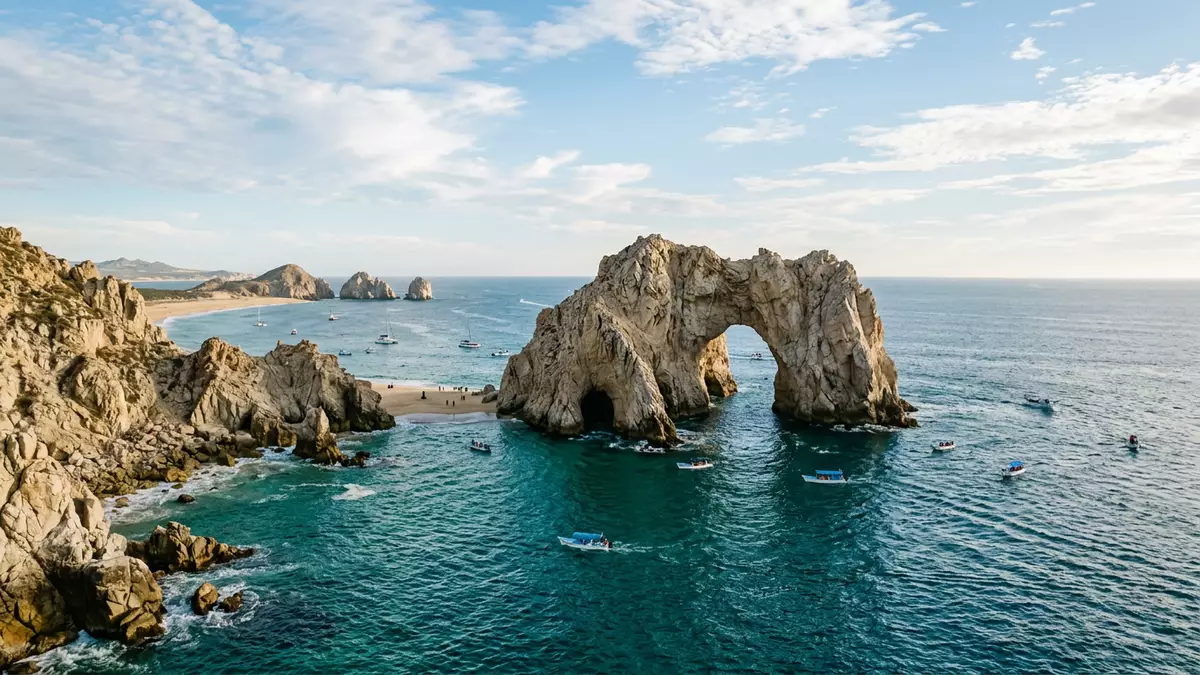
At the southern tip of Cabo San Lucas in Mexico, El Arco rises from the water as a natural granite arch that marks the point where the Pacific Ocean meets the Sea of Cortez. Known in English as the Arch of Cabo San Lucas, it stands at Land’s End on the Baja California Peninsula and has become the most recognisable outline of this rocky tip of Baja California Sur.
Granite, erosion and the making of El Arco
El Arco is carved into granitic rock at the extreme southern end of Mexico’s Baja California Peninsula, in the coastal headland known as Land’s End.granitic rock formation The granite here forms the basement of the peninsula and belongs to intrusive igneous rocks created during the Cretaceous period, long before the modern coastline appeared.intrusive igneous rocks Over geological time, the combination of waves, tides and wind eroded joints and fractures in this granite and opened a gap in the headland that reads clearly as an arch from the sea.
The formation stands several storeys above the water at low tide, a height described consistently as roughly three storeys in guides and local descriptions.three-storey formation From boats in the bay, the arch presents as pale to reddish granite, with cliffs and smaller rock stacks around it forming a compact group of sea-eroded outcrops. The rock surface shows the marks of weathering, with smooth faces where waves strike most directly and more rugged sections on the flanks, but the opening itself remains clearly visible even when the tide rises towards the base.
Where Baja California Sur drops into the sea
Geographically, El Arco sits at the point where the Pacific Ocean becomes the Gulf of California, also known as the Sea of Cortez, giving Cabo San Lucas a visible marker of the transition between these two bodies of water.meeting of Pacific and Sea of Cortez The headland lies off Cabo San Lucas in the municipality of Los Cabos, forming the extreme southern end of the peninsula as it narrows to a rocky point.southern tip of the peninsula Standing on the marina side of town, the group of rocks at Land’s End appears as a jagged line, with El Arco cutting through one section to create a clear opening.
Locally, the formation is known as “El Arco”, meaning “the arch” in Spanish, and also as “Land’s End”, because it marks the point where the land of Baja California Sur gives way to open water.local names El Arco and Land’s End The surrounding cliffs and smaller islets form a short but dramatic stretch of coast, with the arch offering a frame through which the open Pacific can be seen from certain angles. For travellers arriving by sea, this compact group of granite has long served as a visual landmark for Cabo San Lucas, distinguishing the end of the peninsula from the low-lying coast to either side.
Approaching the arch from Cabo San Lucas
El Arco stands just offshore from Cabo San Lucas and is reached from the town by water, with boats leaving from the marina and other departure points in the bay.reached from downtown and marina There is no road or footpath leading directly to the rocks themselves, as the headland forms a compact group of sea cliffs and outcrops. Visitors therefore see the arch from the water, from vessels that navigate around the granite formations and give views of El Arco from different sides.
From a boat, the structure reveals the way the arch sits between taller rock faces and lower shelves that dip towards the sea. The opening frames either the Pacific side or the Sea of Cortez side depending on the viewing angle, underlining its role as a geographic marker rather than a separate monument. As the vessel moves closer, details in the granite become visible, including colour variations within the rock and the pattern of fractures that helped erosion carve the arch over millions of years.
Visiting El Arco: what travellers from Western Europe should know
- El Arco stands off the coast of Cabo San Lucas in Baja California Sur, Mexico, at the outer end of the bay, and is approached by boat from the Cabo San Lucas marina or nearby departure points.
- The terrain at Land’s End consists of steep granite cliffs and sea-washed rock ledges, with no road access to the arch itself; viewing is from vessels moving around the coastal rocks.
- Cabo San Lucas lies at the southern tip of the Baja California Peninsula; journeys by air typically use airports serving Los Cabos before continuing by road into the town and on to the marina.
- The surrounding coast includes other granitic outcrops and beaches near Cabo San Lucas, giving travellers scope to see El Arco from different angles from the water and from some stretches of nearby shore.
- The official language is Spanish and the currency is the Mexican peso.
Searching for El Arco on social platforms
These links open searches for El Arco on each platform.
Frequently asked questions about El Arco
Where is El Arco in relation to Cabo San Lucas?
El Arco stands off the coast of Cabo San Lucas in Baja California Sur, at the extreme southern tip of the Baja California Peninsula where the Pacific Ocean meets the Sea of Cortez.
What can travellers expect when visiting El Arco?
Travellers see El Arco from boats that navigate around the granite formations at Land’s End, viewing the natural arch and neighbouring cliffs from the water rather than from a road or path.
What makes El Arco distinctive as a coastal landmark?
El Arco is distinctive because it is carved into Cretaceous granite at Land’s End and marks the visible junction between the Pacific Ocean and the Sea of Cortez in a single compact rock formation.


