
Efes and the marble avenues of an Aegean metropolis
Published on 09/17/2026 at 11:39 | Editorial responsibility: Rafael Müller, Editor-in-Chief AD HOC NEWS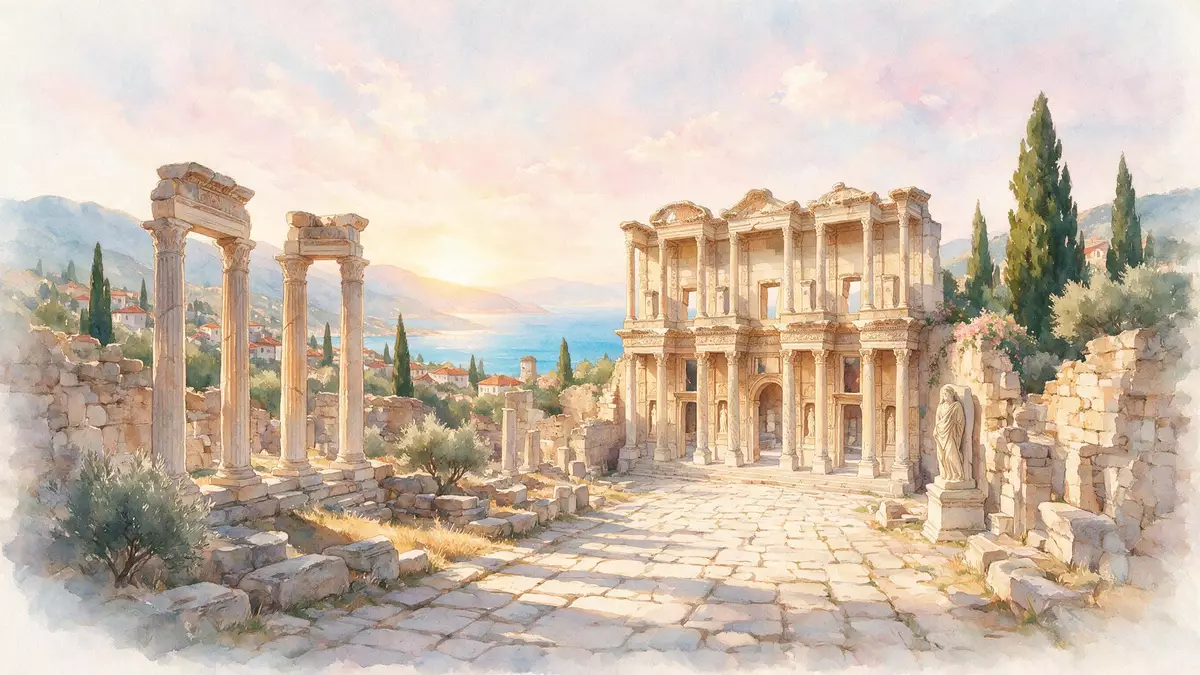
Efes near Selcuk in western Turkey is the archaeological site of the ancient city once known in Greek as Ephesus, laid out across a valley between low hills and the Aegean plain. Paved streets, a theatre cut into the slope and terraces of houses and public buildings together give a clear sense of the scale of a major classical metropolis in the eastern Mediterranean.
From Ionian colony to Roman city in stone
Efes began as an ancient Greek city on the coast of Ionia, closely linked with the wider Ionian world of western Anatolia.ancient Greek city in Ionia Its origins lie in the early first millennium BC, with tradition and archaeology pointing to a foundation by Ionian colonists on the Anatolian shore and continuous settlement in the wider area of Ayasuluk hill and Çukurici mound long before the classical city took its recognisable urban form.continuous settlement history The city later became part of the Roman Empire and grew into an important centre of administration and commerce.
The ruins visitors walk through at Efes largely belong to the period from the first to the fourth century AD, when the city was a prosperous Roman metropolis with monumental architecture and dense urban housing.ruins from the 1st to 4th century AD The site lies a short distance inland from Turkey’s Aegean coast in ?zmir Province, about a few kilometres from the modern town of Selcuk, which serves as the present-day access point.short distance inland from Selcuk Over time the active settlement shifted towards Ayasuluk hill, but the classical city remained in place as a field of stone structures and streets that later excavation brought back into view.
Marble streets, theatres and the Library of Celsus
One of the most striking aspects of Efes is the way the marble-paved streets still organise a walk through the ruins, making a route between major public buildings and smaller structures along the way.marble streets through the ruins The main thoroughfares run along the valley floor and climb gently towards the theatre, with colonnades, shop fronts and civic buildings lining the way. Stone drainage channels, curbs and steps mark out the edges and transitions, setting the ruins apart from many sites where the street plan is less legible.
At one end of the central area the façade of the Library of Celsus rises above its forecourt, with its multi-storey arrangement of columns, niches and windows reconstructed to show the scale of a Roman public library.Library of Celsus facade Nearby, the theatre is cut into the slope of the hill, forming a broad cavea of stone seating that looks down onto a semicircular stage area and the traces of a stage building behind it.magnificent Roman ruins with theatre Terraced houses on the hillside preserve floor mosaics and wall paintings, giving an impression of domestic life alongside the monumental public buildings, while baths and latrines show how closely everyday activity was woven into the urban layout.
Efes in the wider Selcuk landscape
Efes does not stand in isolation but forms part of a wider archaeological landscape west of Selcuk, where ancient and later settlements cluster around Ayasuluk hill and the plain. The UNESCO World Heritage listing for Ephesus brings together the ancient city on the valley floor, the hilltop settlement and associated mounds, tracing habitation from the seventh millennium BCE through the Greek and Roman periods into the present town.UNESCO World Heritage listing for Ephesus The ruins themselves stretch between Panay?r Da?? and Bülbülda??, two low mountains that frame the site and help visitors read the orientation of streets and buildings in relation to the surrounding terrain.ruins between Panay?r Da?? and Bülbülda??
Modern Selcuk lies nearby as the living town connected with Efes, with roads linking it to ?zmir and Ku?adas? on the Aegean coast and local transport running out towards the site.modern Selcuk near the ruins Efes itself functions as an organised archaeological site rather than a populated city, with paths and signposted routes across the valley floor and up the slopes to the different clusters of ruins.organised archaeological site From some points among the columns and façades there are clear views back towards Ayasuluk hill and out across the plain, linking the experience of walking the ancient streets with the wider geography of western Turkey.
Visiting Efes: what travellers from Western Europe should know
- Efes lies a short distance inland from Turkey’s Aegean coast in ?zmir Province, a few kilometres west of Selcuk, which is the nearest town and access point by road and local public transport.
- The archaeological site spreads across a valley floor and the lower slopes of neighbouring hills, and a visit involves walking on stone paving and compacted paths with some gradients and flights of steps between different levels.
- Efes is approached from the Selcuk side along marked routes, with the main streets, theatre, library façade and terraced houses laid out over a wide area that rewards an unhurried exploration on foot.
- The official language is Turkish and the currency is the Turkish lira.
- Entry requirements depend on your nationality; UK travellers can check the FCDO travel advice at gov.uk/foreign-travel-advice, Irish travellers the Department of Foreign Affairs at ireland.ie.
Searching for Efes on social platforms
These links open searches for Efes on each platform.
Frequently asked questions about Efes
Where is Efes and how is it related to Selcuk?
Efes is the archaeological site of the ancient city of Ephesus in ?zmir Province, a few kilometres from the modern town of Selcuk in western Turkey.
What can visitors expect when walking through Efes?
Visitors follow marble-paved streets past the reconstructed façade of the Library of Celsus, a large theatre cut into the hillside, baths, latrines and terraced houses with mosaics and wall paintings.
What makes Efes distinctive among ancient cities?
The combination of extensive Roman-period ruins, clearly legible street layout and the way marble avenues link major monuments makes Efes an unusually complete picture of a classical metropolis in stone.


