

Edinburgh Castle on the volcanic crown of Edinburgh
Published on 08/26/2026 at 07:30 | Editorial responsibility: Rafael Müller, Editor-in-Chief AD HOC NEWS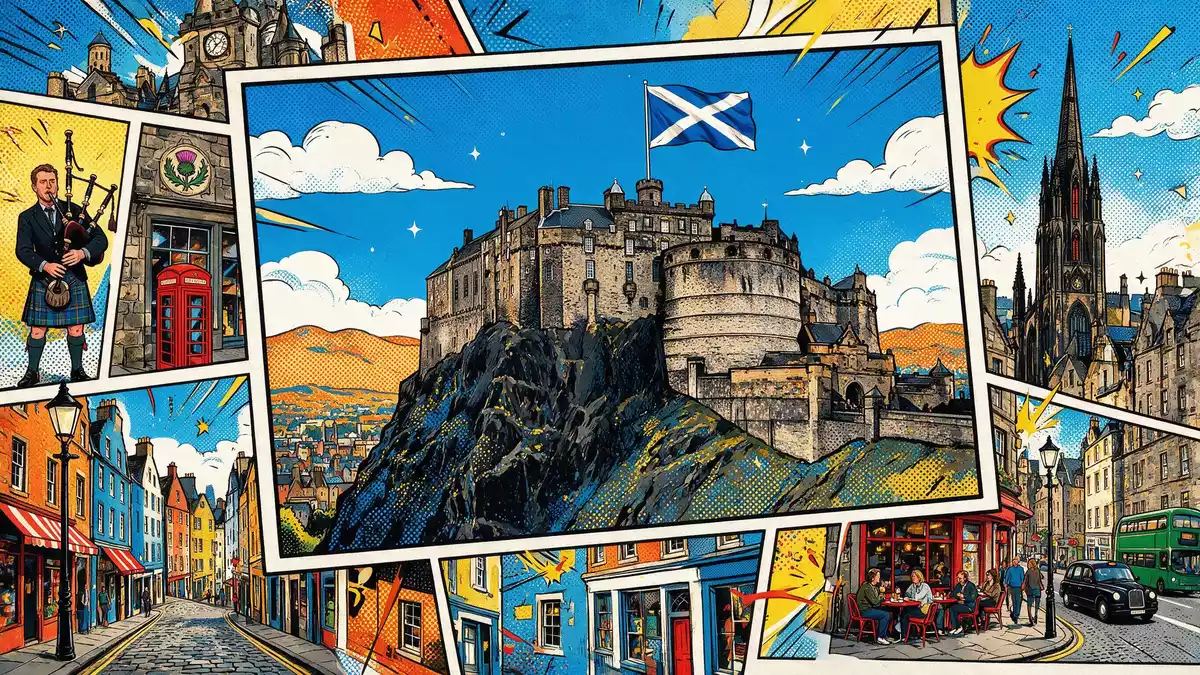
Edinburgh Castle crowns a volcanic rock above the Old Town of Edinburgh, combining fortified walls, royal rooms and military buildings on a single steep summit. Its story reaches back to the Middle Ages, when it became a royal stronghold on Castle Rock and later an important garrison in the wars that shaped Scotland.
Castle Rock and the layered history of a fortress
The defining feature of Edinburgh Castle is its setting on Castle Rock, a volcanic plug that lifts the fortress high above the surrounding streets and closes the western end of the Royal Mile. Archaeological work has shown human activity on the summit since the late Bronze Age, and the rock was fortified as a hilltop stronghold long before stone curtain walls surrounded it.Late Bronze Age occupation
A royal castle stood on Castle Rock by the reign of Malcolm III in the eleventh century, anchoring the growing burgh of Edinburgh and serving as a principal residence of the kings of Scotland.Royal castle from Malcolm III Through the later Middle Ages the fortress was repeatedly drawn into conflict, including sieges during the Wars of Scottish Independence in the late thirteenth and early fourteenth centuries and the Lang Siege in the 1570s, when artillery fire destroyed major towers and prompted substantial rebuilding on the summit.Wars of independence and Lang Siege
Royal apartments and medieval chapels within the walls
Amid the defensive works, Edinburgh Castle contains intimate royal spaces that recall its role as a residence. Near the summit stands St Margaret’s Chapel, a small stone church traditionally dated to the early twelfth century and associated with Queen Margaret, the consort of Malcolm III.Saint Margaret’s chapel Its modest scale and thick masonry contrast with the open parade ground nearby.
The royal palace ranges around an inner courtyard and preserves rooms linked to Mary, Queen of Scots, who gave birth to James VI in the castle in 1566.Birth of James VI in 1566 In these apartments, panelled chambers stand above vaulted ground floors, and the upper rooms look across the city from high windows over the defensive walls. The crown, sceptre and sword of state known as the Honours of Scotland are housed within the same complex, underlining the castle’s long association with Scottish sovereignty.Honours of Scotland
Military batteries, barracks and memorials on the summit
From the late sixteenth century onwards, Edinburgh Castle developed as a major military base as well as a symbol of royal authority. After the Lang Siege the Half Moon Battery was built as a curved artillery platform, partly enclosing the remnants of earlier towers and facing towards the Old Town and the approaches from the south.Half Moon Battery Behind the outer guns, thick stone walls and gatehouses frame routes up through the fortress, with views across the Firth of Forth and the Pentland Hills from the higher terraces.
In the eighteenth and nineteenth centuries extensive barracks and storehouses were added on the summit, reflecting the castle’s use as a garrison and armoury.New Barracks and Governor’s House During this period it also served as a prison for captives from conflicts such as the Seven Years’ War and the Napoleonic Wars.Prisoners of war In the twentieth century the Scottish National War Memorial was built within the walls, bringing together carved stonework and sculpture to commemorate those who died in military service.Scottish National War Memorial
Visiting Edinburgh Castle: what travellers from Western Europe should know
- Edinburgh Castle stands at the top of Castlehill on the Royal Mile, above the Old Town of Edinburgh in Scotland, and is reached on foot along the rising cobbled street.
- The approach from the city climbs a noticeable gradient, and the interior routes include stone steps, sloping paths and paved courtyards on different levels.
- The site lies within the historic centre, with views towards the Firth of Forth and across to Arthur’s Seat, a neighbouring volcanic hill in Holyrood Park.
- The official language is English and the currency is the pound sterling.
Searching for Edinburgh Castle on social platforms
These links open searches for Edinburgh Castle on each platform.Frequently asked questions about Edinburgh Castle
Where is Edinburgh Castle located?
Edinburgh Castle stands on Castle Rock above the Old Town of Edinburgh in Scotland, at the upper end of the Royal Mile on Castlehill.
What should visitors expect inside the castle?
Visitors move through defensive gateways, open batteries, royal apartments and chapels, with stone surfaces, changing levels and wide views across the city and surrounding hills.
What makes Edinburgh Castle distinctive among Scottish castles?
Its combination of medieval royal rooms, later barracks and memorials on a volcanic summit overlooking Edinburgh gives it a compact concentration of Scottish political and military history.


