
Edinburgh Castle on Castle Rock above the Old Town
Published on 09/07/2026 at 20:10 | Editorial responsibility: Rafael Müller, Editor-in-Chief AD HOC NEWS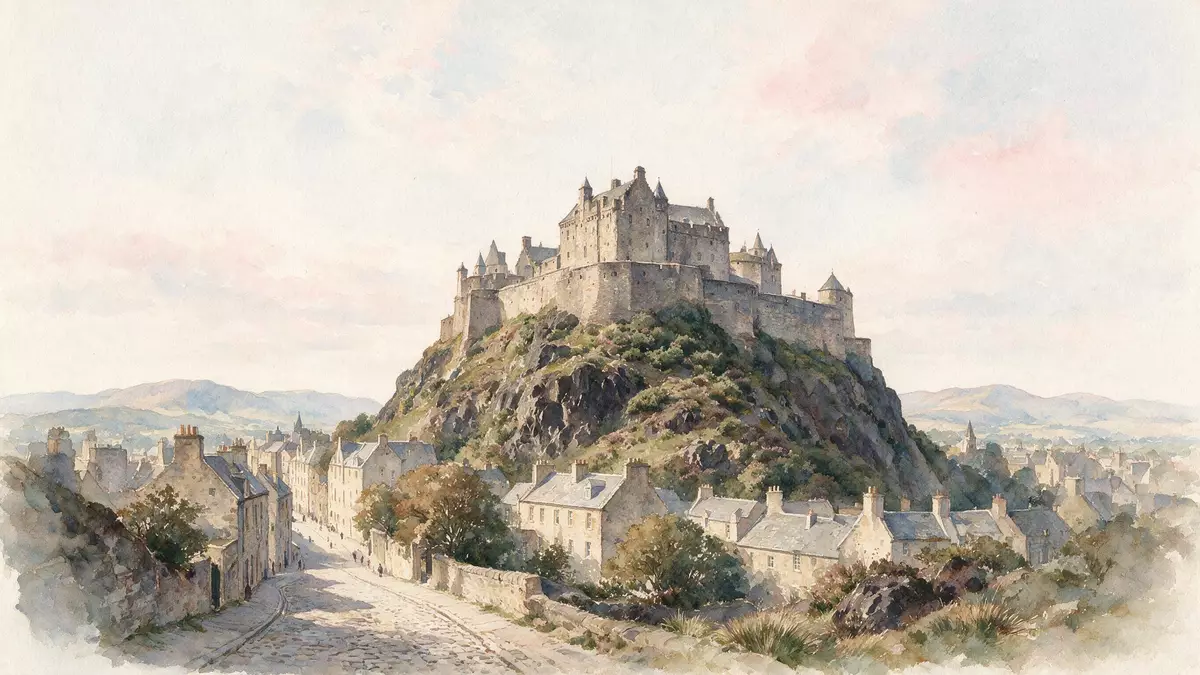
Edinburgh Castle rises from the volcanic bulk of Castle Rock above Edinburgh, its stone walls following the contours of the crag high over the Old Town’s ridge. The fortress has roots in the medieval period and carries traces of earlier settlement, and it became a royal stronghold for the kings and queens of Scotland from the eleventh century onwards.
Fortress on an ancient volcanic rock
The defining feature of Edinburgh Castle is its setting on Castle Rock, a volcanic plug that lifts the site above the surrounding streets and gives the fortress its steep approaches and commanding views. Archaeological work has identified human activity on the rock reaching back into the Bronze Age, long before the first masonry defences rose around the summit.occupied since the Bronze Age The earliest documented use of the rock as a royal castle dates from the reign of Malcolm III Canmore in the eleventh century, when the hilltop became one of the principal residences of the Scottish monarchy.royal castle during Malcolm III
Standing at the summit, the castle’s curtain walls and batteries follow the irregular outline of the rock, and the approach roads climb in stages from the broader ridge of the Old Town. The castle forms the upper anchor of the Old Town’s main spine, with the historic street running down from the gate towards the Palace of Holyrood, and it dominates the World Heritage skyline where the medieval city and the Georgian New Town meet.Old and New Towns of Edinburgh
Royal residence, chapel and great hall
For many centuries Edinburgh Castle served as a royal residence, and several key buildings within its walls date from the high medieval and Renaissance periods. The oldest surviving structure on the summit is St Margaret’s Chapel, a small Romanesque chapel built in the early twelfth century and associated with Queen Margaret, who died at the castle in 1093 and was later canonised.St Margaret’s Chapel early twelfth century Nearby stands the Great Hall, completed under James IV in 1511, which provided a grand ceremonial space for the Stewart court with its timber roof and tall windows looking towards the town.Great Hall completed by James IV
The Royal Palace range includes the room where James VI of Scotland, later James I of England, was born in 1566, linking the castle directly to the dynastic union of the Scottish and English crowns.birthplace of James VI Later works added more formidable towers and defences, including David’s Tower, named for King David II, which rose to substantial height before suffering heavy damage in a later siege. Across the site, successive phases of building and rebuilding have left a patchwork of stonework from different centuries, with medieval and later sections standing side by side.
Garrison, sieges and national symbol
Edinburgh Castle’s history is closely entwined with warfare and conflict in Scotland and beyond. During the Wars of Scottish Independence between 1296 and 1357 the fortress was captured more than once by English forces and retaken by Scottish defenders, a pattern that continued in later upheavals.Wars of Scottish Independence The Lang Siege of 1571–1573 caused extensive damage, prompting substantial strengthening of the defences, including the construction of the Half-Moon Battery and the Portcullis Gate, features that still define the route into the upper ward.Half-Moon Battery and Portcullis Gate
From the fifteenth century onwards the castle’s role as a royal residence declined, and it came to be used increasingly as a garrison, armoury and prison. Between 1757 and 1814, its vaulted spaces housed prisoners of war captured in the Seven Years’ War, the American Revolution and the Napoleonic conflicts, adding international stories to a site already steeped in Scottish political history.prisoners of war 1757–1814 In the nineteenth century, the fortress began to be treated more consciously as part of Scotland’s heritage, with restoration campaigns and commemorative installations that underline its position as a national symbol set above the Old and New Towns.
Visiting Edinburgh Castle: what travellers from Western Europe should know
- Edinburgh Castle stands at the western end of the Old Town’s main ridge above the city centre, reached on foot along the rising street from the heart of Edinburgh.
- The approach climbs a noticeable gradient and includes cobbled surfaces and ramps inside the outer walls, with further staircases leading between the internal terraces and courtyards.
- The castle forms part of the Old and New Towns of Edinburgh World Heritage Site, with views towards the Georgian New Town and across the wider city from the upper battlements.
- Edinburgh lies in Scotland, where the official language is English and the currency is the pound sterling.
Searching for Edinburgh Castle on social platforms
These links open searches for Edinburgh Castle on each platform.Frequently asked questions about Edinburgh Castle
Where is Edinburgh Castle located?
Edinburgh Castle stands on Castle Rock above the Old Town of Edinburgh in Scotland, forming the upper landmark of the historic main street leading towards the Palace of Holyrood.
What can visitors expect inside the castle?
Visitors encounter stone defences, courtyards and historic buildings such as St Margaret’s Chapel, the Great Hall and the Royal Palace range, alongside later batteries and former garrison spaces.
What makes Edinburgh Castle distinctive among European fortresses?
Its combination of ancient volcanic setting, long role as a royal residence and heavily fortified garrison, together with its position within the Old and New Towns World Heritage Site, gives the castle its distinctive profile.


