
Edinburgh Castle and the volcanic rock that shaped it
Published on 09/12/2026 at 21:20 | Editorial responsibility: Rafael Müller, Editor-in-Chief AD HOC NEWS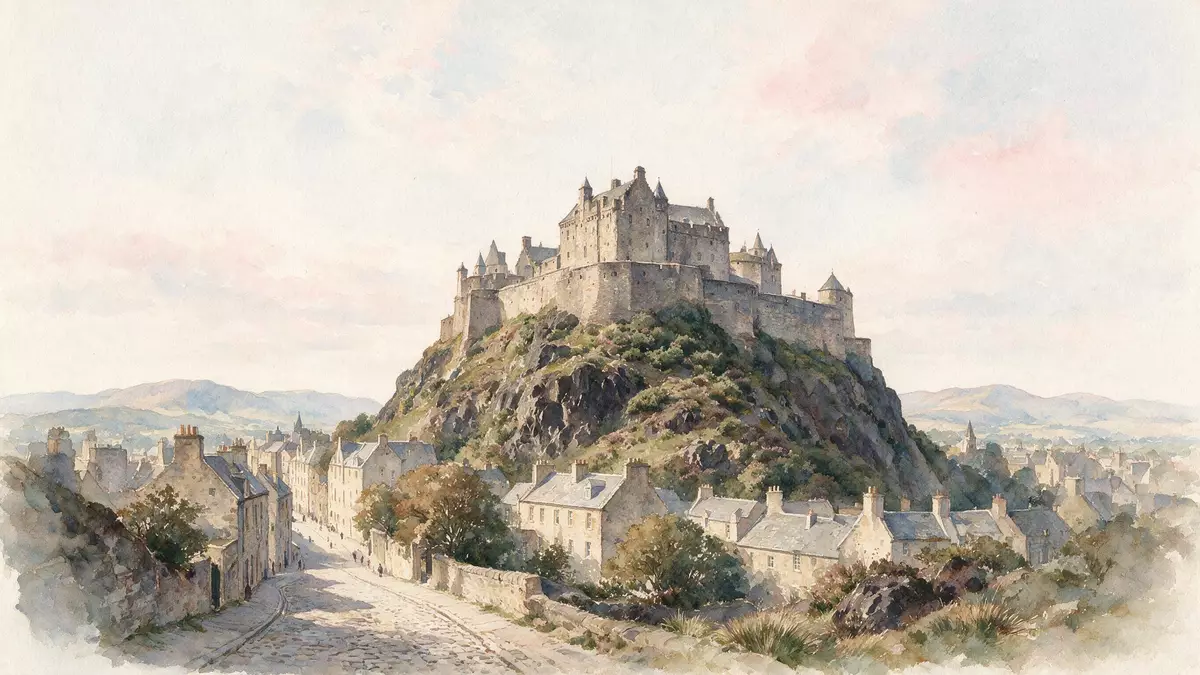
Edinburgh Castle rises above Edinburgh on Castle Rock, an ancient volcanic outcrop that has carried fortifications and royal chambers for many centuries. Set on this high basalt plug, the fortress has watched over Scotland’s capital since at least the reign of Malcolm III in the eleventh century, and its surviving buildings trace a course from the Middle Ages to the modern era.
A fortress on Castle Rock’s volcanic summit
The defining feature of Edinburgh Castle is its position on Castle Rock, the hard core of an extinct volcano that gives the fortress steep cliffs on several sides and a commanding outlook over the surrounding city and hills.Castle Rock, towering above Edinburgh creates a natural summit, and the castle’s stone defences follow the contours of the rock rather than a regular geometric plan. Approached from the east, the upper wards appear as a compact mass of walls and turrets at the top of a long rise, while the western side drops away into sheer faces of dark rock.
Archaeological work on the summit has identified human occupation long before masonry ramparts were raised, with evidence linking the site to Bronze Age settlement and Iron Age fortification.The castle’s official history describes a hill fort here in the Iron Age, and the continuity from early ramparts to medieval curtain walls is central to the character of the place. The rock’s height and narrow approaches helped turn it into one of the best-defended strongholds in Scotland, and later gun batteries were added along the edges to exploit the drop.
From royal residence to military stronghold
The recorded story of Edinburgh Castle as a royal power centre begins with Malcolm III, whose reign in the eleventh century marks the first secure reference to a royal castle on the rock.Malcolm III’s fortress gave the site a role as a residence and seat of government, a status reinforced in the twelfth century when David I held court within its precincts.David I’s early stone buildings began to replace earlier timber structures with more permanent halls and chapels, tying the rock into the wider development of Edinburgh as a royal and administrative centre.
One of the most evocative survivals from this period is St Margaret’s Chapel, a small stone building on the highest point of the enclosure, built in the early twelfth century and associated with Queen Margaret, who died in the castle in 1093.St Margaret’s Chapel on the summit is regarded as the oldest standing building within the walls and, by many accounts, the oldest building in Edinburgh. Later medieval work added the Great Hall and a royal palace block, but repeated conflicts in the thirteenth and fourteenth centuries, including the Wars of Scottish Independence, saw earlier structures damaged, rebuilt and strengthened as the castle’s role as a fortress overtook its function as a residence.
Buildings, courts and regalia within the walls
Most of the masonry visible from the main terraces belongs to periods after the destructive Lang Siege of 1571–73, when artillery bombardment forced extensive reconstruction.Post-siege rebuilding introduced new defensive features such as the Half-Moon Battery, a curved platform for cannon that wraps around earlier gate structures and creates a broad, stone-fronted bastion above the main approach. Behind these outer works, the inner wards contain ranges of barracks, the Crown Square and the royal apartments, whose façades combine late medieval and early modern elements.
Within these upper courts, the castle houses the Honours of Scotland, the Scottish crown jewels, and displays connected with the Stone of Destiny and regimental histories. Over time, the complex has served many purposes beyond royal residence, acting as an armoury, treasury, prison and archive.Accounts of the castle’s multiple roles emphasise how later adaptations layered storage vaults, cell blocks and military quarters onto the original royal core. Inside the Great Hall, a high timber roof and stone walls give a sense of the castle’s ceremonial life, while nearby rooms show the more constrained interiors used by garrison officers and prisoners in later centuries.
Visiting Edinburgh Castle: what travellers from Western Europe should know
- Edinburgh Castle stands on Castlehill at the western end of the Old Town, above the main thoroughfare known as the Royal Mile, and is reached on foot along the rising street from central Edinburgh.
- The approach to the higher wards involves steep cobbled slopes and a sequence of stone steps within gateways and courtyards, with substantial gradients between the lower entrance and the summit.
- From the upper terraces and Crown Square, there are open views across Edinburgh’s New Town, the Firth of Forth and the surrounding hills, with exposed conditions on the ramparts in unsettled weather.
- The official language of Scotland is English and the currency is the pound sterling.
Searching for Edinburgh Castle on social platforms
These links open searches for Edinburgh Castle on each platform.
Frequently asked questions about Edinburgh Castle
Where is Edinburgh Castle located?
Edinburgh Castle is situated on Castle Rock at the western end of the Old Town in Edinburgh, Scotland, above the street known as the Royal Mile.
What should visitors expect on a visit?
Visitors encounter steep approaches, stone gateways, open terraces and a sequence of historic interiors, including St Margaret’s Chapel, the Great Hall and the royal palace.
What makes Edinburgh Castle distinctive among Scottish sites?
Its setting on an ancient volcanic summit, its continuous role from the reign of Malcolm III onwards and the survival of early twelfth-century St Margaret’s Chapel give the castle a particularly layered character.


