

Edinburgh Castle and the volcanic rock that shaped it
Published on 08/28/2026 at 08:27 | Editorial responsibility: Rafael Müller, Editor-in-Chief AD HOC NEWS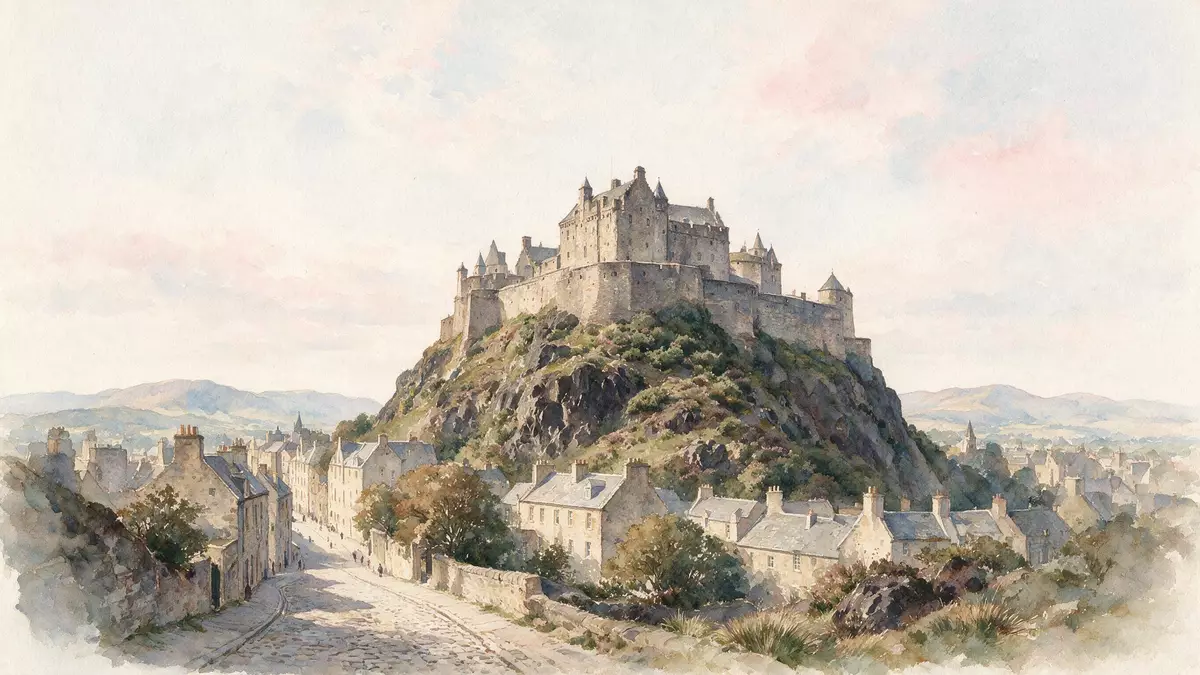
Edinburgh Castle rises above Edinburgh on a volcanic rock that has carried fortifications and royal chambers for many centuries. Perched on Castle Rock, the fortress concentrates layers of Scottish power, conflict and ceremony in one compact site, from medieval stone walls to the rooms where monarchs lived and where royal regalia is still displayed.
Castle Rock and the fortress on the height
The defining feature of Edinburgh Castle is its position on Castle Rock, a volcanic plug that lifts the fortress above the Old Town and gives it its abrupt, cliff-like setting.Castle Rock The rock has supported human settlement since deep prehistory, long before stone curtain walls and towers were built. In the early medieval period, a fortified site took shape on this height, evolving into a royal stronghold that anchored the emerging Scottish kingdom.
The castle complex spans several centuries of construction, with buildings from different periods gathered inside one set of defences.Edinburgh Castle Later work strengthened the outer lines with features such as the Half-Moon Battery and the Portcullis Gate, giving the approach from the town a layered, military character. From the terraces above these fortifications, views run across Edinburgh and out towards the Firth of Forth, underlining how decisively the rock commands the surrounding landscape.
Royal rooms, chapel and the Honours of Scotland
Within the walls, Edinburgh Castle holds a cluster of royal buildings that draw many visitors. The Royal Palace contains the chamber where Mary, Queen of Scots gave birth in 1566 to her son James VI, who later became James I of England and united the crowns in 1603.the room where James VI was born Nearby stands St Margaret’s Chapel, a small stone building dating from the first half of the twelfth century and regarded as the oldest surviving structure within the castle.
Edinburgh Castle is also the place where the Honours of Scotland, the Scottish Crown Jewels, are kept in the Crown Room.the Honours of Scotland This regalia comprises a crown, sceptre and sword of state dating from the fifteenth and sixteenth centuries. They were first used together at the coronation of Mary, Queen of Scots in 1543 and later locked away after the Acts of Union in 1707. In 1818 the writer Sir Walter Scott rediscovered them in a chest within the castle, and they have since been displayed as symbols of Scotland’s monarchy.
Layers of military, political and ceremonial history
For much of its life, Edinburgh Castle functioned as a royal residence and as a fortress embedded in the military history of Scotland. From the reign of Malcolm III in the eleventh century, Scottish kings used the rock as a seat of power, and the stronghold was drawn repeatedly into conflict, including episodes during the Wars of Scottish Independence in the late thirteenth and early fourteenth centuries.royal residence and warfare Sieges in the sixteenth century damaged parts of the complex and prompted further fortification work.
Over time, the castle’s role expanded beyond kingship into garrison duty, prison use and the storage of artillery. One of the principal interior spaces, the Great Hall, was completed in 1511 for King James IV and later adapted as needs changed.the Great Hall Parts of the site still serve military functions, while much of the complex is arranged as a museum-like environment where arms, uniforms and historical displays sit alongside royal rooms and chapel.
Visiting Edinburgh Castle: what travellers from Western Europe should know
- Edinburgh Castle stands at the western end of the Old Town on Castle Rock, reached on foot by the sloping expanse of the Royal Mile that rises towards the Esplanade.
- The approach from the city involves a steady climb and, within the castle, movement between levels by way of stone steps and cobbled surfaces that can feel uneven underfoot.
- Wider Edinburgh is served by Waverley railway station in the valley below the Old Town, from which streets and closes lead uphill towards the castle area.
Searching for Edinburgh Castle on social platforms
These links open searches for Edinburgh Castle on each platform.Frequently asked questions about Edinburgh Castle
Where is Edinburgh Castle located in the city?
Edinburgh Castle stands on Castle Rock at the western end of Edinburgh’s Old Town, above the Royal Mile and close to the city’s historic centre.
What should visitors expect inside the castle?
Visitors move through fortified gateways into a complex of courtyards, royal chambers, chapel and exhibition rooms, together with military displays and panoramic viewpoints.
What makes Edinburgh Castle distinctive among Scottish sites?
The combination of an ancient volcanic rock, medieval fortifications, royal birth chamber, twelfth-century chapel and the Honours of Scotland gives the castle a concentrated national significance.


