
Duomo di Siena and its striped marble world
Published on 09/03/2026 at 07:55 | Editorial responsibility: Rafael Müller, Editor-in-Chief AD HOC NEWS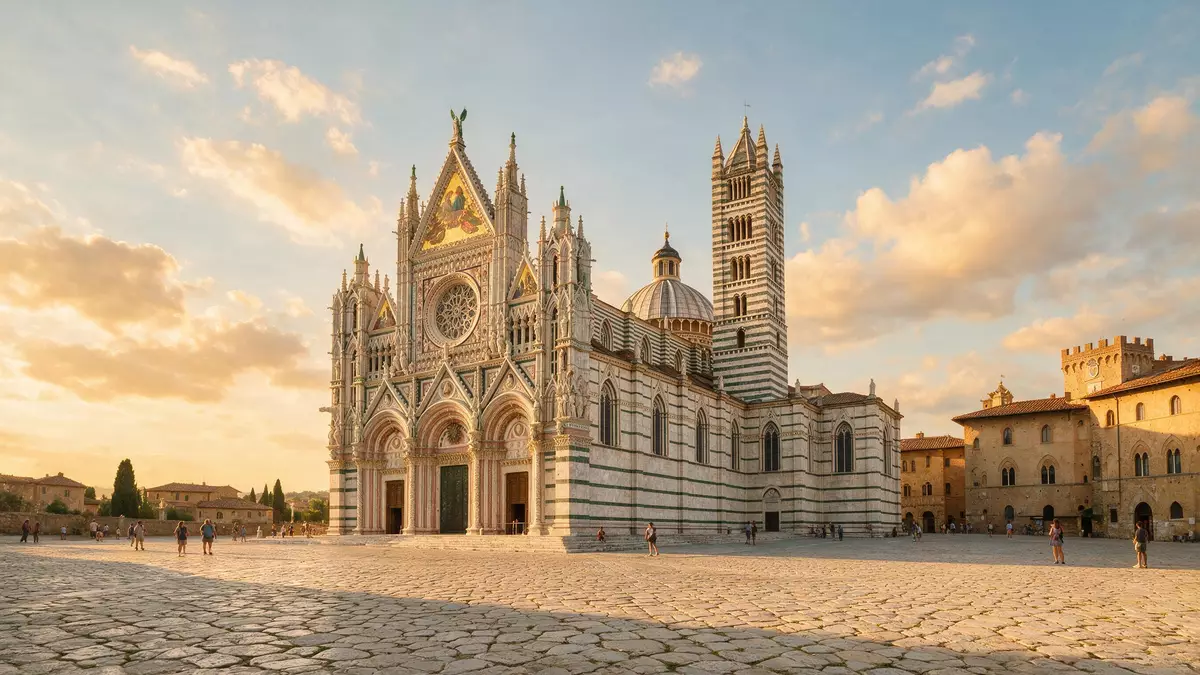
Duomo di Siena rises above the medieval streets of Siena as a high Gothic cathedral where black-and-white marble, sculpture and painted stone floor form one continuous artwork. Built primarily in the thirteenth and fourteenth centuries and dedicated to Santa Maria Assunta, it gathers Romanesque and Gothic elements into a single, intensely decorated space that rewards slow looking.
Striped stone and a hilltop silhouette
The cathedral stands on one of the highest points of Siena, facing Piazza del Duomo and forming a compact ensemble with its bell tower, baptistery and associated museum buildings.The Duomo di Santa Maria Assunta anchors this part of the city, its bulk visible from many directions as the streets climb towards it. The exterior combines Romanesque solidity with the pointed arches and elaborate sculptural decoration of Italian Gothic.
From the piazza, the first impression is of striped stone. The main body of Duomo di Siena is built in alternating bands of dark and light marble that wrap around walls and bell tower in horizontal courses.The campanile continues these black-and-white stripes, tying the vertical accent of the tower back to the church below. The west front adds coloured marble, carved figures and inlaid details that turn the façade into a dense stone tapestry.
A medieval project layered over centuries
Construction of the present cathedral structure gathered pace around the turn of the thirteenth century and was largely complete by the end of that century, even though work on details continued well into the fourteenth century.Major phases of work in the thirteenth and fourteenth centuries added transepts, choir and decorative campaigns that gave the building its current outline. A consecration took place in 1179, during the pontificate of Alexander III, marking an early liturgical milestone for the site even as later centuries brought further enlargement.The cathedral is recorded as consecrated in 1179.
In the early fourteenth century the Sienese embarked on an ambitious plan known as the Duomo Nuovo, intended to transform the existing church into the transept of a much larger basilica. Work on new nave walls and piers advanced into the 1330s, but both financial pressure and the impact of the Black Death in 1348 brought construction to a halt.The enlarged scheme was abandoned in the mid-fourteenth century, and the cathedral visible now reflects the earlier, more compact plan. In the seventeenth century, Gian Lorenzo Bernini designed a lantern for the dome, adding a Baroque accent at the crown of the crossing.
Inside the striped marble interior
Stepping through the main doors, the striped pattern of the exterior continues along piers, arches and vaults, turning structural elements into a graphic rhythm. The nave, transepts and choir are lined with columns clad in alternating dark and light stone, and the same colours frame painted ceilings and sculpted capitals.Interior views show the black-and-white scheme carried throughout. The eye moves from these strong bands to the more intricate detail of pavement, pulpits and side chapels.
The cathedral houses an extraordinary concentration of works by major Italian artists. There are sculptures by Nicola Pisano and his son Giovanni Pisano, who were active in the thirteenth and early fourteenth centuries, and later additions by Donatello, Michelangelo and Bernini.The building brings together sculpture from multiple periods. Taken together, these works turn the interior into a compact survey of Italian religious art from the Gothic period into the Baroque.
The marble floor as a stone picture book
One of the most distinctive features of Duomo di Siena lies underfoot. The marble floor is formed from inlaid panels and graffito designs that extend across nave, transepts and choir.This pavement is described as a mosaic in marble inlay and graffito, depicting scenes from scripture, allegorical figures and stories connected to Siena’s civic identity. Individual panels span centuries of work, beginning in the fourteenth century and continuing into the sixteenth.
The technique combines differently coloured marbles, cut and set like stone intarsia, with lines engraved and filled to define faces, drapery and inscriptions. The result reads almost like a graphic novel in stone, running down the central nave and branching into side bays. Because of its artistic value and the wear that foot traffic brings, large parts of the floor are protected for much of the year with coverings, leaving selected panels visible near the entrance.
Visiting Duomo di Siena: what travellers from Western Europe should know
- Duomo di Siena stands in the historic centre of Siena in Tuscany, on Piazza del Duomo close to other cathedral complex buildings such as the baptistery and Museo dell’Opera.
- The site sits on a pronounced hill, and reaching the cathedral from lower parts of Siena involves walking up streets and stairways with noticeable gradients.
- Inside the cathedral, the nave and side aisles are long and the marble floor is precious, so visitors follow defined routes that keep foot traffic away from the most delicate panels.
- The official language is Italian and the currency is the euro.
Searching for Duomo di Siena on social platforms
These links open searches for Duomo di Siena on each platform.
Frequently asked questions about Duomo di Siena
Where is Duomo di Siena?
Duomo di Siena stands in the Tuscan city of Siena in central Italy, on Piazza del Duomo at the top of one of the city’s hills.
What can visitors expect inside Duomo di Siena?
Visitors encounter black-and-white striped marble columns, richly decorated chapels, important sculptures and an extensive inlaid marble floor with biblical and allegorical scenes.
What makes Duomo di Siena distinctive among Italian cathedrals?
The combination of striped exterior and interior, concentrated artworks by figures such as Nicola and Giovanni Pisano, and the narrative marble floor give the cathedral a distinctive character.


