
Duomo di Siena and its marble floor of stories
Published on 09/23/2026 at 23:34 | Editorial responsibility: Rafael Müller, Editor-in-Chief AD HOC NEWS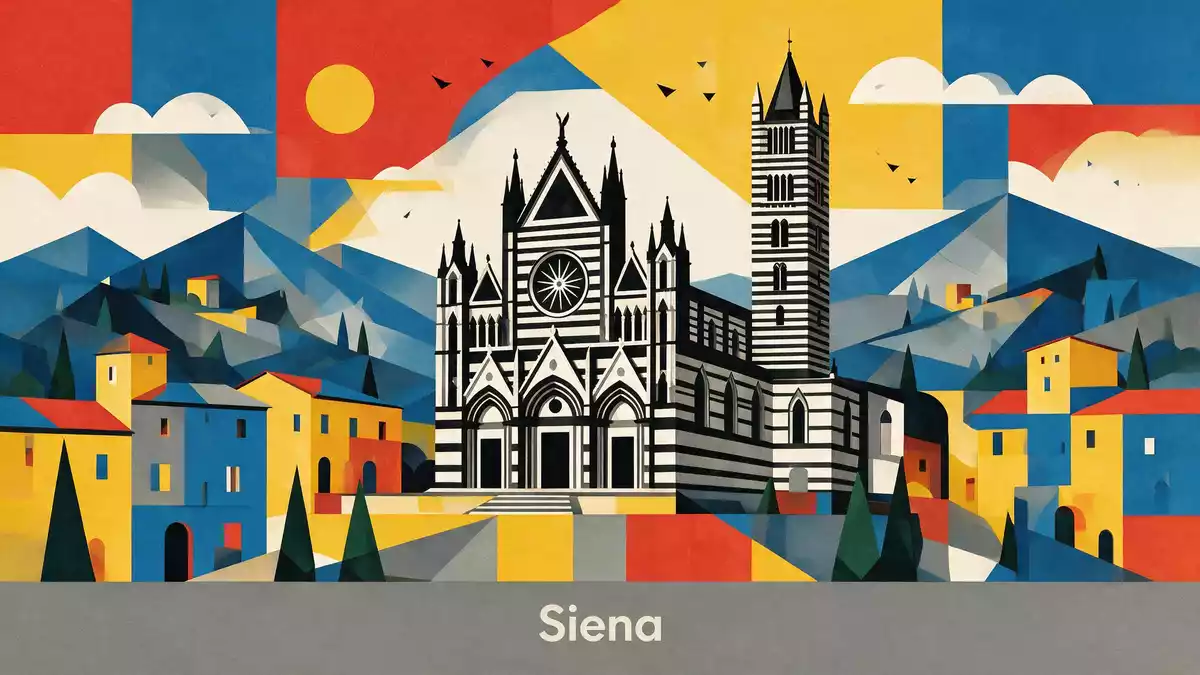
Duomo di Siena rises above Piazza del Duomo with a façade of white, green and red marble. Inside, the same building moves from striped columns and carved stone to a vast marble floor, a painted library and works by Nicola Pisano, Michelangelo and Pinturicchio.
Duomo di Siena: a cathedral built in colour
The cathedral is dedicated to Santa Maria Assunta and belongs to Siena’s historic centre. Its architectural language combines Romanesque and Gothic elements, with alternating dark and pale marble defining the exterior and the nave.
Construction belongs to the medieval history of Siena. The present building took shape between the thirteenth and fourteenth centuries, while the dome had been completed by 1263. The cathedral’s medieval development is recorded through surviving documents and artistic commissions.
The west façade carries sculpture associated with Giovanni Pisano, who worked on its lower section from 1284 to 1297. Prophets, sibyls and philosophers once formed part of its sculptural programme; original figures are preserved in the Museo dell’Opera, while copies occupy parts of the exterior.
The marble floor and the artists of Siena
The floor is made from marble inlay and graffito, a technique in which lines are incised into the surface and filled with contrasting materials. Its panels show biblical, allegorical and symbolic scenes across the nave and transepts.
The floor programme began in the fourteenth century and continued into the nineteenth. Artists supplied designs for its panels, including Pinturicchio, who created the Mount of Wisdom design in 1505. Siena’s inlaid marble floor forms one of the cathedral’s defining interior features.
Nicola Pisano carved the pulpit between 1265 and 1268. The work stands in the north transept and combines relief sculpture with architectural supports, creating a concentrated display of medieval narrative art.
Other works belong to later centuries. Michelangelo carved figures for the Piccolomini Altar, Donatello made Saint John the Baptist, and Gian Lorenzo Bernini contributed statues to the Chapel of the Vow. The cathedral therefore contains sculpture from the thirteenth century through the Baroque period.
Piccolomini Library, dome and surviving medieval space
The Piccolomini Library opens from the cathedral interior as a richly painted chamber. Pinturicchio and his workshop created its fresco cycle between 1503 and 1508, depicting scenes from the life of Pope Pius II.
The library also contains illuminated religious books in showcases around the walls. The paintings, vault decoration and manuscript displays place Renaissance art within the medieval cathedral complex.
The dome forms a central feature of the building, rising above the crossing and supported by a decorated drum. Materials for its covering were purchased in 1263, establishing a firm date for this stage of the cathedral’s construction.
Duccio di Buoninsegna created the design for the great choir window in 1287 and 1288. The cathedral also contains stained glass from later centuries, including a window made by Pastorino de’ Pastorini in 1549.
The cathedral’s relationship with sculpture continues through the choir, chapels and side altars. Fra Giovanni da Verona created the choir inlays, while Antonio Federighi produced holy-water stoups and other carved elements.
Visiting Duomo di Siena: what travellers from Western Europe should know
- Duomo di Siena stands at Piazza del Duomo, 8, in Siena’s historic centre. The cathedral is reached on foot through the central streets, while Siena FS connects the city with the wider Tuscan rail network.
- The approach from Siena FS rises towards the historic centre. Local buses connect the station area with central stops, followed by a walk through Siena’s hilltop streets.
- The interior combines marble paving, steps, chapels and carved details. Care is required on uneven historic surfaces and around narrow interior passages.
- The cathedral complex includes the cathedral, Piccolomini Library and Museo dell’Opera. The museum preserves original sculptures associated with Giovanni Pisano’s façade programme.
- The official language is Italian and the currency is the euro.
Searching for Duomo di Siena on social platforms
These links open searches for Duomo di Siena on each platform.
Frequently asked questions about Duomo di Siena
Where is Duomo di Siena?
Duomo di Siena stands in Piazza del Duomo, within the historic centre of Siena in Tuscany, Italy.
What can visitors expect inside?
The interior contains striped marble architecture, an inlaid floor, Nicola Pisano’s pulpit, the Piccolomini Library and sculpture by Michelangelo and Bernini.
What makes the cathedral distinctive?
Its distinctive character comes from the combination of polychrome marble, medieval sculpture, Renaissance frescoes and a large narrative floor programme.


