
Duomo di Orvieto and its striped stone silhouette
Published on 09/17/2026 at 10:01 | Editorial responsibility: Rafael Müller, Editor-in-Chief AD HOC NEWS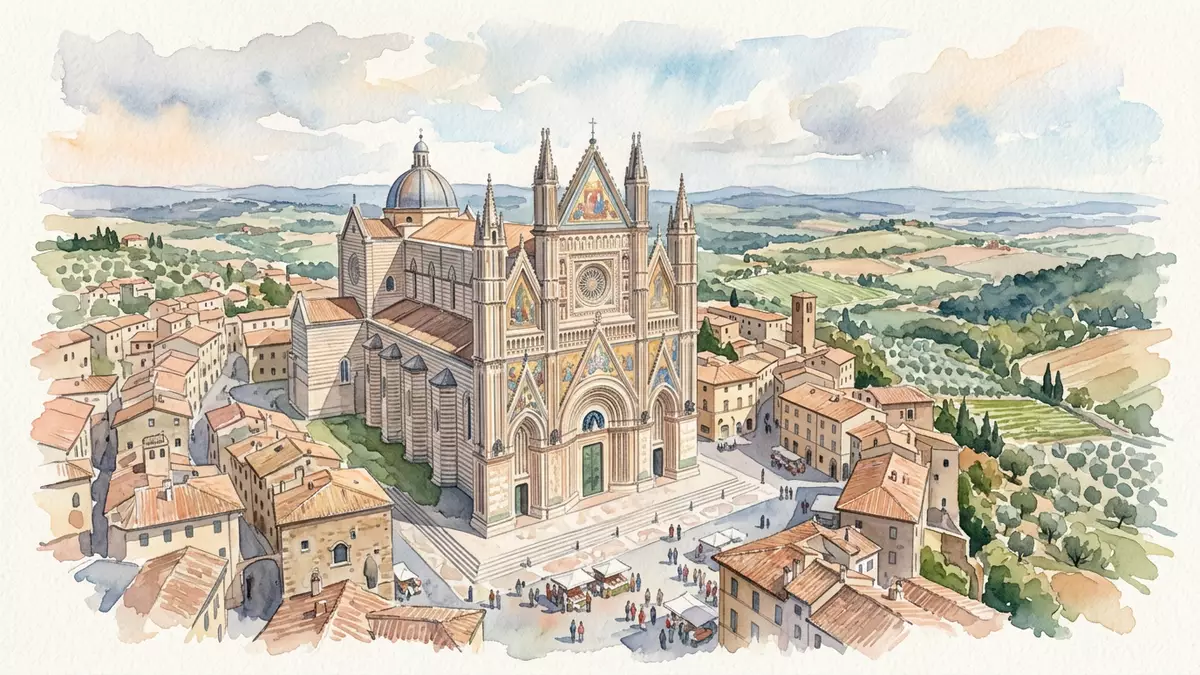
Duomo di Orvieto in Umbria is a Roman Catholic cathedral whose striped stone silhouette dominates the hilltop town of Orvieto in central Italy. Dedicated to Santa Maria Assunta, it is a major work of Romanesque-Gothic architecture begun in 1290 under Pope Nicholas IV.
Striped stone and a sculpted facade
Seen from the piazza, Duomo di Orvieto presents a striking exterior of alternating lighter and darker stone courses, giving the walls a horizontal banding that runs the length of the nave and transept.Romanesque-Gothic architecture This striped masonry continues around the apse, tying the whole structure together visually. The full name of the cathedral, Cattedrale di Santa Maria Assunta, reflects its dedication to the Virgin Mary Assumed into Heaven.dedicated to the Virgin Mary Assumed
The west front is organised into vertical zones with three great gables and a dense programme of sculpted and painted decoration. This facade took shape over more than two centuries, with a decisive phase under the Sienese architect and sculptor Lorenzo Maitani, whose intervention in the early fourteenth century strengthened the transept and defined the three-gabled design adopted for the front.three-gabled design adopted Marble reliefs frame the central doorways, mosaics fill the gables, and a large rose window by Andrea di Cione, known as Orcagna, punctuates the upper part of the facade.
Building a medieval cathedral over centuries
Duomo di Orvieto was founded in the late thirteenth century when Pope Nicholas IV laid its foundation stone on 13 November 1290 in the presence of the papal court.foundation stone on 13 November 1290 Over the following decades and centuries, work on the structure passed through the hands of several architects and master builders. The project has been attributed to figures such as Arnolfo di Cambio and Fra Bevignate of Perugia, and later directed by Giovanni Uguccione, Lorenzo Maitani and others.Arnolfo di Cambio and Fra Bevignate
Architectural completion of the facade is generally placed in the sixteenth century, after more than two centuries of intermittent work. The nave and transept were followed by the apse, chapels and sculptural cycles, while decorative campaigns extended into the fifteenth and sixteenth centuries. In the Cappella di San Brizio inside the cathedral, frescoes of the Last Judgement and “Stories of the Last Days” were begun by Fra Angelico in 1447 and completed between 1499 and 1504 by Luca Signorelli, adding a powerful painted cycle to the building’s interior art.Fra Angelico and Luca Signorelli frescoes
Interior space and chapels
Inside, Duomo di Orvieto follows a basilica plan with three naves. Tall piers carry the arcades, and the striped stone pattern from the exterior continues on the internal walls, where dark volcanic rock alternates with lighter stone. The main volume is punctuated by chapels opening off the aisles, including the Cappella di San Brizio with its frescoes and the Chapel of the Corporal, associated with the miracle of Bolsena and the relic housed there.basilica plan with three naves
The cathedral stands on Piazza del Duomo in Orvieto, with its front set slightly above the square on a broad platform. The surrounding streets open out onto the piazza, giving varied vantage points on the facade and side walls. Bronze doors by sculptor Emilio Greco, installed in the twentieth century, form a more recent addition to the entrance, contrasting with the medieval stonework and mosaics around them.bronze doors by Emilio Greco
Visiting Duomo di Orvieto: what travellers from Western Europe should know
- Duomo di Orvieto stands on Piazza del Duomo in Orvieto, a hill town in Umbria, accessible by rail services to Orvieto station and local transport up to the historic centre.
- The cathedral rises above a paved square, and reaching its entrances from the surrounding streets involves short uphill stretches and stairways on the external platform.
- Orvieto is in Italy, where the official language is Italian and the currency is the euro.
Searching for Duomo di Orvieto on social platforms
These links open searches for Duomo di Orvieto on each platform.
Frequently asked questions about Duomo di Orvieto
Where is Duomo di Orvieto located?
Duomo di Orvieto is in the town of Orvieto in Umbria, central Italy, standing on Piazza del Duomo at the top of the tufa plateau.
What can visitors expect inside the cathedral?
Inside, visitors encounter a basilica-plan interior with three naves, striped stone arcades, chapels such as the Cappella di San Brizio, and fresco cycles from the fifteenth and sixteenth centuries.
What makes Duomo di Orvieto distinctive among Italian cathedrals?
The cathedral is distinctive for its banded stone walls, richly sculpted and painted facade shaped by Lorenzo Maitani and others, and the major frescoes by Fra Angelico and Luca Signorelli in the Cappella di San Brizio.


