
Duomo di Orvieto and its striped stone masterpiece
Published on 09/16/2026 at 09:55 | Editorial responsibility: Rafael Müller, Editor-in-Chief AD HOC NEWS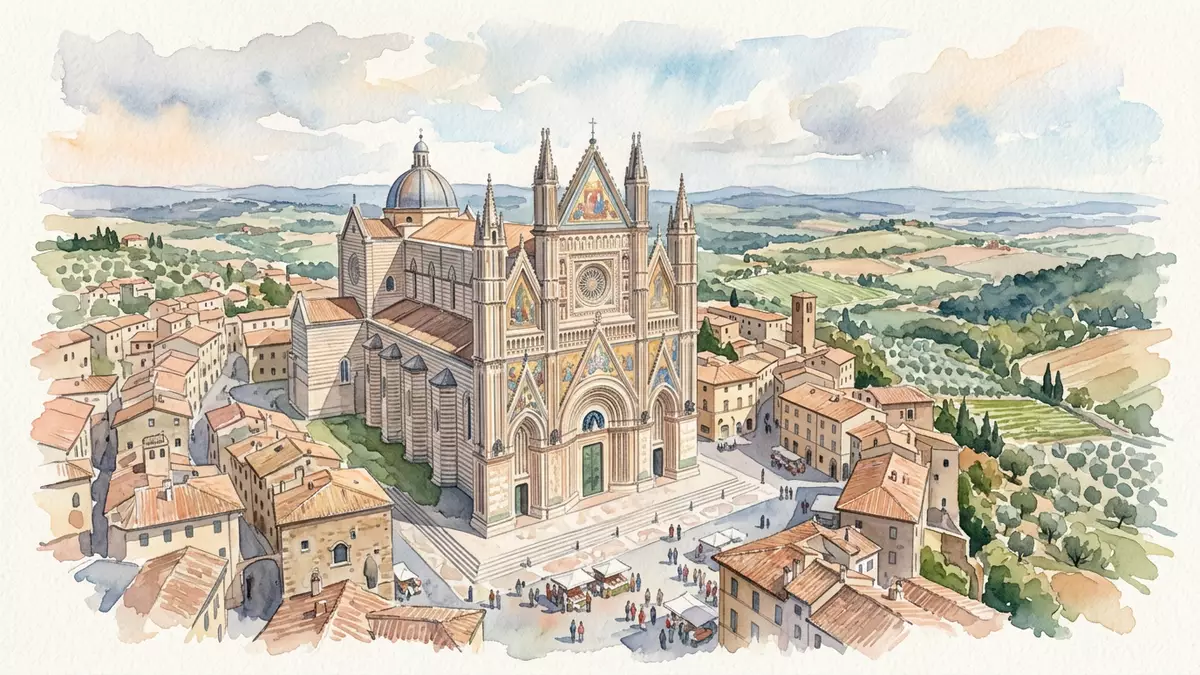
Duomo di Orvieto rises above the Umbrian hill town of Orvieto as a cathedral of striking striped stone and a façade dense with sculpture and gold-coloured mosaics. Built for the Latin rite and dedicated to the Virgin Mary, it belongs to the long wave of ecclesiastical building that reshaped central Italy in the late thirteenth century, when the first stone was laid in 1290 in the presence of Pope Nicholas IV.first stone in 1290
Striped walls and a Gothic space in stone
Seen from the side, Duomo di Orvieto is defined by horizontal bands of dark and light stone that run uninterrupted along the nave and apse. The dark courses use local volcanic tufa, while the pale bands are travertine, a pairing that reads clearly in the Umbrian light and ties the building to the plateau it stands on.striped tufa and travertine Behind the façade the plan follows a Latin cross, with a long nave intersected by a transept and ending in a deep choir, a layout that Lorenzo Maitani shaped when he took over the works around 1310 and pushed the architecture decisively towards an Italian Gothic idiom.Lorenzo Maitani and Gothic
The interior has clustered columns that separate the nave from its aisles and carry pointed arches towards a timber roof, a combination that reads as both robust and refined. Light filters through tall windows in the nave walls and from higher openings in the transept and choir, touching the striped stone and the painted surfaces of chapels and altars. The striped pattern continues inside, where the alternating tufa and travertine appear on piers and wall faces, turning the whole space into a three-dimensional rendering of the exterior striping. Side chapels open off the aisles, some enclosed by metal screens and many richly decorated, so that walking the length of the nave becomes a sequence of distinct spaces cut into the larger volume.
The façade: mosaics, sculpture and bronze
The west front of Duomo di Orvieto is the cathedral’s most elaborate face, rising in three steep gables above the square and covered with marble panels, gilded mosaics and dense sculptural work.three-gabled façade Work on this front advanced over centuries, with contributions from several generations of artists, and can be regarded as architecturally complete by 1532, although later additions continued to refine the decoration.façade complete in 1532 The surface is divided into vertical zones by slender buttresses, whose faces carry reliefs narrating scenes from the Bible, while the upper gables hold mosaics that shimmer in strong sunlight.
Modern visitors enter through bronze doors installed in the twentieth century, cast by sculptor Emilio Greco and delivered in the 1960s.bronze doors by Emilio Greco Above the central doorway sits a large circular opening framed by elaborate tracery created in the fourteenth century under Andrea di Cione, known as Orcagna, whose intervention gave the façade one of its most recognisable details.Orcagna and the rose window Freestanding marble figures, including depictions of sibyls, stand at ground level to either side, adding sculpted silhouettes against the smooth paving of the piazza. Taken together, the façade reads almost as a stone altarpiece enlarged to the scale of a building, with narrative sculpture, figurative statues and luminous mosaics layered on a precise Gothic structure.
Cappella di San Brizio and Renaissance painting
Inside the cathedral, the Cappella di San Brizio forms one of its most celebrated interior spaces, a side chapel whose walls and vaults are covered with a dramatic fresco cycle on the Last Days.Cappella di San Brizio The programme began in 1447 when Fra Angelico undertook the first sections, and was significantly extended by Luca Signorelli, who worked there between 1499 and 1504 and ultimately received a second contract entrusting him with the whole chapel.Fra Angelico and Luca Signorelli
Signorelli’s scenes, including “Sermon of the Antichrist”, “End of the World” and “Last Judgement”, line the walls with densely populated compositions, bodies studied in detail and expressions rendered with careful attention.Last Judgement cycle Standing beneath the vault, visitors see Renaissance painting set within a medieval architectural shell, framed by stone ribs and lit through controlled openings. The chapel forms a compact counterpart to the vast nave outside, turning theological themes into vivid imagery in a contained space where painted architecture and real masonry interact closely.
Visiting Duomo di Orvieto: what travellers from Western Europe should know
- Duomo di Orvieto stands in the historic centre of Orvieto in Umbria, Italy, on the tufa plateau above the surrounding countryside, with its façade facing Piazza del Duomo.Piazza del Duomo address Rail services from cities such as Rome and Florence reach Orvieto station below the town, with local transport links ascending to the old centre.
- The approach to the cathedral from the streets of the old town leads across a paved square, and inside the building the length of the nave and the side chapels require walking on stone floors over a substantial distance.
- Orvieto sits on an elevated volcanic plateau, and the cathedral stands near the edge of this high ground, so views of the surrounding Umbrian landscape open up from streets and viewpoints close to the building.
- Italy’s official language is Italian and the national currency is the euro.
Searching for Duomo di Orvieto on social platforms
These links open searches for Duomo di Orvieto on each platform.
Frequently asked questions about Duomo di Orvieto
Where is Duomo di Orvieto located?
Duomo di Orvieto stands in the town of Orvieto in Umbria, central Italy, on a volcanic tufa plateau with its main front on Piazza del Duomo.
What can visitors expect inside the cathedral?
Visitors encounter a striped stone interior with a long nave, side chapels, frescoed spaces such as the Cappella di San Brizio and a combination of medieval and later artworks.
What makes Duomo di Orvieto distinctive among Italian cathedrals?
The cathedral’s striped tufa and travertine walls, richly decorated Gothic façade and major Renaissance fresco cycle by Fra Angelico and Luca Signorelli together give it a distinctive character.


