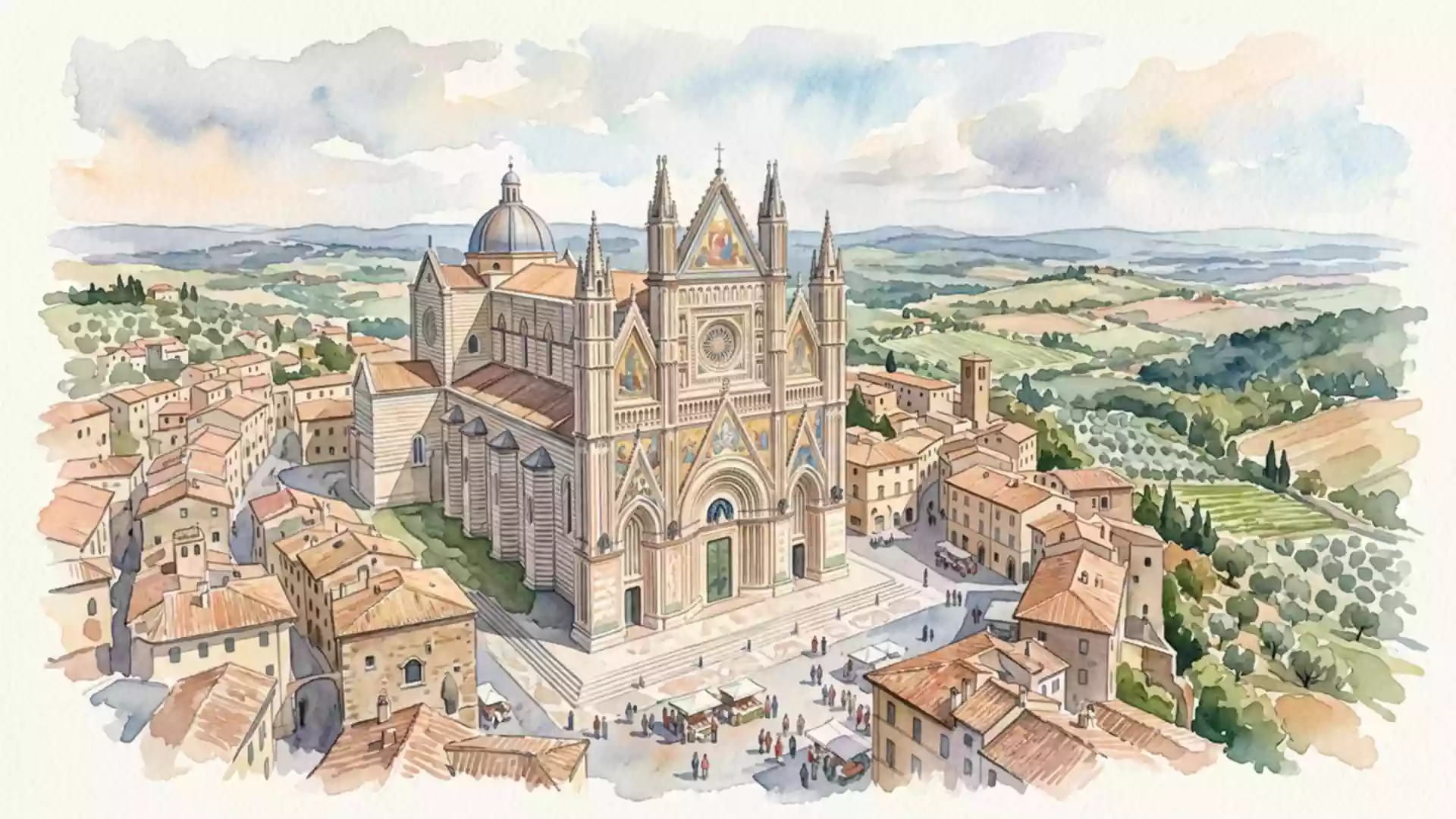
Duomo di Orvieto and its striped stone cathedral front
Published on 09/11/2026 at 14:15 | Editorial responsibility: Rafael Müller, Editor-in-Chief AD HOC NEWS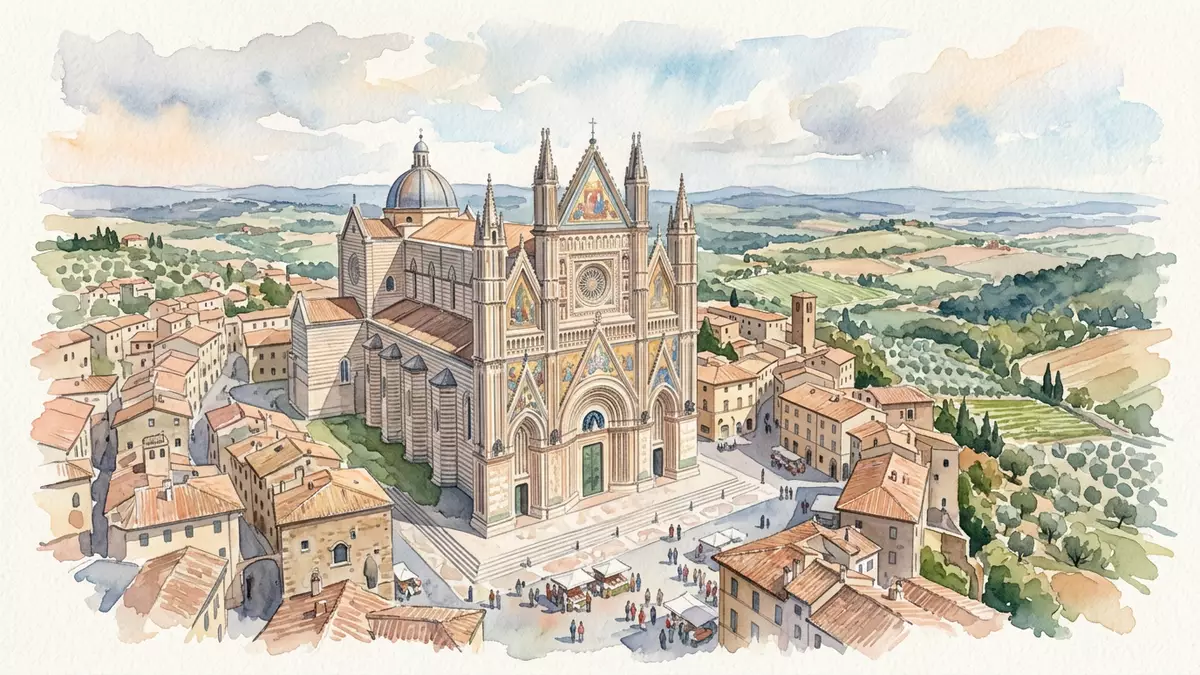
Duomo di Orvieto rises on the plateau of Orvieto as a striped stone cathedral where black and white banding meets a richly decorated façade. Begun in 1290 as Cattedrale di Santa Maria Assunta, it blends Romanesque solidity with Italian Gothic ornament in a way that defines the skyline of this Umbrian hill town.
Striped walls and a golden front
From the piazza, the most striking feature of Duomo di Orvieto is its façade, where stone, sculpture and mosaics form a dense vertical screen above the square. The façade took shape over several generations and can be considered architecturally complete in the sixteenth century, creating the layered surface that visitors see today.Construction began on 13 November 1290 under Pope Nicholas IV, giving the cathedral a documented starting point in late medieval Italy.
The design attributed to the Sienese architect and sculptor Lorenzo Maitani focuses the decoration on the front, where bas-reliefs climb the piers and sculpted figures stand above the panels.Maitani is recorded as capomaestro of the cathedral from 1310, and the façade’s lower zones and sculptural programme are closely associated with his workshop. The gables carry mosaics that add strong colour to the façade, while bronze figures such as the Lamb of God and an image of St Michael punctuate the skyline.
A striped body in black and white stone
Walk along the flanks of Duomo di Orvieto and the building resolves into alternating courses of dark and light stone, running the length of the nave and transept. This banded treatment places the cathedral firmly in the family of central Italian churches that use striped masonry to emphasise their volume, but here it sits above the steep drop of Orvieto’s volcanic tuff, giving the long walls a sense of height when seen from the surrounding countryside.The cathedral stands in Orvieto in Umbria, and the contrast between the dark local stone and pale travertine marks it out against the town’s fabric.
The overall plan follows the type of a basilica, with a nave separated from the aisles by arcades and a transept intersecting the main volume.Work on the cathedral runs through the late thirteenth and early fourteenth centuries, creating a structure that bridges Romanesque and Gothic practice. On the exterior, buttresses mark the bays along the sides, and the roofline is animated by sculpted elements that echo the imagery of the façade.
Interior chapels and painted cycles
Inside, the striped masonry continues, with the alternating stone wrapping the tall arcades and drawing the eye toward the eastern chapels. The interior combines the broad nave associated with Italian churches and a series of richly decorated side spaces that reward closer inspection. Light filters through the windows into a space that appears both elongated and contained by the pattern of the stone.
Among the interior highlights are the chapels at the east end, which house important painted cycles and liturgical furnishings connected with the cathedral’s role in the life of Orvieto.The dedication of the building as a cathedral of Santa Maria Assunta underlines its status as the mother church of the diocese, and the interior decoration reflects this prominence. Sculpted choir fittings, painted walls and the interplay of stone and plaster combine to create a sequence of spaces that extends the drama of the façade into the body of the church.
Visiting Duomo di Orvieto: what travellers from Western Europe should know
- Duomo di Orvieto stands on Piazza del Duomo in the historic centre of Orvieto, in the Italian region of Umbria; the town is reached by road and rail connections that link with larger Umbrian and central Italian cities.
- The cathedral sits on a volcanic plateau above the surrounding plain, and reaching the square from the lower parts of Orvieto involves uphill streets or mechanical links that climb the height difference.
- The immediate surroundings of Piazza del Duomo are paved, and movement around the exterior of the cathedral involves crossing gently sloping stone surfaces rather than long flights of steps.
- Orvieto lies in central Italy, where summers can be hot and winters comparatively cool, and the exposed position of the piazza means weather conditions are felt directly when standing outside the cathedral.
- The official language is Italian and the currency is the euro; Duomo di Orvieto stands within the European Union, so no special entry sentence for non-EU visitors applies beyond standard travel advice for Italy.
Searching for Duomo di Orvieto on social platforms
These links open searches for Duomo di Orvieto on each platform.
Frequently asked questions about Duomo di Orvieto
Where is Duomo di Orvieto?
Duomo di Orvieto stands on Piazza del Duomo in the hill town of Orvieto, in the region of Umbria in central Italy.
What can visitors expect inside the cathedral?
Visitors encounter a nave marked by alternating dark and light stone, high arcades and chapels with painted cycles and sculpted furnishings at the eastern end.
What makes Duomo di Orvieto distinctive among Italian cathedrals?
Its combination of a richly decorated façade by Lorenzo Maitani, striped stone walls and hilltop position above the Umbrian landscape gives Duomo di Orvieto a character that defines Orvieto itself.