
Duomo di Orvieto and its mosaic Gothic façade
Published on 09/23/2026 at 04:24 | Editorial responsibility: Rafael Müller, Editor-in-Chief AD HOC NEWS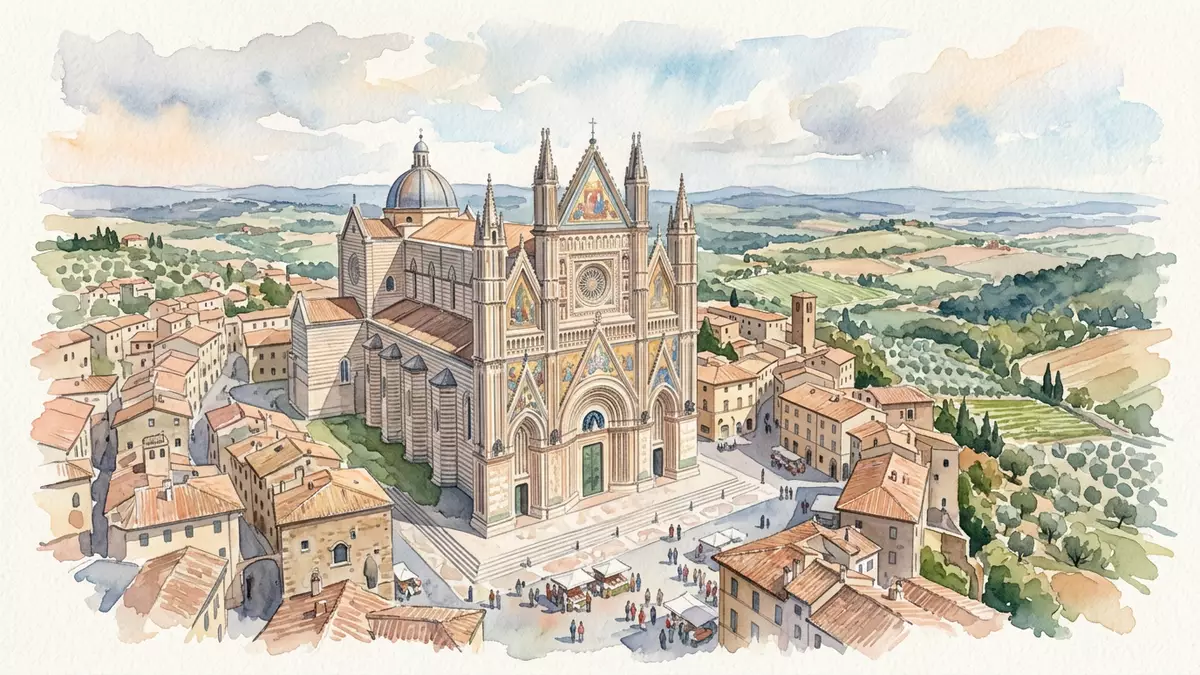
Duomo di Orvieto presents a broad Gothic façade where coloured mosaics, marble sculpture and bronze doors meet above the Piazza del Duomo. The cathedral in Orvieto combines a Romanesque-Gothic basilica with major works by Lorenzo Maitani, Luca Signorelli and Fra Angelico.
Duomo di Orvieto: a façade built in colour
The façade is the cathedral’s most immediate feature. Its three-part composition carries pointed forms, sculpted reliefs, gilded mosaic surfaces and a large rose window. Bronze doors occupy the lower centre, while spires rise above the decorated front.
Work on the façade began around 1310 and reached architectural completion in 1532. The façade’s construction dates place its visible appearance within more than two centuries of artistic work.
From Nicholas IV to Lorenzo Maitani
Pope Nicholas IV laid the foundation stone on 13 November 1290. The cathedral honours Santa Maria Assunta in Cielo, the Assumption of the Virgin Mary, and its building history belongs to the late thirteenth and sixteenth centuries.
The original design is attributed to Arnolfo di Cambio and the friar Bevignate of Perugia. Lorenzo Maitani took responsibility for the works around 1310, and his contribution shaped the cathedral’s façade and its Gothic character. Lorenzo Maitani’s role connects Orvieto with the artistic culture of Siena and central Italy.
The building combines architecture, sculpture, decorative arts and painting. Its walls use alternating pale and dark marble, while the interior follows a basilica plan with three naves, pillars and chapels along the sides.
San Brizio and the cathedral’s painted interior
The Chapel of San Brizio occupies the right transept. Its fresco cycle centres on the Last Judgement and includes scenes of the Last Days, with Luca Signorelli’s paintings forming the chapel’s defining visual element.
Fra Angelico began the work in 1447. Luca Signorelli completed the cycle between 1499 and 1504, covering the walls and vaults with figures, architectural settings and dramatic scenes. The San Brizio fresco cycle records the passage from an early Renaissance painter to one of central Italy’s major masters.
The left transept contains the Chapel of the Corporal. Built in the mid-fourteenth century, it takes its name from the sacred altar linen associated with the Miracle of Bolsena. The cathedral crypt functions as an oratory and includes painted areas and burial spaces.
Visiting Duomo di Orvieto: what travellers from Western Europe should know
- Duomo di Orvieto stands in Piazza del Duomo in Orvieto, Umbria. Orvieto is served by the main railway line between Florence and Rome, while the historic centre rises above the station.
- The cathedral occupies the upper town, whose approach includes steep streets and stone paving. Piazza del Duomo provides the principal open space beside the façade.
- The official language is Italian and the currency is the euro.
Searching for Duomo di Orvieto on social platforms
These links open searches for Duomo di Orvieto on each platform.
Frequently asked questions about Duomo di Orvieto
Where is Duomo di Orvieto?
Duomo di Orvieto stands in Piazza del Duomo in Orvieto, a hill town in the Italian region of Umbria. The cathedral occupies the historic upper town.
What can visitors expect inside?
The interior has three naves, alternating marble, chapels, painted walls and sculptural details. The Chapel of San Brizio contains Luca Signorelli’s frescoes on the Last Judgement.
What makes Duomo di Orvieto distinctive?
Its façade combines mosaics, marble reliefs, a rose window, spires and bronze doors. The building also unites medieval architecture with Renaissance painting by Signorelli and Fra Angelico.


