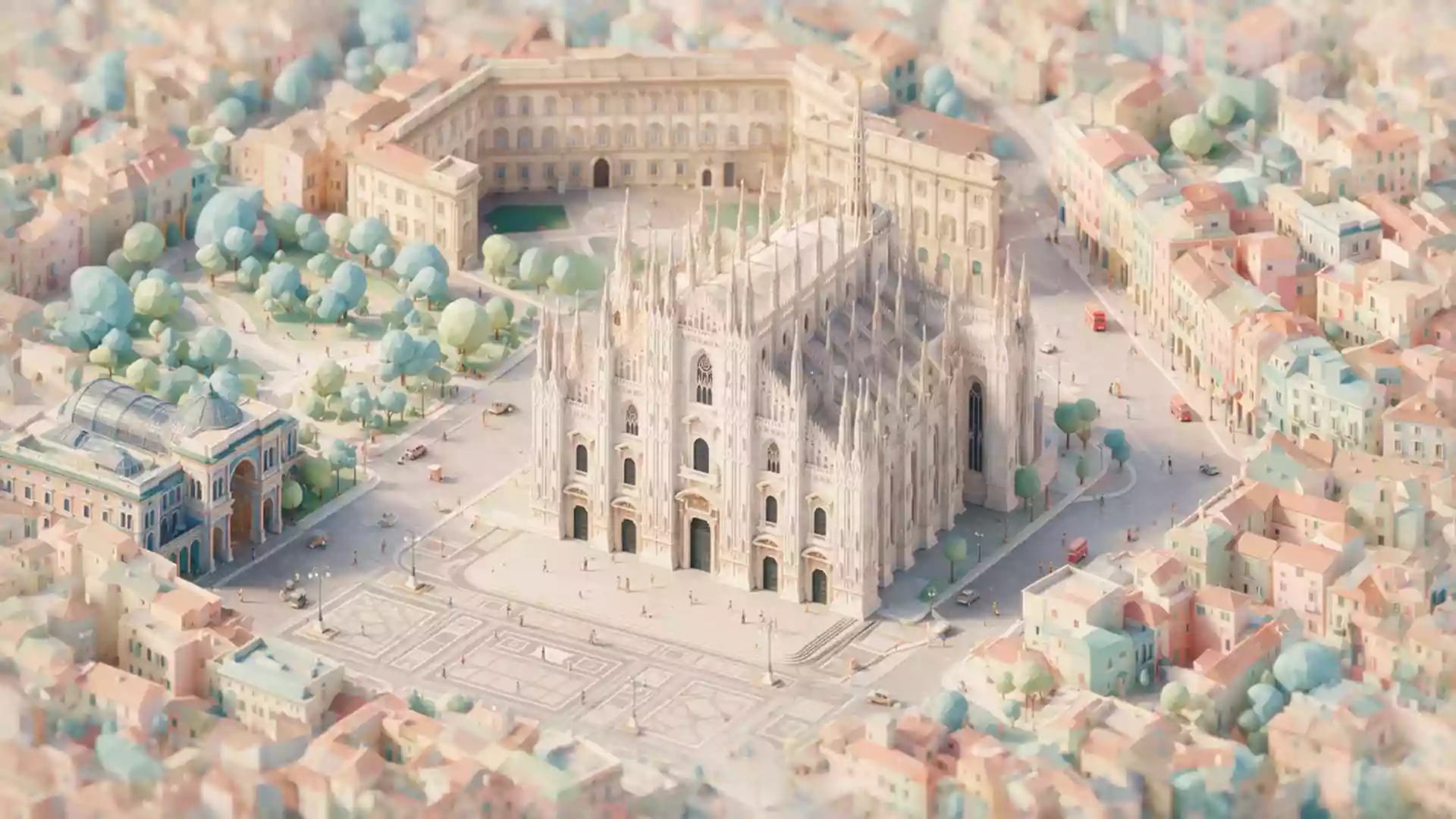
Duomo di Milano and its forest of marble in Mailand
Published on 09/09/2026 at 19:11 | Editorial responsibility: Rafael Müller, Editor-in-Chief AD HOC NEWS
Duomo di Milano in Mailand is a vast Gothic cathedral where a forest of marble spires and statues climbs above the central Piazza del Duomo, giving the city an unmistakable profile. Built as the mother church of the Diocese of Milan and dedicated to Santa Maria Nascente, it is a late medieval project whose construction began in 1386 and whose final structural details were only completed in 1965, stretching across nearly six centuries of European history.Construction work on the Duomo
A Gothic giant of Candoglia marble
Seen from the square, Duomo di Milano reads as a single, monumental block of pale stone, but closer inspection reveals thousands of carved details in its Candoglia marble cladding.The cathedral is clad in rare pink Candoglia marble The main body follows the plan of a Latin cross, with a long nave intersected by a broad transept and framed by flying buttresses that carry the weight of the high vaults.
The building is frequently described as Flamboyant Gothic, a form more associated with northern France and the Low Countries than with most Italian churches of the late fourteenth century.Milan Cathedral was designed in the Flamboyant Gothic style Inside, the nave is lined with tall clustered columns that rise to ribbed vaults, creating a vertical emphasis that echoes the forest of pinnacles outside. Light filters through large stained-glass windows in the aisles and apse, where panels depict biblical scenes in coloured glass set into traceried stone frames.
Six centuries of construction and craft
Work on Duomo di Milano began under Gian Galeazzo Visconti, first Duke of Milan, in 1386, at a time when Gothic architecture still dominated northern Europe even as early Renaissance forms were emerging elsewhere in Italy.Milan Cathedral was founded in 1386 by Gian Galeazzo Visconti Construction continued with changing workshops for centuries, involving dozens of master architects from different regions and generations, and the overall project only reached completion in 1965 when the last major elements of the west facade and bronze doors were installed.Final details on the facade were completed in 1965
This extended timeline means that visitors encounter a building where late medieval Gothic structure coexists with details shaped in the Baroque and twentieth century. The cathedral’s dimensions underline its status: it is around 158 m (520 ft) long and about 92 m (302 ft) wide, with the main spire rising to roughly 108 m (354 ft) above the square.Length 158.6 m, width 92 m, height 108 m Inside, the vast floor area allows the nave and aisles to accommodate tens of thousands of worshippers during major liturgical celebrations, though precise capacity figures belong to the domain of changeable statistics.
Spiralling spires and thousands of statues
From ground level, one of the most striking properties of Duomo di Milano is the sheer density of sculptural work: statues, gargoyles and carved figures line buttresses, pinnacles and facades, turning structural elements into elaborate ornament. Counts made for conservation and guidebook purposes indicate that there are in the region of 3,400 statues distributed across the interior and exterior, together with around 135 spires and many gargoyles.3,400 statues inside and outside the Duomo Figures range from prophets and saints to allegorical personifications and decorative motifs, each carved in marble and set into niches or along the line of the roof.
Above the crossing, the tallest spire carries the gilded copper statue known as the Madonnina, installed in the eighteenth century and visible across much of central Mailand.Madonnina statue installed in 1774 The building’s roof terraces, reached by stairs and lifts inside the cathedral complex, reveal the full extent of the marble forest: visitors walk among pinnacles, carved balustrades and sculpted figures, with views over the square and the broader city beyond the tracery. From here the geometry of the structure becomes clear, with the nave, transept and apse laid out below and the buttresses framing the aisles.
Visiting Duomo di Milano: what travellers from Western Europe should know
- Duomo di Milano stands on Piazza del Duomo in central Mailand, with the cathedral integrated directly into the urban fabric and surrounded by portico-lined streets and arcades.
- Access to the interior involves steps at the main entrances, and reaching the roof terraces requires further staircases or enclosed lifts within the building’s upper levels.
- The cathedral lies within the historic core of Mailand, with the Galleria Vittorio Emanuele II and other major civic spaces immediately adjacent on the same square.
- Mailand is in Italy, where the official language is Italian and the currency is the euro.
- Entry requirements depend on your nationality; UK travellers can check the FCDO travel advice at gov.uk/foreign-travel-advice, Irish travellers the Department of Foreign Affairs at ireland.ie.
Searching for Duomo di Milano on social platforms
These links open searches for Duomo di Milano on each platform.
Frequently asked questions about Duomo di Milano
Where is Duomo di Milano located?
Duomo di Milano stands on Piazza del Duomo in the historic centre of Mailand, in northern Italy, surrounded by major civic and commercial buildings.
What should visitors expect inside the cathedral?
Inside, visitors encounter a vast Gothic interior with tall marble columns, ribbed vaults, stained-glass windows and multiple chapels arranged along the nave and transept.
What makes Duomo di Milano distinctive among European cathedrals?
The cathedral is distinctive for its Flamboyant Gothic style in Italy, its Candoglia marble cladding and its extraordinary number of spires and statues crowning the roof and facades.