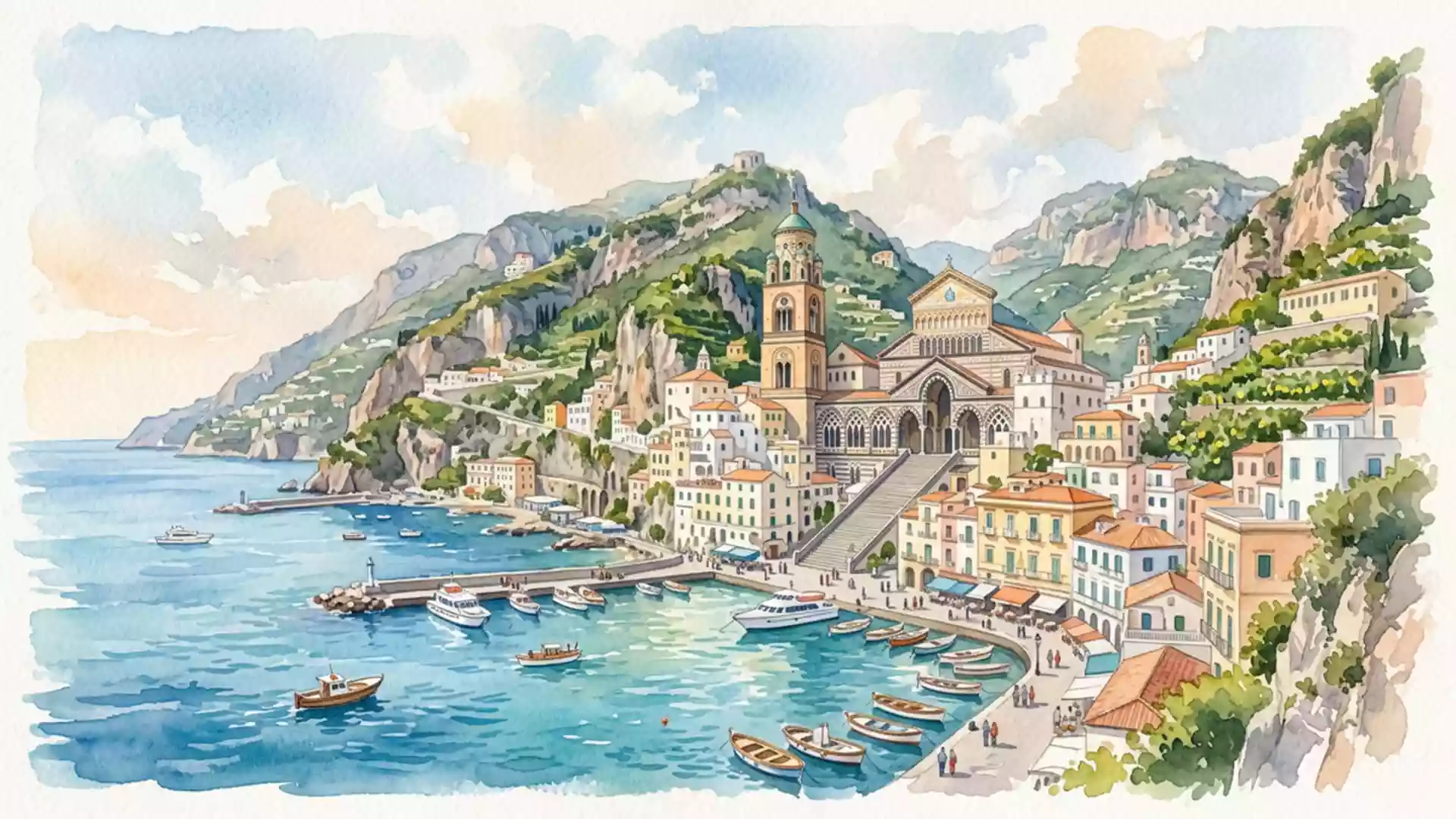
Duomo di Amalfi rising above Amalfi’s stepped piazza
Published on 09/12/2026 at 12:48 | Editorial responsibility: Rafael Müller, Editor-in-Chief AD HOC NEWS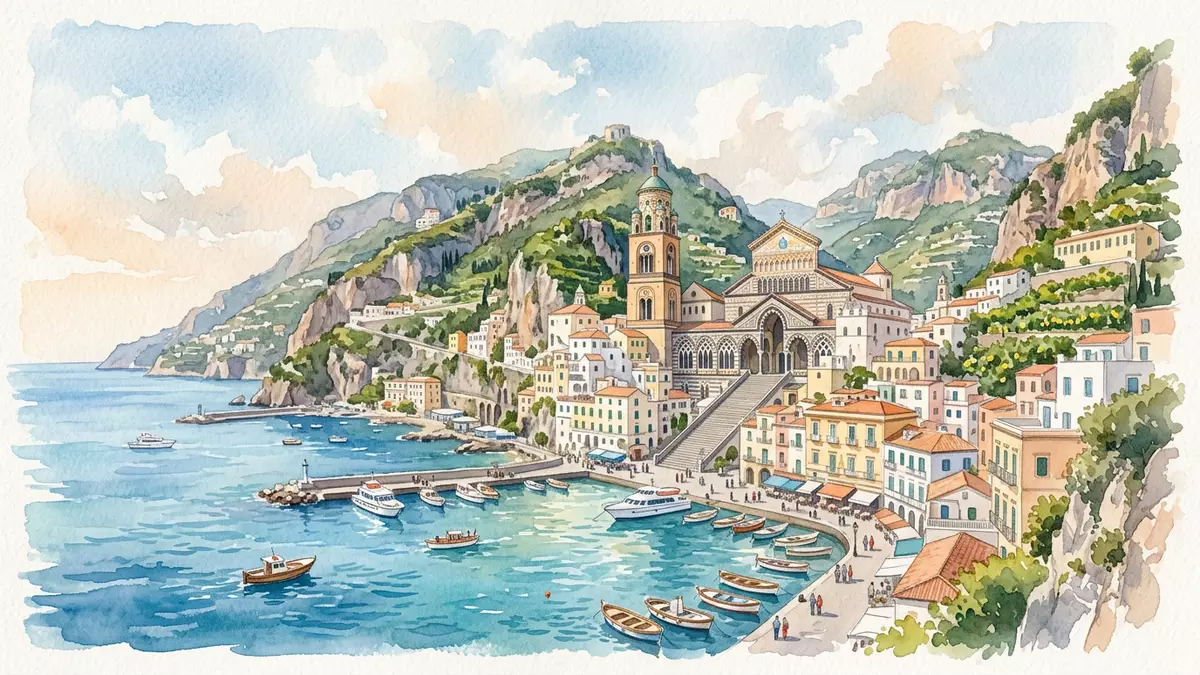
Duomo di Amalfi dominates the centre of Amalfi with a broad staircase climbing to a striped façade, a bell tower and a cluster of adjoining church buildings shaped over many centuries. Built as part of the medieval Maritime Republic of Amalfi, it is dedicated to Saint Andrew and combines Romanesque Arab?Norman structure with Gothic, Renaissance and Baroque additions dating from the medieval and early modern periods.Romanesque Arab?Norman structure
A stepped approach to Amalfi’s cathedral complex
Seen from Piazza Duomo, the most striking feature of Duomo di Amalfi is the long staircase leading up from the square to the portal, emphasising how the cathedral sits on a terrace above the town’s central space.staircase above Amalfi's main square At the top of the steps, the façade presents horizontal bands of dark and light stone and decorative arches that recall Arab?Norman forms found across southern Italy.Arab-Norman forms
To one side rises the cathedral’s bell tower, dating from the twelfth and thirteenth centuries, with arcaded openings and a crown of smaller elements at the top.bell tower built during the 12th and 13th centuries Behind and beside the main church lie other parts of the complex, including the Basilica of the Crucifix and the Paradise Cloister, which together turn the site into an ensemble of chapels, museum spaces and courtyards linked by corridors and stairways.Paradise Cloister and Basilica of the Crucifix
Medieval origins and layers of rebuilding
The origins of Duomo di Amalfi lie in the ninth century, when an early Christian church now known as the Basilica of the Crucifix was built as Amalfi grew into a trading power.Basilica of the Crucifix built before 833 In 987 the Duke Mansone I founded a new cathedral beside this earlier basilica, creating a second three?aisled church dedicated to Saint Andrew.founded by the duke Mansone I in 987 During the twelfth century the two buildings were united into one larger Romanesque church with multiple aisles, reflecting Amalfi’s ambition in the age when maritime republics such as Amalfi, Pisa and Venice were prominent on Mediterranean trade routes.two churches formed a single Romanesque church
In the early thirteenth century the complex was remodelled in Arab?Norman forms, giving the cathedral its distinctive striped exterior and arcaded motifs that mix influences from Norman rulers and Mediterranean Islamic architecture.renovated in 1203 in Arab-Norman forms Later, in the sixteenth and seventeenth centuries, bishops and architects introduced Baroque decoration inside, adding stucco, altars and side chapels that overlay the earlier Romanesque structure.additional Baroque reconstruction between the sixteenth and eighteenth centuries The façade visible from the square dates from the nineteenth century, after a collapse of the previous front, and continues the striped and arcaded language established in medieval phases.facade dates from the 19th century
Saint Andrew’s relics and sacred spaces inside
Duomo di Amalfi is dedicated to Saint Andrew the Apostle, whose relics were brought to Amalfi in the early thirteenth century and placed in a crypt beneath the main church.relics brought to Amalfi from Constantinople in 1206 The crypt, completed in 1208, holds a reliquary and devotional artworks and is one of the most important sacred spaces of the complex, reinforcing the cathedral’s role as a shrine associated with the apostle.crypt completed in 1208
Above the crypt, the nave and aisles combine elements from several styles, with Romanesque structure supporting later Baroque decoration and further Gothic and Renaissance details added over centuries.Arab-Norman, Gothic, Renaissance, Baroque elements The adjoining Basilica of the Crucifix, now used as the diocesan museum, preserves older frescoes and liturgical objects, while the Paradise Cloister offers arcades with intersecting pointed arches and a small garden at the centre, providing a quieter courtyard space framed by stonework.Paradise Cloister with pointed arches
Visiting Duomo di Amalfi: what travellers from Western Europe should know
- Duomo di Amalfi stands on Piazza Duomo in the coastal town of Amalfi in southern Italy, reached by road along the Amalfi Coast or by local buses from neighbouring centres.
- The cathedral complex sits above the main square with a staircase that involves a sustained climb on stone steps between the piazza and the entrance level.
- Nearby lie narrow streets of Amalfi’s historic centre and the seafront, so the cathedral can be combined with walks through the town’s lanes and views over the small harbour.
- The official language is Italian and the currency is the euro.
Searching for Duomo di Amalfi on social platforms
These links open searches for Duomo di Amalfi on each platform.
Frequently asked questions about Duomo di Amalfi
Where is Duomo di Amalfi located?
Duomo di Amalfi stands on Piazza Duomo in the town of Amalfi in southern Italy, above the square and close to the harbour and historic streets.
What should visitors expect inside Duomo di Amalfi?
Visitors encounter a multi?aisled church with Arab?Norman and Baroque elements, a crypt dedicated to Saint Andrew and adjoining spaces such as the Basilica of the Crucifix and the Paradise Cloister.
What makes Duomo di Amalfi distinctive among Italian cathedrals?
Its stepped setting above the main square, Arab?Norman striped façade, medieval bell tower and combination of shrine, museum and cloistered courtyard make the Amalfi cathedral complex distinctive.