
Duomo di Amalfi and its staircase rising above the Amalfi Coast
Published on 08/27/2026 at 07:39 | Editorial responsibility: Rafael Müller, Editor-in-Chief AD HOC NEWS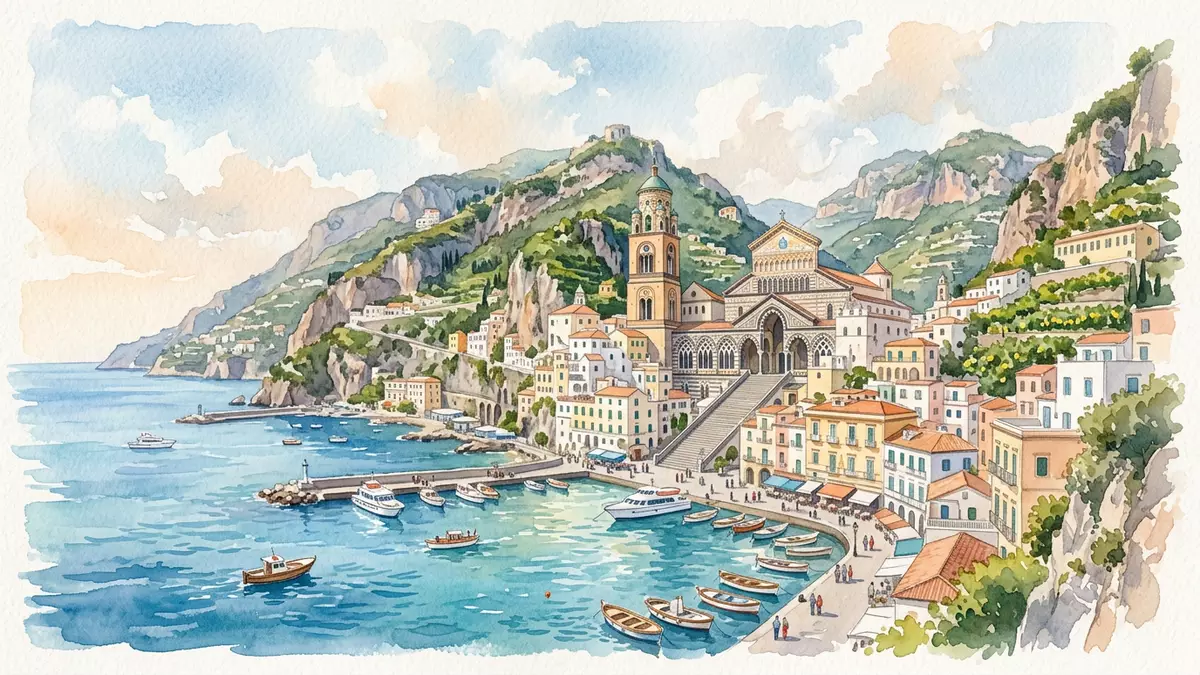
Duomo di Amalfi rises above the main square of Amalfi on a broad staircase, its striped façade and tall bell tower forming a landmark that ties the town to centuries of Mediterranean history. Dedicated to Saint Andrew the Apostle and rooted in a church founded in 987 during the era of the Maritime Republic of Amalfi, it combines Romanesque structure with Arab-Norman, Gothic, Renaissance and Baroque layers that remain legible in stone and mosaic.The Cathedral of Amalfi
A staircase leading into a layered façade
The first encounter with Duomo di Amalfi is the monumental flight of steps that climbs from the Piazza Duomo to the atrium, elevating the cathedral above the surrounding streets and framing the façade like a stage set.The unique and majestic duomo of Amalfi The staircase brings visitors to an open atrium in front of the main doors, where arcades run along the side and the view drops back towards the square and the houses clustered along the valley.
The façade seen from this atrium dates from the nineteenth century and follows a Norman-Arab-Byzantine pattern, with a gabled outline, polychrome bands and a central mosaic of Christ that catches the light above the portal.Amalfi Cathedral Behind it stands the older Romanesque mass of the church, the layers visible where Baroque stucco, Gothic details and earlier masonry meet in a single elevation. To one side rises the bell tower, begun in the twelfth century and finished in the thirteenth century under Archbishop Filippo Augustariccio, distinguishable by its interlaced arches and decorative tiled crown that echo patterns from across the Mediterranean.the bell tower, instead
Two basilicas, a crypt and a cloister
Within the monumental complex of Duomo di Amalfi lie more spaces than the main nave suggests, because the cathedral incorporates two communicating basilicas, a crypt, the Basilica of the Crucifix and the Cloister of Paradise into a single ensemble.St Andrew's Cathedral The older Basilica of the Crucifix dates to the ninth century, its columns and capitals reused from ancient Roman buildings brought to Amalfi by sea, and it stands as a parallel hall beside the later Romanesque church founded by the Amalfitan duke Mansone I in 987.founded by the duke Mansone I in 987
Below the main altar lies the crypt where relics of Saint Andrew are kept, brought from Constantinople to Amalfi in the early thirteenth century during the period of the Fourth Crusade.remains of St. Andrew To one side of the nave, an entrance leads to the Cloister of Paradise, built between 1266 and 1268 as a burial ground for the town’s nobility, with slender paired columns and interlaced arches in an Arab-Norman style that frames a small garden and a series of marble sarcophagi carved with mythological scenes.the Cloister of Paradise Walking through these interconnected spaces reveals how the cathedral complex grew from a cluster of basilicas into a single monument with multiple levels and functions.
Arab-Norman, Romanesque and Baroque under one roof
Duomo di Amalfi’s architectural character reflects the wider history of Campania, with its core Romanesque church overlaid by later styles that track political and liturgical change from the Middle Ages into the nineteenth century.Duomo di Amalfi The main structure belongs to the Romanesque tradition, with a longitudinal plan and arcades, but it was remodelled in the thirteenth century with Arab-Norman features that resonate with the broader pattern of church building in southern Italy in that period.Arab-Norman Romanesque architectural style
In the first decades of the thirteenth century the interior gained Baroque forms under Archbishop Michele Bologna, with stucco decoration and altars that reshaped the visual rhythm of the nave without erasing the Romanesque skeleton beneath.renovated in baroque style The façade rebuilt in the late nineteenth century adopts a historicising Norman-Arab-Byzantine design, with striped bands that recall churches in other parts of Italy and mosaics executed in a style that matches medieval models, binding the cathedral visually to the centuries in which Amalfi was a maritime power.Arab-Norman, Gothic, Renaissance, Baroque elements
Visiting Duomo di Amalfi: what travellers from Western Europe should know
- Duomo di Amalfi stands in the centre of Amalfi in southern Italy, on the Piazza Duomo, and is reached on foot by climbing the long staircase from the square.
- The cathedral complex sits on a slope above the town’s main streets, and access involves a sustained flight of steps up to the atrium and further internal staircases to the crypt and cloister.
- The official language is Italian and the currency is the euro.
Searching for Duomo di Amalfi on social platforms
These links open searches for Duomo di Amalfi on each platform.
Frequently asked questions about Duomo di Amalfi
Where is Duomo di Amalfi located?
Duomo di Amalfi stands above the Piazza Duomo in the town of Amalfi in southern Italy, within the Campania region on the Tyrrhenian coast.
What can visitors expect inside Duomo di Amalfi?
Visitors encounter a Romanesque church with Baroque interiors, a crypt housing relics of Saint Andrew, the ninth-century Basilica of the Crucifix and the Arab-Norman Cloister of Paradise.
What makes Duomo di Amalfi distinctive among Italian cathedrals?
Its combination of a steep external staircase, a nineteenth-century striped façade, a medieval bell tower and a complex of basilicas, crypt and cloister gives Duomo di Amalfi a layered character shaped by Amalfi’s maritime past.


