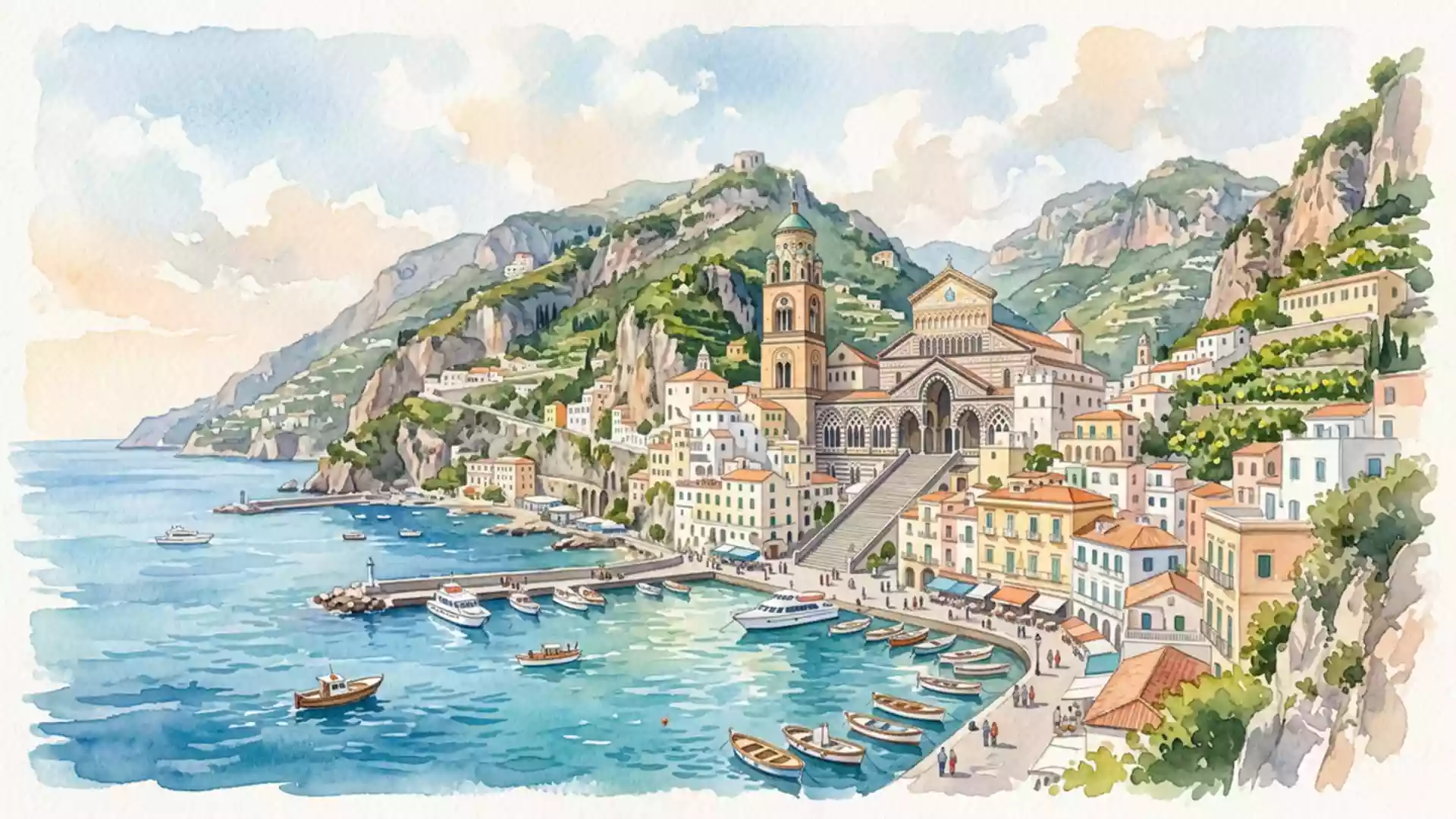
Duomo di Amalfi and its layered stone ascent
Published on 09/11/2026 at 18:56 | Editorial responsibility: Rafael Müller, Editor-in-Chief AD HOC NEWS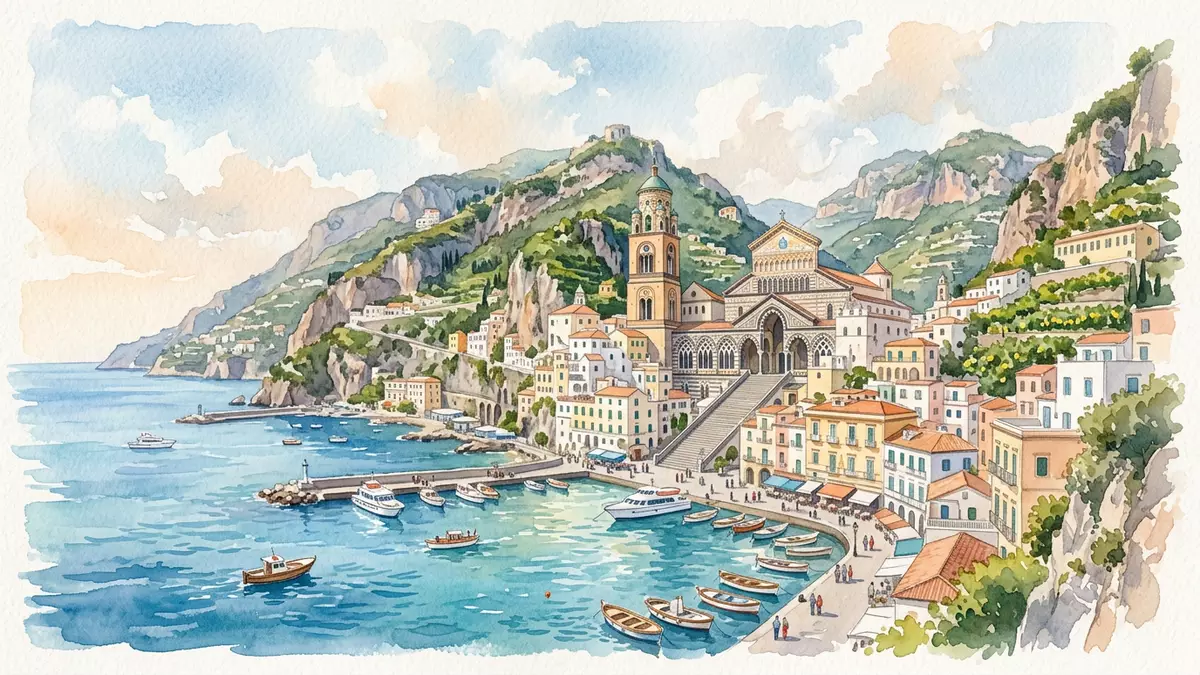
Duomo di Amalfi stands in Piazza del Duomo in Amalfi, where a stepped frontage, layered masonry and a tall campanile give the church its first strong outline. The cathedral is dedicated to Saint Andrew, and its long building history reaches back to the ninth and tenth centuries.
Stone, steps and a mixed medieval face
The front of Duomo di Amalfi combines Romanesque mass with later Gothic, Renaissance and Baroque additions, so the building reads as a sequence of periods rather than a single campaign. The present façade belongs to the nineteenth century and sits above a wide stair approach.
The cathedral’s bronze doors came from Constantinople before 1066, and the bell tower rises beside the main body of the church. Inside the complex, the basilica, cloister and crypt keep the building anchored to its medieval core.Bronze doors from Constantinople
The cathedral complex around Saint Andrew
Saint Andrew’s relics are kept in the crypt, and the church remains closely tied to the apostle through its dedication and liturgical identity. The cathedral also includes the Basilica of the Crucifix, a separate medieval element folded into the larger ensemble.
The name Duomo di Amalfi is linked to the archiepiscopal seat of Amalfi, and the church has long been central to the town’s religious topography. The adjoining structures make the complex feel expanded, layered and unusually rich in parts that belong to different centuries.Saint Andrew’s relics
Arab-Norman detail on the Amalfi hillside
Arab-Norman features appear in the cloister and in parts of the tower, where carved arches and patterned surfaces break up the stone surfaces. That blend sits naturally within Amalfi’s wider medieval setting, where seaborne contacts shaped the town’s art and building traditions.
The cathedral’s staircase, atrium and tower give the complex a vertical profile that is easy to read from the square below. It is a place of visible layers: one façade, one tower and several building phases, each leaving its own mark.Arab-Norman elements
Visiting Duomo di Amalfi: what travellers from Western Europe should know
- Duomo di Amalfi stands in the centre of Amalfi, on Piazza del Duomo. The main approach is by the town streets and the broad stairway in front of the church.
- The cathedral rises in levels, with steps, terraces and a tower beside the nave. The exterior presents a clear vertical climb from the square.
- The complex includes the basilica, the crypt and the cloister. These parts belong to a single religious ensemble, but each has a distinct architectural character.
- The church sits within the historic townscape of Amalfi, where narrow streets and steep changes in level define movement through the centre.
- The official language is Italian and the currency is the euro.
Searching for Duomo di Amalfi on social platforms
These links open searches for Duomo di Amalfi on each platform.
Frequently asked questions about Duomo di Amalfi
Where is Duomo di Amalfi?
It stands in Piazza del Duomo in Amalfi, on the Amalfi Coast in southern Italy. The church forms part of the historic town centre.
What does a visit involve?
The complex is reached by a staircase from the square, and the site includes the cathedral, crypt, cloister and basilica. The setting is compact, with several architectural layers close together.
What makes Duomo di Amalfi distinctive?
Its layered appearance sets it apart: Romanesque structure, Arab-Norman detail, later façades and a prominent tower all belong to the same ensemble. Saint Andrew’s relics also give the cathedral a strong religious identity.