
Dune du Pilat and the sweep of sand
Published on 08/31/2026 at 06:08 | Editorial responsibility: Rafael Müller, Editor-in-Chief AD HOC NEWS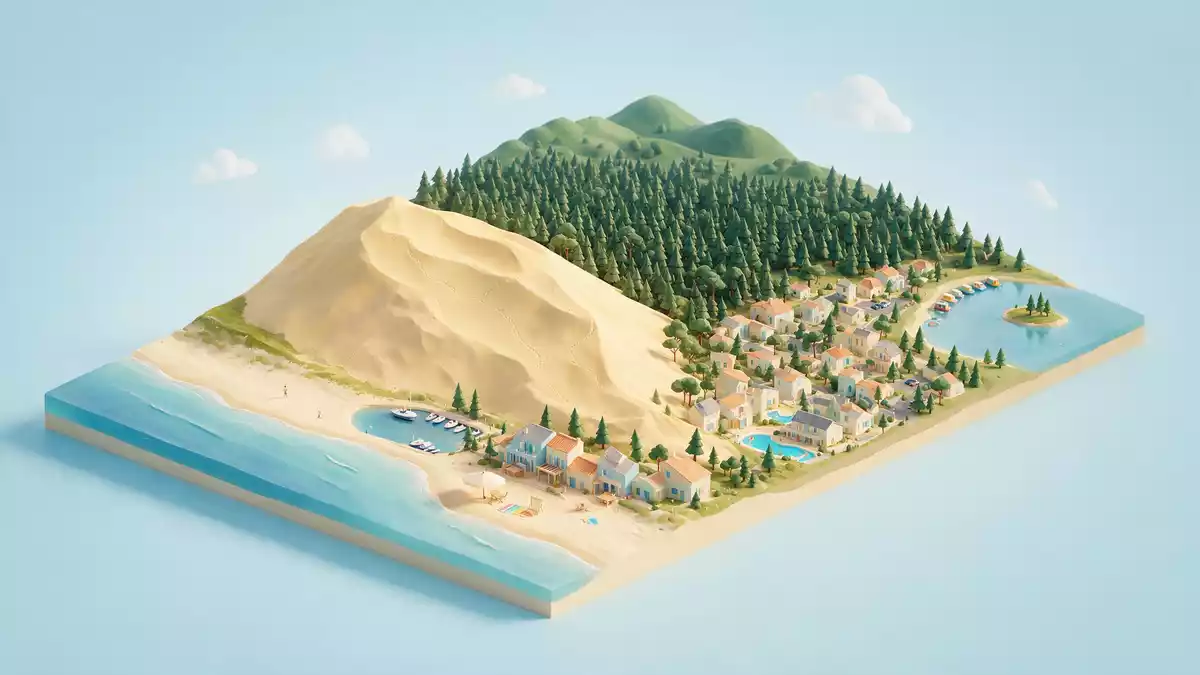
Dune du Pilat rises from the edge of the Bassin d’Arcachon in La Teste-de-Buch, where it meets the Landes forest and the Atlantic coast. Its long, high ridge makes the sand mass the clearest feature in the landscape.
The dune is the tallest sand dune in Europe and reaches about 100 to 115 m (328 to 377 ft) in height. It extends for 2.7 km (1.7 miles) and carries the weight of a long natural history.
A sand ridge between bay and forest
The dune stands at the mouth of the Arcachon Bay area, facing Cap Ferret and overlooking Banc d’Arguin. That position gives it an unusual relationship with water, sand and pine forest in a single view.
Its broad flank, steep face and long crest are easy to read from the site itself. The scale of the dune is visible without needing any explanation.
commune of La Teste-de-Buch and the local coast define its setting, while the dune’s height is a defining part of its identity. The site also forms part of a larger protected landscape on the Arcachon side.
Sand, strata and a long geological story
The western face exposes layers of sand and darker bands formed by buried soils and vegetation. These bands give the dune a striped appearance in section and make its internal structure visible.
The dune has been shaped over millennia by wind, sea and sediment movement. Its body keeps its form through constant accumulation and shifting sand, rather than remaining fixed in place.
Conservatoire du littoral records the site in La Teste-de-Buch and describes the dune as a mass of around 60 million cubic metres of sand. It also notes that the dune advances inland by several metres each year.
The protected area around the dune was formally classified in 1943, and later extended to include much of the surrounding forest. The result is a landscape where the dune sits within a wider managed natural site.
Landscape, protection and a public site
The Grand Site includes the dune and adjoining forest areas, with the Conservatoire du littoral as a major public owner. That framework helps explain why the dune is treated as a shared natural landscape rather than a private one.
The site is linked to the broader Basin of Arcachon coast, where the dune’s western face meets open sand and its eastern side slopes towards forest. Four visible paleosols on the western face add an older layer to the scene.
Grand Site Dune du Pilat describes the dune as a protected landscape of 6,875 hectares at the entrance to the basin. It also identifies the dune as a major natural feature of the Aquitaine coast.
Visiting Dune du Pilat: what travellers from Western Europe should know
- The dune is in La Teste-de-Buch, at the entrance to the Bassin d’Arcachon. It lies on the south-western French coast, between the ocean and the Landes forest.
- The ascent is on sand and can be demanding underfoot. The slope is steep on the seaward side, and the crest runs for a long stretch.
- The site combines open dune, pine forest and views over the bay. Banc d’Arguin and Cap Ferret are part of the immediate coastal scene.
- English is not an official language here. The official language is French and the currency is the euro.
Searching for Dune du Pilat on social platforms
These links open searches for Dune du Pilat on each platform.
Frequently asked questions about Dune du Pilat
Where is Dune du Pilat?
It stands in La Teste-de-Buch, on the south-west coast of France, beside the Bassin d’Arcachon. The dune sits between the ocean, the bay and the Landes forest.
What does a visit involve?
The main experience is the climb on sand and the view from the crest. The dune’s slope and height are the features that shape the visit.
What makes it distinctive?
Its size, its position at the bay entrance and its visible layers set it apart. The dune is also a protected landscape with a long geological profile.


