
Dujiangyan and the ring of water control
Published on 08/29/2026 at 09:58 | Editorial responsibility: Rafael Müller, Editor-in-Chief AD HOC NEWS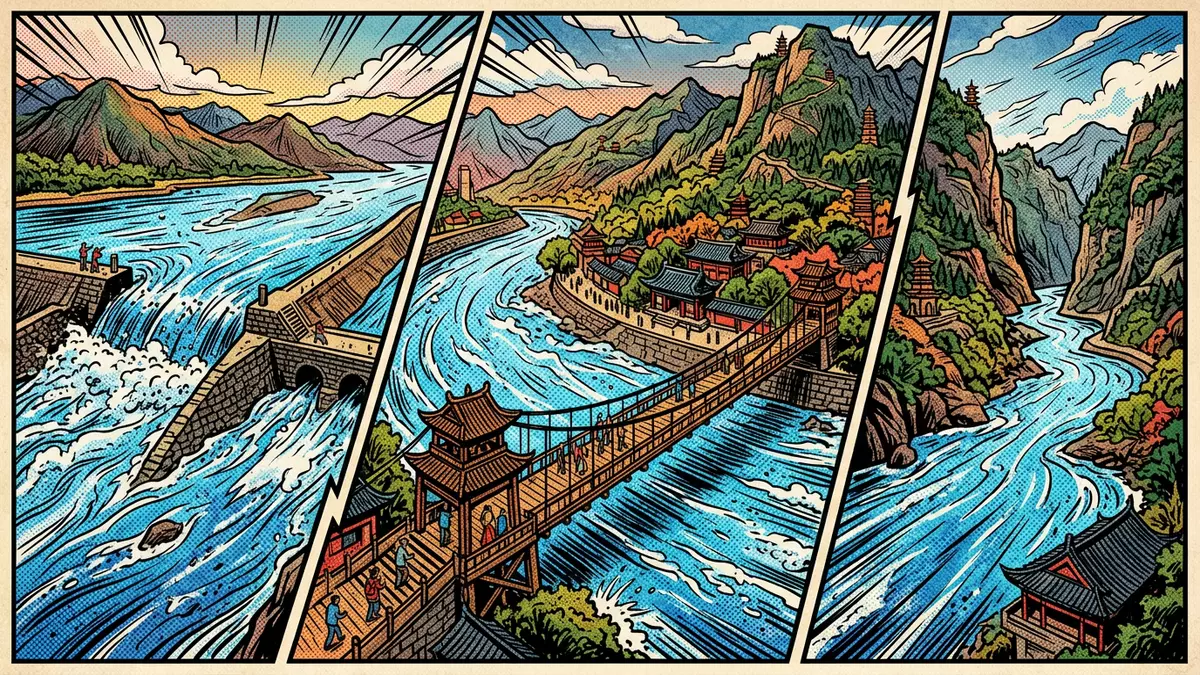
Dujiangyan in Chengdu is an ancient water-control landscape built around 256 BC, linked with Li Bing and the Qin state. Its channels, embankments and river works are spread across open ground rather than hidden inside a single enclosure.
Li Bing’s system on the Minjiang
The core site belongs to the third century BC and is associated with Li Bing, who served as governor of Shu under the Qin. The system was inscribed on the World Heritage List in 2000 as part of Mount Qingcheng and the Dujiangyan Irrigation System.World Heritage List
The structure is not a monumental dam in the usual sense. It works through diversion works, embankments and channels on the Minjiang River, and that layout remains the place’s defining feature.diversion works The site is part engineering landscape, part river plain, with water guided across a broad working area.
From irrigation works to heritage landscape
Dujiangyan is one of the best-known surviving water-management projects from ancient China. The system is closely tied to the Chengdu plain, where water control and agriculture have been linked for centuries.ancient China
The visible appeal lies in the mixture of river, channels and masonry rather than in height or ornament. The place combines an engineering function with a landscape setting, and the result is readable at a glance: water is carried, split and managed in the open.water is carried
Mount Qingcheng and the wider setting
The Dujiangyan system forms one half of the UNESCO property with Mount Qingcheng, a name that also belongs to the history of Daoism in Sichuan. That wider setting places the irrigation works within a cultural landscape rather than as an isolated monument.Mount Qingcheng
The site lies west of the Chengdu plains at the edge of the Sichuan Basin. It is a river landscape of stone, water and low relief, with the Minjiang as its central element.
Visiting Dujiangyan: what travellers from Western Europe should know
- The site lies west of Chengdu on the Minjiang River. It is reached by road from the city and is linked with Mount Qingcheng in the same World Heritage property.
- The terrain is open rather than mountainous, with river channels, embankments and low stone works spread across the plain.
- Chinese is the official language and the currency is the renminbi.
- Entry requirements depend on your nationality; UK travellers can check the FCDO travel advice at gov.uk/foreign-travel-advice, Irish travellers the Department of Foreign Affairs at ireland.ie.
Searching for Dujiangyan on social platforms
These links open searches for Dujiangyan on each platform.
Frequently asked questions about Dujiangyan
Where is Dujiangyan?
Dujiangyan lies in Chengdu, in Sichuan, on the Minjiang River. It forms part of a World Heritage property with Mount Qingcheng.
What does a visit involve?
The place is an open river landscape rather than a single hall or museum room. Visitors encounter channels, embankments and stone structures spread across the site.
What makes Dujiangyan distinctive?
Its defining feature is the ancient water system associated with Li Bing and the Qin period. The layout of river control works has made it a landmark of Chinese engineering and a UNESCO-listed cultural landscape.


