Dujiangyan and the Minjiang: an ancient river reshaped
Published on 09/11/2026 at 22:58 | Editorial responsibility: Rafael Müller, Editor-in-Chief AD HOC NEWS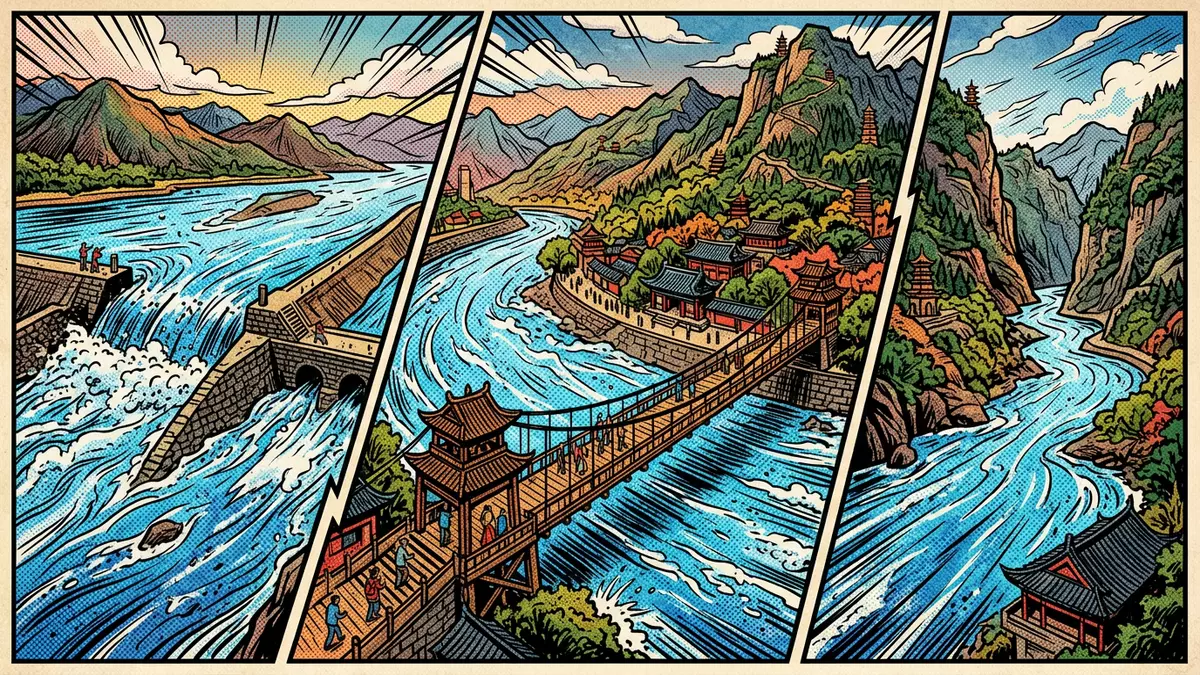
On the western edge of the Chengdu Plain in southwest China, Dujiangyan transforms the Minjiang River from a mountain torrent into a carefully managed web of channels feeding farmland. This ancient irrigation system near Chengdu was first constructed in the third century BC and still distributes water across the plain. Built under the Qin dynasty official Li Bing, it has become both a working hydraulic project and a cultural landscape recognised on the UNESCO World Heritage List.
Dujiangyan: a river engineered without a dam
Dujiangyan is an extensive hydraulic system set on the Minjiang River at the point where the Sichuan basin meets the rising ground of the Qinghai–Tibet Plateau. Instead of blocking the river, the system uses diversion and carefully shaped riverbanks to guide part of the flow into irrigation channels while letting the rest continue downstream. The core layout divides the river into an inner and outer channel, turning a single current into two paths that serve different purposes for agriculture and flood control.Dujiangyan irrigation system Construction began in the third century BC during the Warring States period, when the Qin state sought to stabilise water supply for the fertile Chengdu region.constructed during the Warring States period
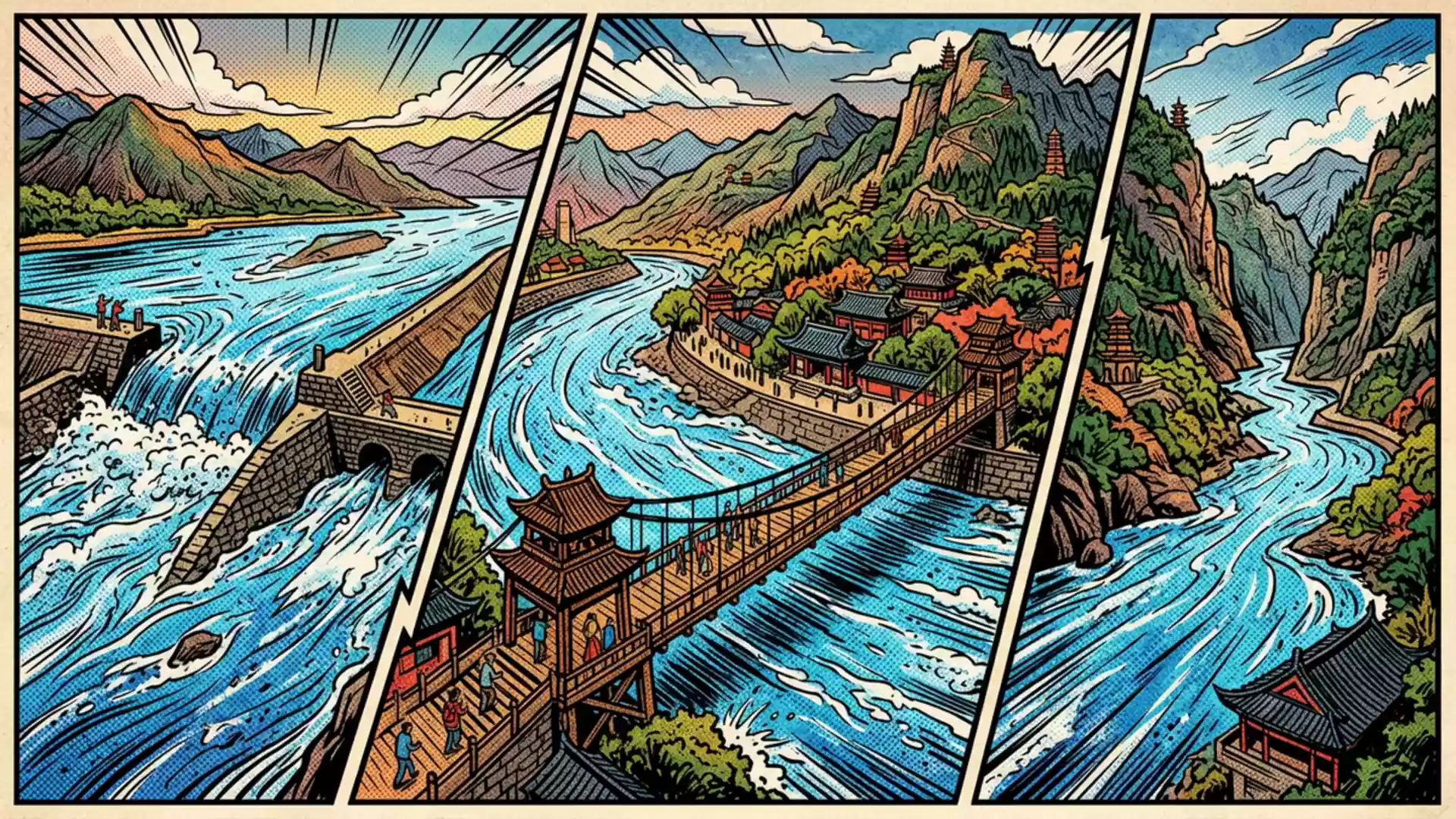
At the heart of Dujiangyan are three interrelated works on the river itself: the Yuzui diversion dike, the Feisha weir spillway and the Baopingkou inlet. The Yuzui, also known as the “Fish Mouth” levee, stands in the river and splits the flow towards the inner and outer channels. The Feisha weir forms a spillway that helps to discharge floodwaters and sediment out of the system. The Baopingkou opening cuts through the riverbank and leads water into the main irrigation channel that fans across the Chengdu Plain.Yuzui diversion dike, Feisha weir spillway, Baopingkou inlet Together they show how the builders used the river’s gradient and curves to control water without a tall barrier.
An ancient project that still shapes the Chengdu Plain
The Dujiangyan system was first built around 256 BC under the direction of Li Bing, who served as governor of Shu County on behalf of the Qin state.first built around 256 BC by Li Bing He and subsequent engineers extended channels from the Baopingkou opening into a network that carries river water across the Chengdu Plain. Over dynasties including the Tang, Song, Yuan and Ming, the system was enlarged and adjusted, but the basic principle of river diversion remained. Minjiang water continues to irrigate farmland over a wide area, contributing to the long-standing description of the plain as a “Land of Heaven” for agriculture.world’s oldest dam-free water diversion project
Dujiangyan has gained formal recognition as heritage as well as infrastructure. Mount Qingcheng and Dujiangyan together were inscribed on the UNESCO World Heritage List in 2000, under cultural criteria that highlight the development of water management and technology in ancient China.inscribed on the World Heritage List in 2000 International water organisations have also listed the irrigation system as a heritage structure, reflecting its continuing function and the way it uses natural topography for river control.World Water Systems Program List For travellers, this means that Dujiangyan serves both as a working landscape and as an example of early hydraulic engineering preserved on a large scale.
Walking through a working waterscape
A visit to Dujiangyan reveals a broad stretch of the Minjiang River framed by embankments, channels and small structures related to the waterworks. Paths and bridges give access to viewpoints over the Yuzui diversion dike and the split between inner and outer channels, where the river’s surface shows the division created by the engineering. Downstream, the Feisha weir can be seen guiding overflowing water away from the main intake, while the Baopingkou opening appears as a cut in the riverbank directing part of the flow towards irrigation channels. Temples, pavilions and markers within the scenic area refer to Li Bing and later figures associated with the system’s upkeep.ancient hydraulic engineering system in Dujiangyan City
The wider setting combines river, terraces and the foothills leading towards Mount Qingcheng. Forested slopes rise above the Minjiang, and the difference between flat farmland and higher ground is visible from many viewing points. Sections of the irrigation works extend beyond the immediate riverbank, including embankments such as the Baizhang Dike and auxiliary watercourses that link back towards settlements and fields.ancillary embankments and watercourses Dujiangyan therefore presents itself not as a single monument but as an interconnected waterscape stretching between mountain edge and cultivated land.
Visiting Dujiangyan: what travellers from Western Europe should know
- Dujiangyan lies in Sichuan Province in southwest China, north-west of Chengdu. It is reached by rail and road links from Chengdu, including services towards Dujiangyan City.
- The main scenic area sits along the Minjiang River and involves considerable walking on paths, stepped approaches and bridges over water channels.
- Mount Qingcheng rises near the irrigation system, and the combined landscape of river, foothills and forested slopes is visible from terraces and viewpoints around Dujiangyan.
- The official language is Chinese and the currency is the renminbi.
- Entry requirements depend on your nationality; UK travellers can check the FCDO travel advice at gov.uk/foreign-travel-advice, Irish travellers the Department of Foreign Affairs at ireland.ie.
Searching for Dujiangyan on social platforms
These links open searches for Dujiangyan on each platform.
Frequently asked questions about Dujiangyan
Where is Dujiangyan located?
Dujiangyan stands on the Minjiang River near Dujiangyan City in Sichuan Province, on the western side of the Chengdu Plain in southwest China.
What can visitors expect when exploring Dujiangyan?
Visitors encounter a broad riverside landscape of diversion dikes, spillways, channels and temples, with paths and bridges offering views of the working irrigation system.
What makes Dujiangyan distinctive among hydraulic projects?
Dujiangyan is an ancient large-scale irrigation system begun in the third century BC that controls the Minjiang River through diversion rather than a dam, and it still functions for farmland.