
Dujiangyan and the Min River: an ancient waterwork shaping Chengdu
Published on 08/18/2026 at 14:01 | Editorial responsibility: Rafael Müller, Editor-in-Chief AD HOC NEWS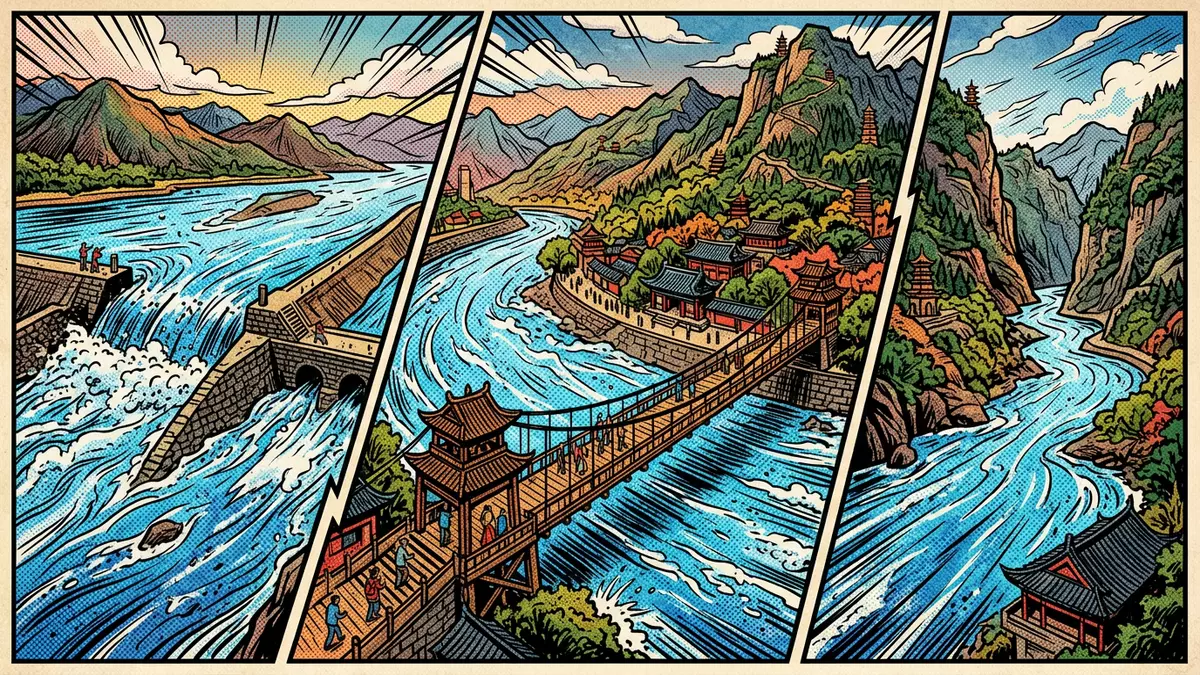
On the western edge of the Chengdu Plain in China, Dujiangyan is an ancient irrigation system that turns the Min River into a carefully managed network of channels and weirs. Built under the Qin dynasty in the third century BC, it still directs river water across farmland around Chengdu and has become a large riverside landscape of stone works, temples and walkways.
An open river instead of a dammed reservoir
Dujiangyan lies on the middle reaches of the Min River, a tributary of the Yangtze, where the river leaves the mountains and enters the flatlands of Sichuan. The project was constructed during the Warring States period under Li Bing, governor of Shu in the State of Qin, together with his son, using the natural course of the river rather than stopping it with a solid barrier.constructed during the Warring States period The waterworks sits close to Dujiangyan City, north-west of Chengdu, where the rising land approaches Mount Qingcheng and the foothills of the Qinghai–Tibet plateau.western portion of the Chengdu flatlands
At its core, Dujiangyan reshapes the Min River into several linked structures that divide and redirect the current. Rather than a single wall, the headworks form a spread of embankments, diversion dikes and spillways built in stone and earth, set within the riverbed and along its banks. Walking along the river, visitors see the main channels split around low islets, cut past sloping embankments and enter narrow inlets that lead towards the irrigated plain.
The three classic structures of Dujiangyan
The historical descriptions of the system name three principal elements at the river head: the Fish Mouth diversion dike, the Feisha Weir spillway and the Baopingkou inlet. Together they divert part of the Min River towards irrigation, let excess flow bypass the inlet, and send water into the inner river without enclosing it behind a dam.Fish Mouth and Flying Sand Weir The arrangement uses differences in river level and gradient to separate clear water from sediment and to balance the volume sent into the Chengdu Plain.
Beyond the headworks, additional embankments and waterways extend the scheme downstream. Historical accounts describe features such as the Baizhang Dike, the Erwang Temple Watercourse and a V-shaped dike that stabilise banks and guide water into secondary channels.ancillary embankments and watercourses In the present landscape these works appear as long, low ridges of masonry and earth, set parallel to the flow or projecting into it, with paths, small shrines and viewing platforms built along them.
An irrigation landscape with temples and terraces
Since its construction in the third century BC, Dujiangyan has supplied irrigation water to the fertile farmland of the Chengdu Plain and controlled floods on the Min River.controls the waters of the Minjiang River Fields downstream receive water through a lattice of channels that descend from the main inlet and divide towards villages and rice paddies. The irrigated area forms a broad zone of cultivation that helped to underpin Sichuan’s reputation as an agricultural province.
Over time, buildings have grown up around the old headworks and along the banks. Erwang Temple stands near the river, honouring Li Bing and his son, and its halls and courtyards look out across the stone structures and flowing water.ancient hydraulic engineering system Below and around the temple, terraces, bridges and paved paths connect viewing points and small shrines, turning the river engineering into a large public landscape. On a visit, the combination of temple architecture, river channels and tree-lined embankments makes Dujiangyan feel both like an outdoor museum of hydraulic engineering and a broad park area shaped by water.
Visiting Dujiangyan: what travellers from Western Europe should know
- Dujiangyan lies north-west of Chengdu in Sichuan Province, on the Min River where the river meets the Chengdu Plain. It is reached by road and rail links from Chengdu.
- The central structures stand beside and within the river, with paths, bridges and stairways linking terraces and temple precincts; some sections involve climbing steps on uneven stone.
- Mount Qingcheng rises nearby to the south-west, and its forested slopes and temple complexes form a second historic area linked to the same UNESCO World Heritage inscription as the irrigation system.
- The official language is Chinese and the currency is the yuan (renminbi).
Searching for Dujiangyan on social platforms
These links open searches for Dujiangyan on each platform.
Frequently asked questions about Dujiangyan
Where is Dujiangyan and what kind of place is it?
Dujiangyan is an ancient irrigation and flood-control system on the Min River near Dujiangyan City in Sichuan Province, north-west of Chengdu.
What can visitors expect on a visit to Dujiangyan?
Visitors walk along river embankments, bridges and terraces, see the historic diversion structures and explore temple buildings such as Erwang Temple overlooking the waterworks.
What makes Dujiangyan distinctive among irrigation works?
Dujiangyan dates back to the third century BC, uses a layout of diversion dikes and inlets instead of a dam, and continues to direct water across the Chengdu Plain.


