
Dujiangyan and the engineering landscape of Chengdu
Published on 09/12/2026 at 21:02 | Editorial responsibility: Rafael Müller, Editor-in-Chief AD HOC NEWS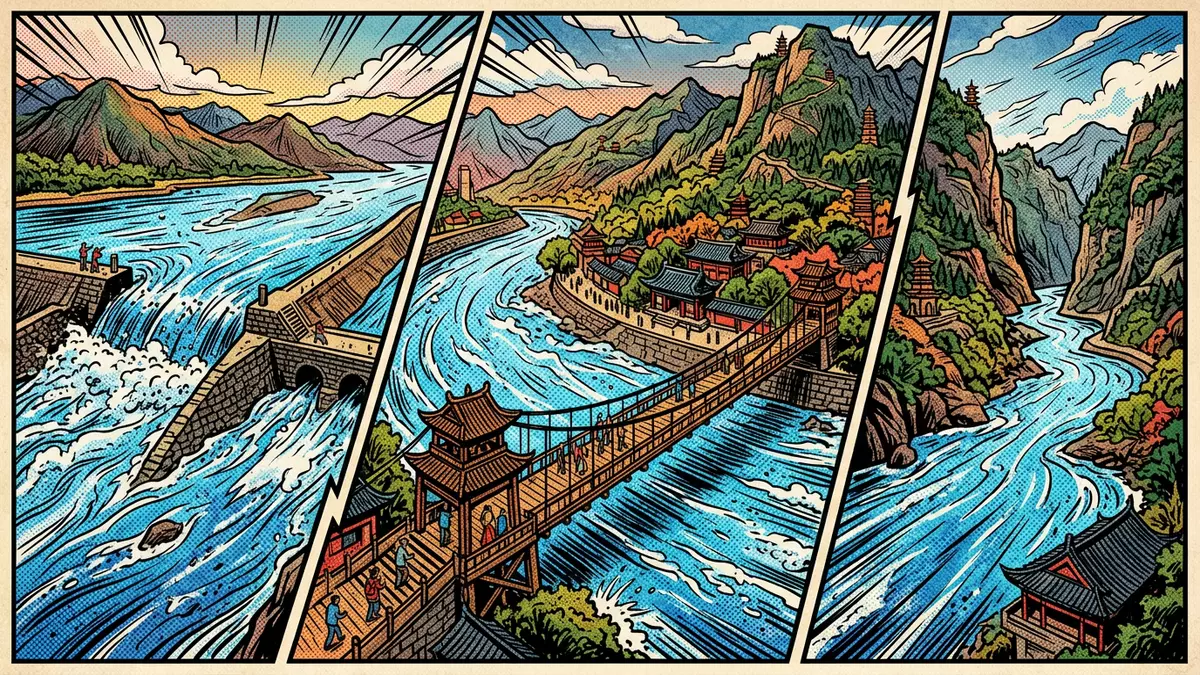
Dujiangyan is an ancient water system in the Chengdu plain, and its most striking feature is the way canals, levees and river channels sit in the landscape together. Li Bing’s name is tied to its early history, and the system is linked with 256 BC and a long engineering tradition.
Water, channels and the Chengdu plain
The site lies in Sichuan, west of Chengdu, where the Min River meets a broad agricultural plain. Its World Heritage inscription in 2000 and its association with Mount Qingcheng place it among China’s best-known cultural landscapes.World Heritage inscription
The system is famous for the Fish Mouth levee, the Feishayan spillway and the Baopingkou channel. These named parts form a working ensemble rather than a single monument, and the whole remains rooted in the river’s movement and the plain beyond.three main components
Li Bing and the Qin period
The historical core belongs to the Warring States period, when the state of Qin held sway in western China. Li Bing is the figure most closely associated with the project, and the system is traditionally dated to the third century BC.Li Bing
The date matters because it places the place in the world of pre-imperial China, before the Qin dynasty unified the realm. The result is not a ruin in the ordinary sense, but an older hydraulic landscape that kept its identity through later dynastic periods.third century BC
Dujiangyan as a living water landscape
The most memorable impression is the scale of the system itself. River, embankment and channel remain legible as separate elements, yet they belong to one continuous working arrangement across the plain.working arrangement
Mount Qingcheng adds a religious and scenic companion landscape to the hydraulic works. Together they explain why the area is read not as a single attraction, but as a cultural terrain shaped by water, hills and long historical memory.Mount Qingcheng
Visiting Dujiangyan: what travellers from Western Europe should know
- The site is in Dujiangyan City, west of Chengdu, in Sichuan. Rail links and roads connect it with the provincial capital and the wider Chengdu plain.
- The terrain combines river, engineered channels and temple landscape. Paths, steps and embankments make the site a place for walking rather than a flat urban promenade.
- English is not an official language. The official language is Chinese and the currency is the Chinese yuan.
- The site sits within a wider heritage landscape that also includes Mount Qingcheng. That pairing is part of its identity and helps explain why the place is visited for both engineering and scenery.
Searching for Dujiangyan on social platforms
These links open searches for Dujiangyan on each platform.
Frequently asked questions about Dujiangyan
Where is Dujiangyan?
It lies in Sichuan, west of Chengdu, on the edge of the Chengdu plain. The setting links river engineering with a broader mountain-and-plain landscape.
What does a visit involve?
The site combines channels, embankments, river views and associated heritage scenery. Walking through it brings the hydraulic system and the surrounding landscape into the same frame.
What makes Dujiangyan distinctive?
Its identity rests on an ancient hydraulic system associated with Li Bing and the Qin period. The World Heritage status and the named waterworks give it a clear historical profile.


