
Dujiangyan and the engineered waterway of Chengdu
Published on 09/14/2026 at 15:59 | Editorial responsibility: Rafael Müller, Editor-in-Chief AD HOC NEWS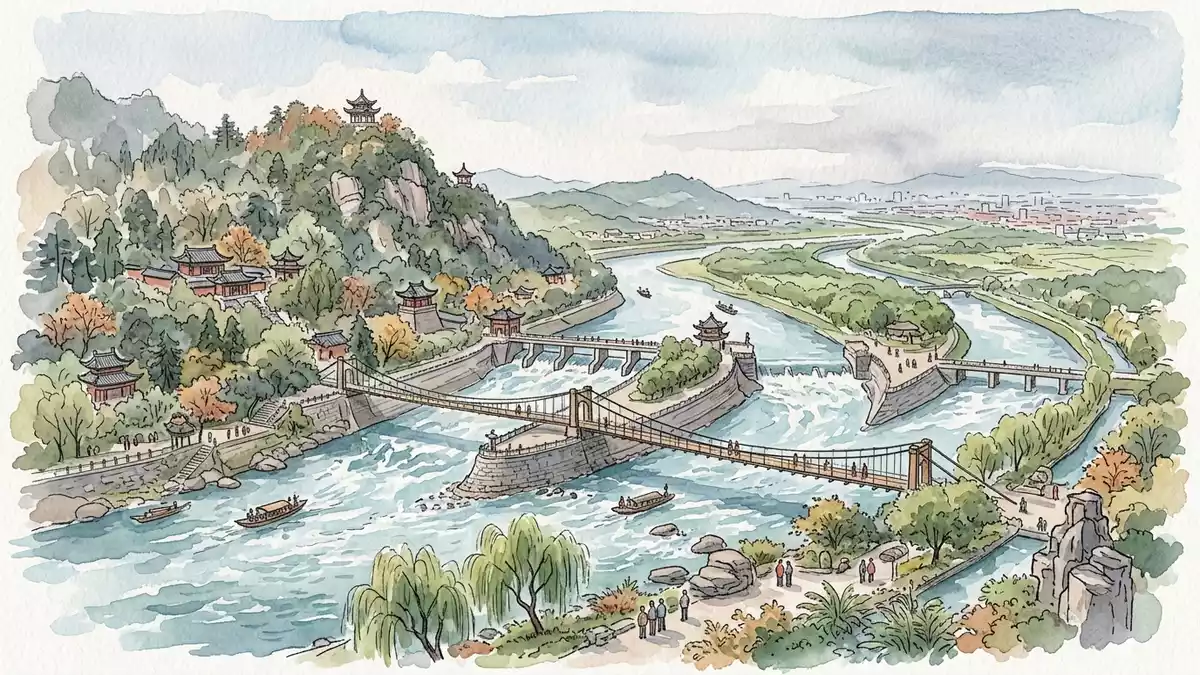
Dujiangyan is the best-known water landscape on the Chengdu plain, where stone, river, and mountain engineering meet in a single protected site. Built around 256 BC under Li Bing during the Qin Dynasty, it remains tied to the Minjiang River and the wider Chengdu basin.
Dujiangyan’s river works and mountain setting
The core of Dujiangyan is not a dam wall but a sequence of channels, weirs, and control structures. The system was inscribed on the World Heritage List in 2000 and belongs with Mount Qingcheng as a single heritage property.
Its setting matters as much as its layout. The UNESCO description places the works in the western Chengdu flatlands at the junction of the Sichuan basin and the Qinghai-Tibet plateau, with the weir works at 726 m (2,382 ft) above sea level.
Li Bing, Qin rule, and a long working system
The name most closely linked with the place is Li Bing, the magistrate of Shu County under the Qin state. The engineering began in the third century BC and was modified through the Tang, Song, Yuan, and Ming dynasties.
The components named in official descriptions include Yuzui, Feishayan, and Baopingkou. The system still controls the waters of the Minjiang River and distributes them across the Chengdu plains.
Mount Qingcheng and the Taoist landscape
Dujiangyan also belongs to a broader cultural landscape shaped by Mount Qingcheng. The mountain is associated with the foundation of Taoism by Zhang Ling in 142 CE, and its temples form part of the same World Heritage property.
The combination of hydraulic works and sacred mountain gives the place its character. One side presents river management in stone and earth, the other a mountain of temples and wooded slopes, both framed by the Chengdu plain.
Visiting Dujiangyan: what travellers from Western Europe should know
- The site lies west of Chengdu in Sichuan, on the Minjiang River. It forms part of the wider Mount Qingcheng and Dujiangyan World Heritage property.
- The landscape includes river channels, embankments, and a mountain setting. The heritage area also reaches the south side of the Chengdu plains.
- Dujiangyan is a water-engineering site rather than a single monument. Its major named parts are Yuzui, Feishayan, and Baopingkou.
- The nearby Mount Qingcheng carries Taoist temples. Zhang Ling is linked with the mountain in 142 CE.
Searching for Dujiangyan on social platforms
These links open searches for Dujiangyan on each platform.
Frequently asked questions about Dujiangyan
Where is Dujiangyan?
Dujiangyan lies in Sichuan, west of Chengdu, beside the Minjiang River. It belongs to the Mount Qingcheng and Dujiangyan World Heritage property.
What appears on a visit?
The place combines river works, embankments, and mountain scenery. The named hydraulic elements, the river setting, and nearby Taoist temples define the experience.
What makes Dujiangyan distinctive?
The site unites Qin-era hydraulic engineering with a Taoist mountain landscape. Li Bing, the Minjiang River, and Mount Qingcheng all belong to its identity.


