
Dujiangyan and the art of dam?free water in Sichuan
Published on 08/31/2026 at 09:24 | Editorial responsibility: Rafael Müller, Editor-in-Chief AD HOC NEWS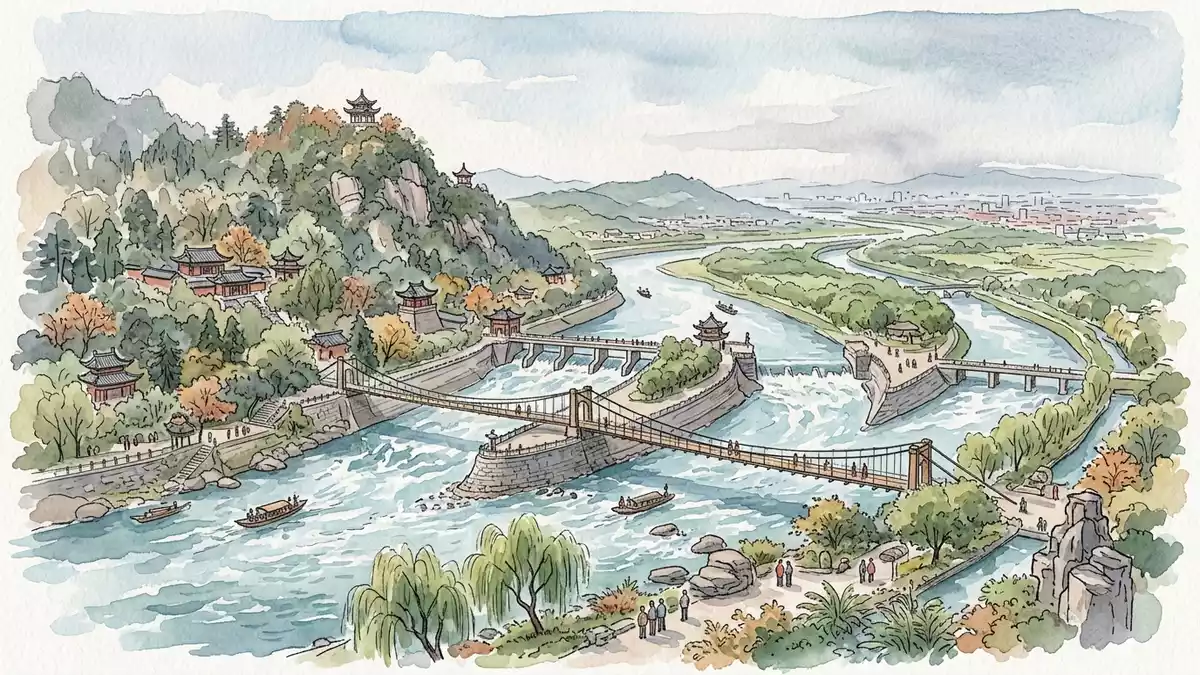
On the western edge of the Chengdu Plain in China, Dujiangyan turns a mountain river into a carefully managed waterscape that still feeds surrounding farmland. Conceived in the third century BC under the Qin dynasty and attributed to the engineer Li Bing, this ancient irrigation system redirects the Min River with channels, levees and weirs rather than a single enclosing dam. As part of Mount Qingcheng and the Dujiangyan Irrigation System, it has been recognised as a UNESCO World Heritage site since 2000, reflecting both its age and the scale of its hydraulic engineering.
Shaping the Min River without a dam
Dujiangyan sits on the Min River, a tributary of the Yangtze, where the river leaves the highlands and enters the Sichuan basin. Here the water meets a landscape of low hills and the opening plain, and the system uses that transition to split and guide the flow. Instead of a tall barrier across the river, Dujiangyan relies on a group of works traditionally dated to around 256 BC that control direction and volume at several points along the channel. The result is a layout that distributes water to the Chengdu Plain while letting flood surges pass without backing up behind a dam.The Dujiangyan irrigation system forms part of a wider cultural landscape with Mount Qingcheng, combining hydraulic engineering with temples, paths and forested slopes in one corridor.
The core of the system lies near Dujiangyan City at an altitude identified as the upper edge of the plain, where builders diverted the Min River into inner and outer channels. Historic descriptions divide the works into the Weir Works, close to the city, and the irrigated area stretching across the fields of the Chengdu Plain.Construction of Dujiangyan began in the third century BC and the structures have been modified during later dynasties, but the principle of dam?free diversion remains visible in the arrangement of riverbanks, stonework and channels that visitors see today.
Channels, levees and the Baopingkou inlet
Walking through the scenic area at Dujiangyan reveals how individual features combine into a single hydraulic system. A diversion dike known as Yuzui splits the Min River into two streams, directing part of the water towards the inner channel that feeds the Chengdu Plain and leaving the rest to run along an outer course.Descriptions of Dujiangyan list Yuzui, Feisha Weir and Baopingkou among the principal structures. Downstream, Feisha Weir acts as a spillway that lets excess water escape and carries sediment away from the intake. Together these works steer clear water into the inlet at Baopingkou, where a cut through the hillside brings the flow into the irrigation network that leads out across the plain.
The Baopingkou inlet, sometimes described as a bottle?neck channel, shows how the builders used the rock of Yulei Mountain itself as part of the structure. By cutting into the hillside they created a contour channel that feeds lower ground without towering masonry. Later dynasties such as the Tang and Song expanded and reinforced the system, adding embankments and secondary watercourses, but the original concept of splitting and throttling the Min River with modest?height works is still legible in the landscape.Modern accounts from the Ministry of Water Resources emphasise how features such as the Fish Mouth and Flying Sand Weir divide, drain and control the river using the slope and current rather than a wall across the channel.
Living heritage on the Chengdu Plain
Dujiangyan is more than an archaeological site; it is a working irrigation system intertwined with temples, bridges and small urban districts. The irrigated area linked to the Min River spreads across tens of thousands of hectares, supporting agriculture on the Chengdu Plain.Periodic reporting by UNESCO notes the size of the protected property and buffer zone, showing the breadth of land shaped by the system. Recognition has come not only from UNESCO but also from organisations concerned with irrigation heritage, which place Dujiangyan among historic water?management works still in operation.
Cultural elements sit alongside this hydraulic infrastructure. Erwang Temple, associated with Li Bing and his son, overlooks part of the works, and the town around the weirs includes causeways and walkways connecting viewpoints along the river. Because the system was constructed in the Warring States period and adapted in later dynasties, it offers a physical record of changing techniques in Chinese water engineering over more than two millennia.Accounts of the Dujiangyan Irrigation System underline its status as an early water?conservation project that diverts a major river without a dam and remains in use.
Visiting Dujiangyan: what travellers from Western Europe should know
- Dujiangyan lies north?west of Chengdu in Sichuan Province, at the point where the Min River leaves the hills and enters the Chengdu Plain. Rail and road links connect Chengdu with Dujiangyan City and the scenic area along the river.
- The terrain around the Weir Works combines riverside paths, steps and terraced slopes, with some routes climbing towards temple precincts and viewpoints above the channels.
- Mount Qingcheng rises nearby as part of the same World Heritage property, and the wider corridor includes forested hills, temple complexes and panda habitat areas recognised in separate listings.
- The official language is Chinese and the currency is the yuan.
- Entry requirements depend on your nationality; UK travellers can check the FCDO travel advice at gov.uk/foreign-travel-advice, Irish travellers the Department of Foreign Affairs at ireland.ie.
Searching for Dujiangyan on social platforms
These links open searches for Dujiangyan on each platform.Frequently asked questions about Dujiangyan
Where is Dujiangyan and what kind of place is it?
Dujiangyan is an ancient irrigation system on the Min River near Dujiangyan City in Sichuan Province, west of the Chengdu Plain. It combines hydraulic works, temples and riverside landscapes.
What can visitors expect when exploring Dujiangyan?
Visitors encounter channels, diversion dikes, spillways and the Baopingkou inlet, with paths and stairways leading to viewpoints, temple precincts and bridges along the Min River.
What makes Dujiangyan distinctive among historic sites?
Dujiangyan dates back to the third century BC and diverts a major river without a high dam, forming part of a UNESCO World Heritage property that remains integrated with working irrigation and surrounding farmland.


