
Dujiangyan and the ancient waters that shaped Chengdu
Published on 08/28/2026 at 07:43 | Editorial responsibility: Rafael Müller, Editor-in-Chief AD HOC NEWS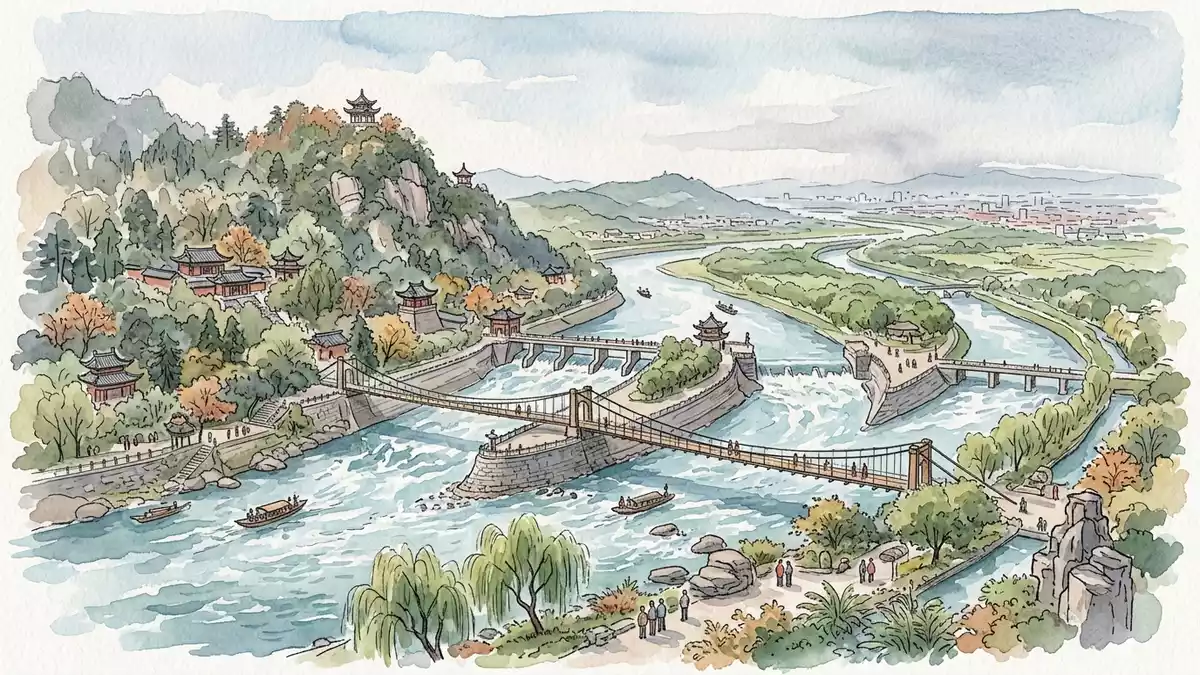
West of Chengdu in Sichuan, Dujiangyan is an ancient irrigation system that tames the Minjiang River without a dam and still feeds the fertile Chengdu Plain. Built under the Qin dynasty governor Li Bing in the third century BC, it has become both a World Heritage landmark and a living piece of hydraulic engineering history.
An ancient river system in the foothills of Sichuan
Dujiangyan lies where the Chengdu flatlands meet the rising ground of the Sichuan basin’s western edge, on the Minjiang River near Dujiangyan City in Sichuan Province. Here the river leaves the mountains and enters the plains, and the waterworks harness this transition with channels, embankments and stone structures that guide the flow towards farmland.the Dujiangyan irrigation system The site forms part of the World Heritage property “Mount Qingcheng and the Dujiangyan Irrigation System”, which links the river engineering works with the wooded slopes of nearby Mount Qingcheng.
Construction of the Dujiangyan system began in the third century BC during the Warring States period, under Li Bing, governor of Shu in the state of Qin, working with his son.the Dujiangyan Irrigation System Rather than blocking the Minjiang River, the design uses its natural gradient and course to divide, slow and redirect water onto the Chengdu Plain. Over the centuries, the works were modified and extended in dynasties including the Tang and Song, while their basic layout remained recognisable.
Engineering without a dam: Yuzui, Feishayan and Baopingkou
The core of Dujiangyan centres on three interlocking elements in the river channel and on its banks. At the upstream end stands Yuzui, sometimes translated as “Fish Mouth”, a diversion dike that splits the river into two branches, sending water towards both the inner irrigation channel and the outer course.Dujiangyan is composed of the Fish Mouth and Diamond Dike Downstream, Feishayan, the “Flying Sand Weir”, acts as a spillway that helps control sediment and surplus water, discharging part of the flow back into the main river.
Baopingkou, a carved opening in the hillside, forms the intake where water passes into the inner channel towards the Chengdu Plain.This project mainly consists of three parts: Yuzui diversion dike, Feisha weir spillway, Baopingkou inlet Together, Yuzui, Feishayan and Baopingkou create a system that diverts water, controls floods and manages silt without a single blocking dam across the Minjiang River. Additional embankments and auxiliary channels, such as the Baizhang Dike and Erwang Temple Watercourse, continue the work of distributing water to farmland further downstream, forming a network that has remained in operation for more than two millennia.Dujiangyan is a renowned ancient flood control and irrigation system
Living heritage: from Qin engineers to World Heritage status
Dujiangyan is widely recognised as a landmark in the history of water management and technology, combining practical flood control with large-scale irrigation. The system continues to regulate the Minjiang River and feed farmland across the Chengdu Plain, supporting agriculture in dozens of counties.Dujiangyan irrigation system in Chengdu, Sichuan province Its longevity and continued use have given rise to the description of the Chengdu region as a “Land of Heaven”, rooted in reliable water and fertile soil.
In 2000, Mount Qingcheng and the Dujiangyan Irrigation System were inscribed on the UNESCO World Heritage List as a cultural property, recognising both the hydraulic works and their landscape setting.Construction of the Dujiangyan irrigation system began in the 3rd century B.C. Later, Dujiangyan gained further recognition as a World Heritage Irrigation Structure from the International Commission on Irrigation and Drainage, reflecting its status as one of the oldest operating large water conservancy projects that uses diversion rather than damming.the Dujiangyan irrigation system, characterized by dam-free water diversion Alongside the waterworks, temples and viewpoints such as Erwang Temple offer places to reflect on the figures behind the project and to overlook the channels and river bends below.
Visiting Dujiangyan: what travellers from Western Europe should know
- Dujiangyan lies north-west of Chengdu on the Minjiang River, near Dujiangyan City in Sichuan Province, and is reached by road and rail connections from Chengdu.
- The core works sit in varied terrain along a river channel and adjacent slopes, with paths, steps and bridges linking viewpoints over the diversion dikes and intake structures.
- Mount Qingcheng rises nearby, and the combined landscape of wooded hills and engineered riverbanks forms the wider scenic area that includes both the irrigation system and the mountain.
- The official language is Chinese and the currency is the yuan.
- Entry requirements depend on your nationality; UK travellers can check the FCDO travel advice at gov.uk/foreign-travel-advice, Irish travellers the Department of Foreign Affairs at ireland.ie.
Searching for Dujiangyan on social platforms
These links open searches for Dujiangyan on each platform.
Frequently asked questions about Dujiangyan
Where is Dujiangyan and what kind of place is it?
Dujiangyan is an ancient irrigation and flood control system on the Minjiang River near Dujiangyan City, north-west of Chengdu in Sichuan Province.
What can visitors expect to see at Dujiangyan?
Visitors encounter river channels, diversion dikes, spillways and the Baopingkou intake set in a landscape of banks, bridges and paths facing the Minjiang River.
What makes Dujiangyan distinctive among historic waterworks?
Dujiangyan is distinctive for its dam-free design, its origins under Li Bing in the third century BC, and its continued role in irrigating the Chengdu Plain.


