
Dubai Mall’s indoor city of districts, ice and water
Published on 09/08/2026 at 12:41 | Editorial responsibility: Rafael Müller, Editor-in-Chief AD HOC NEWS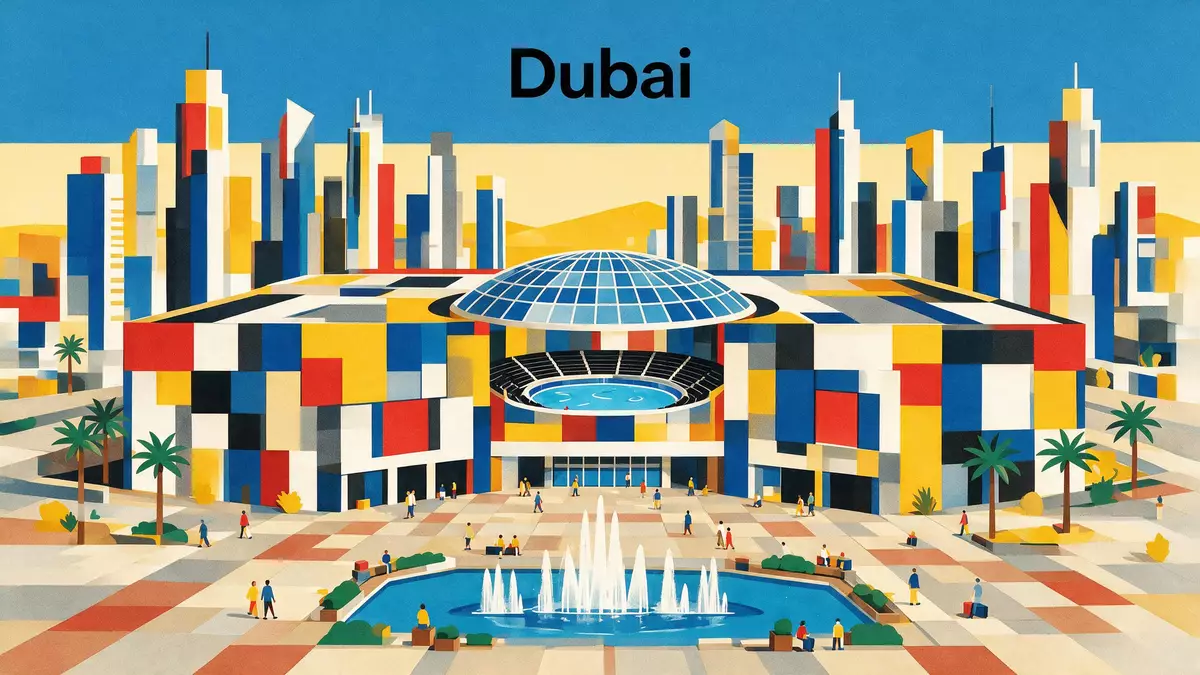
Dubai Mall in Dubai is a vast indoor complex that treats retail as one element in a larger urban world of themed districts, ice, water and performance spaces. Opened in 2008 beside Burj Khalifa, it forms part of the Downtown Dubai development led by Emaar Properties and extends over a built area measured in the millions of square metres.
An urban-scale mall beside Burj Khalifa
Dubai Mall anchors the Downtown Dubai district, a masterplanned area of towers and promenades that took shape under Emaar Properties as developer.Emaar’s flagship mega-project places the mall alongside residential and hotel towers around the same axis, with Burj Khalifa rising immediately next to the complex.Financial Centre Road in Downtown Dubai provides one of the principal road approaches, tying the building into Dubai’s main highway network.
The mall’s total built footprint surpasses 1,000,000 m², with internal floor space counted in millions of square feet and gross leasable area running into hundreds of thousands of square metres.Total area equivalent to around 200 football pitches makes Dubai Mall comparable in scale to a compact city district under one climate-controlled roof. This envelope houses well over 1,200 retail units alongside dining, leisure and event spaces.
Architecture, atria and mashrabiyya patterns
The main architectural design for Dubai Mall was developed by DP Architects from Singapore, working with Emaar Properties as client and Meinhardt as engineering consultant.DP Architects as lead designer set the project on the scale of urban planning, with long gallerias and atria forming indoor streets rather than simple corridors.Naturally lit atria of varying volumes serve as rest points and orientation markers.
Externally, cladding panels carry mashrabiyya-inspired patterns that reference traditional screened openings from the wider region, while the roof reads as layered plates and volumes when seen from surrounding towers.Mashrabiyya pattern on the facade cladding lends a recognisable texture to the elevations and filters daylight into some of the perimeter spaces. Inside, polished stone floors, metalwork, glass balustrades and large expanses of glazing give the main halls a contemporary finish, with occasional regional motifs in screens and lighting.
Districts of fashion, ice and water
Rather than a single undifferentiated mall, Dubai Mall is divided into several internal districts, each with its own atmosphere and mix of uses.Themed zones including fashion, sports and gold organise the plan into areas that feel closer to neighbourhoods than rows of identical units. A fashion district includes catwalk space and sequences of high-end boutiques, while a gold souk zone evokes traditional outdoor markets through arabesque detailing and skylit courtyards.
Leisure and spectacle play a central role. A massive indoor aquarium forms one wall of a main hall and continues into the Dubai Aquarium and Underwater Zoo, where a walk-through tunnel passes beneath the tank.Dubai Aquarium and Underwater Zoo as internal landmark stands alongside an Olympic-sized ice rink cut into the slab and overlooked by terraces and cafés.Sports area with Olympic-size ice-skating rink turns part of the building into a winter sports arena, while multi-screen cinemas and indoor theme attractions occupy stacks of upper levels.
Visiting Dubai Mall: what travellers from Western Europe should know
- Dubai Mall stands in Downtown Dubai beside Burj Khalifa, with one of its main road approaches along Financial Centre Road linking towards Sheikh Zayed Road.
- Inside, movement between levels involves extended promenades, escalator banks and lifts, and some areas overlook major features such as the aquarium and ice rink from upper terraces.
- The climate-controlled interior contrasts with Dubai’s desert environment, and passages can feel long, so covering the mall on foot involves substantial indoor walking.
- Dubai is part of the United Arab Emirates, where the official language is Arabic and the currency is the UAE dirham.
- Entry requirements depend on your nationality; UK travellers can check the FCDO travel advice at gov.uk/foreign-travel-advice, Irish travellers the Department of Foreign Affairs at ireland.ie.
Searching for Dubai Mall on social platforms
These links open searches for Dubai Mall on each platform.
Frequently asked questions about Dubai Mall
Where is Dubai Mall located within Dubai?
Dubai Mall stands in the Downtown Dubai district of the United Arab Emirates, adjoining Burj Khalifa and reached from Financial Centre Road.
What can visitors expect on a typical visit?
Visitors encounter extensive indoor promenades lined with shops, large attractions such as an aquarium and ice rink, dining areas and themed districts including a gold market zone.
What makes Dubai Mall distinctive among large malls?
Dubai Mall’s scale, its division into districts, and signature features like Dubai Aquarium and Underwater Zoo and an Olympic-size ice rink give it the character of an indoor city.


