
Drottningholms slott and the royal island landscape on Lake Mälaren
Published on 09/18/2026 at 17:16 | Editorial responsibility: Rafael Müller, Editor-in-Chief AD HOC NEWS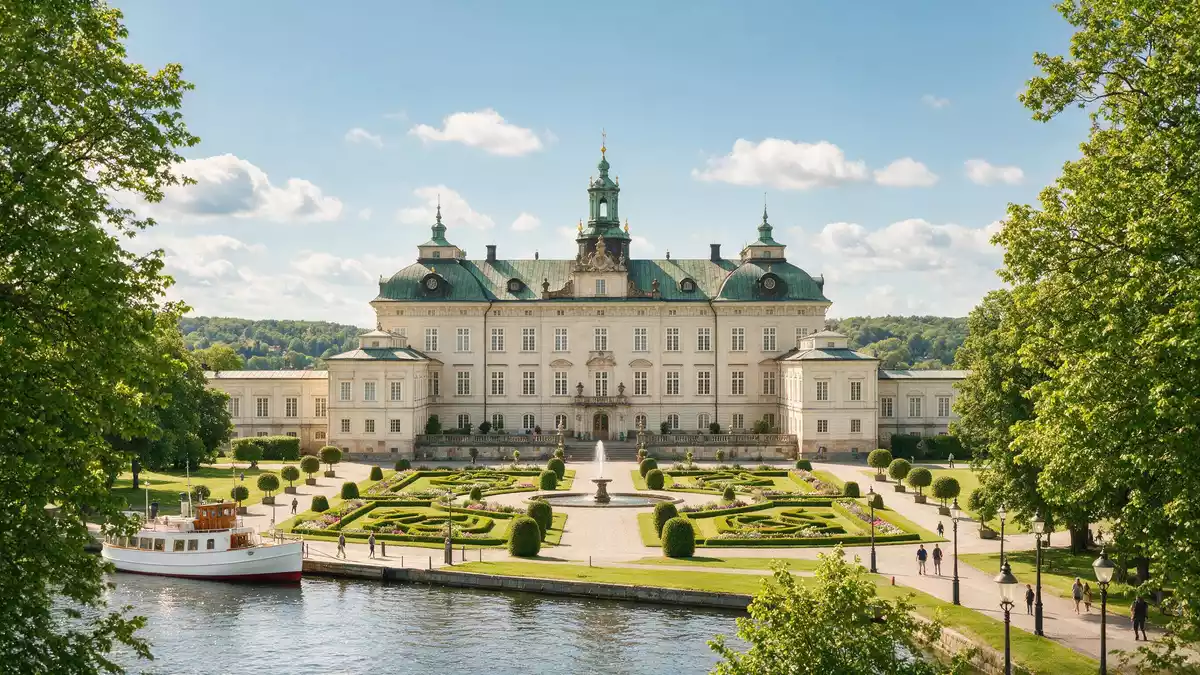
Drottningholms slott, known in English as Drottningholm Palace, stands on the island of Lovön in Lake Mälaren, west of central Stockholm. Built as a royal residence in the seventeenth century for Queen Hedvig Eleonora of Holstein-Gottorp, it anchors an island landscape where palace, theatre, park and water form one continuous setting.
An island palace shaped by water and royal power
Drottningholms slott occupies a low rise on Lovön, one of the islands in Lake Mälaren, with the palace complex opening towards the lake and its inlets. The royal domain here has long been associated with leisure and summer residence, and the choice of an island site creates a clear spatial separation between Drottningholm and the main districts of Stockholm.
The present palace was commissioned in the seventeenth century by Queen Hedvig Eleonora after an earlier royal building on the island was lost to fire in 1661, and construction of the new residence began in 1662. Architect Nicodemus Tessin the Elder developed the main Baroque layout, while Nicodemus Tessin the Younger and Carl Hårleman continued work into the eighteenth century, giving the complex its extended sequence of formal rooms and façades.Seventeenth- and eighteenth-century construction The wider royal domain includes Drottningholm Palace itself, Drottningholm Palace Theatre, the Chinese Pavilion and surrounding grounds on Lovön, forming a substantial ensemble on the lake.Royal Domain of Drottningholm on Lovön
Baroque residence with theatre and Chinese Pavilion
Drottningholms slott is arranged as an eighteenth-century north European royal residence with a central palace flanked by gardens and outbuildings. The palace itself is described as one of the most well-preserved royal castles built in the 1600s in Sweden, with interiors that reflect the Baroque and Rococo tastes of the Swedish court.Well-preserved seventeenth-century royal residence The main façades face the formal gardens, creating a long axis that links palace and park.
Beyond the palace building, the domain is distinguished by its court theatre and its Chinese Pavilion. The Drottningholm Palace Theatre, built in the 1760s, retains historic stage machinery and forms part of the World Heritage listing. The Chinese Pavilion, also within the park, represents the eighteenth-century European fascination with Chinese-inspired architecture and decoration.Theatre and Chinese Pavilion in the domain Together with the palace gardens and Canton-style village, these structures give Drottningholm a layered character: royal residence, performance venue and ornamental landscape.
UNESCO World Heritage and the royal domain landscape
The Royal Domain of Drottningholm was inscribed on the UNESCO World Heritage List in 1991 as a cultural property under criterion (iv). The inscription recognises Drottningholm as one of the finest examples of an eighteenth-century north European royal residence influenced by the Palace of Versailles, with a palace, theatre, Chinese Pavilion and gardens forming a coherent ensemble.UNESCO inscription in 1991 The Swedish National Commission for UNESCO notes that Drottningholm was the first cultural site in Sweden to receive World Heritage status, underscoring its significance in the country’s heritage protection.First Swedish World Heritage cultural site
Within this designation, the landscape of Lovön and Lake Mälaren is recognised alongside the buildings. The palace gardens extend from formal Baroque parterres into more informal parkland, blending geometric alignments with tree-lined avenues and waterside views. The theatre, Chinese Pavilion and small ancillary buildings sit in this landscape as discrete but connected elements, and the overall composition illustrates how royal architecture, performance spaces and designed nature were combined in eighteenth-century Sweden.
Visiting Drottningholms slott: what travellers from Western Europe should know
- Drottningholms slott stands on the island of Lovön in Lake Mälaren, west of central Stockholm, and is reached by road or by boat services across Mälaren.
- The palace complex and gardens involve walking over formal gravel paths and lawns, with extended routes between the main building, the theatre and the Chinese Pavilion.
- Drottningholm Palace is in Sweden; the official language is Swedish and the currency is the Swedish krona.
Searching for Drottningholms slott on social platforms
These links open searches for Drottningholms slott on each platform.
Frequently asked questions about Drottningholms slott
Where is Drottningholms slott located?
Drottningholms slott stands on Lovön, an island in Lake Mälaren, to the west of central Stockholm in Sweden.
What should visitors expect at Drottningholms slott?
Visitors encounter a seventeenth-century royal palace with historic interiors, formal gardens, a court theatre and the Chinese Pavilion arranged across an island landscape.
What makes Drottningholms slott distinctive among Swedish palaces?
Its combination of palace, theatre, Chinese-inspired pavilion and designed gardens on an island in Lake Mälaren, recognised as a UNESCO World Heritage Site, gives Drottningholm a distinctive character.


