
Drottningholms slott and the royal island landscape on Lake Mälaren
Published on 08/30/2026 at 14:06 | Editorial responsibility: Rafael Müller, Editor-in-Chief AD HOC NEWS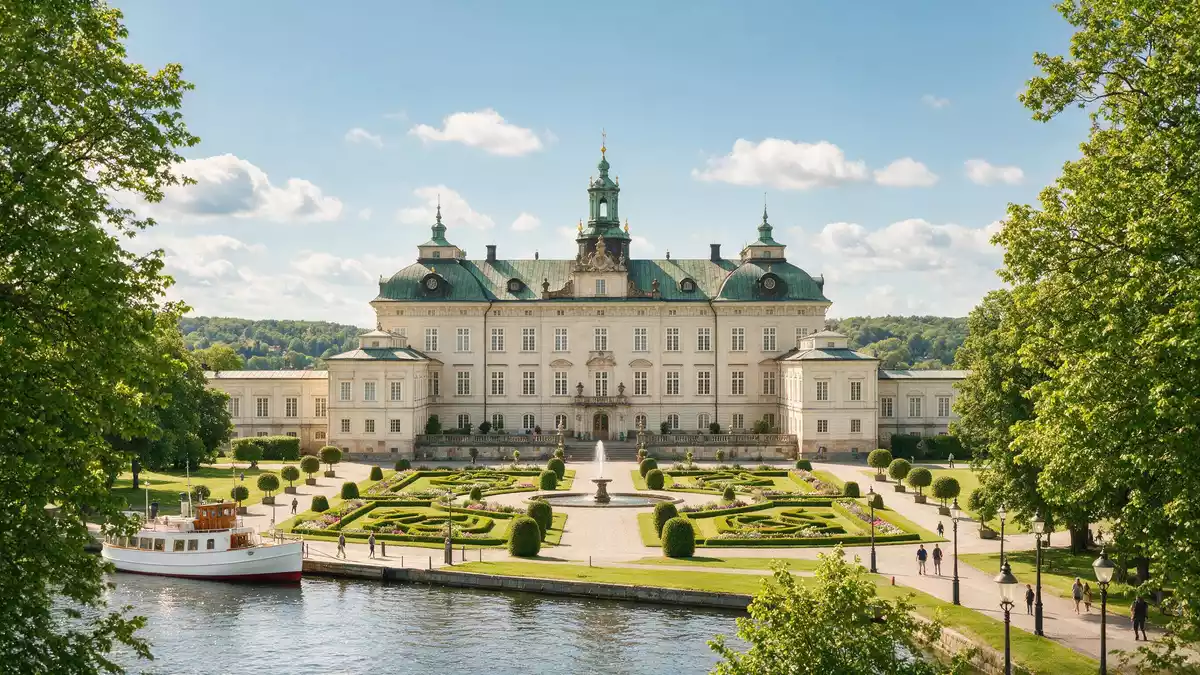
Drottningholms slott, known in English as Drottningholm Palace, stands on the island of Lovön in Lake Mälaren west of central Stockholm and forms a complete royal landscape of palace, theatre and gardens. Built as a Baroque residence for Queen Hedvig Eleonora of Holstein-Gottorp in the seventeenth century and inscribed as a UNESCO World Heritage Site in 1991, it links Swedish royal history with a carefully preserved architectural ensemble.
A Baroque palace shaped by the Swedish great power era
The present Drottningholms slott dates to the later seventeenth century, when Hedvig Eleonora commissioned architect Nicodemus Tessin the Elder to design a new residence after an earlier palace on the site was destroyed by fire in 1661.Hedvig Eleonora’s commission Work on the new palace began in 1662 and continued into the early eighteenth century, with Nicodemus Tessin the Younger completing many of the facades and interiors.seventeenth-century construction
The architecture of Drottningholms slott combines French Baroque planning with Italian classical elements, adapted to a Nordic setting.French Baroque influences The main building is organised around central halls and state apartments, with symmetrical wings and a roof form characteristic of Swedish Baroque. Inside, Tessin the Elder created suites of rooms with elaborate stucco, painted ceilings and carved panelling that belong to the early Baroque phase, while later alterations introduced interiors in French-inspired Rococo.Baroque and Rococo interiors
The Royal Domain of Drottningholm as a World Heritage landscape
Drottningholms slott forms the heart of the Royal Domain of Drottningholm, a cultural landscape recognised as a UNESCO World Heritage Site.Royal Domain of Drottningholm The World Heritage inscription, confirmed in 1991, covers the palace, the Drottningholm Palace Theatre, the Chinese Pavilion, the palace park, Canton Village and part of the Malmen area on Lovön.World Heritage designation
The palace park immediately behind Drottningholms slott is laid out as a formal French Baroque garden with straight avenues, clipped hedges and water features extending along the island’s axis.Baroque park Beyond this formal core the landscape opens into more informal English-style parkland, with winding paths and varied planting that frame views back towards the palace and across Lake Mälaren.English-style parkland Together, the palace and gardens offer an example of an eighteenth-century northern European royal residence influenced by Versailles, transferred to the wooded shores of Mälaren.Versailles-inspired ensemble
The Drottningholm Palace Theatre and Chinese Pavilion
On the edge of the formal gardens stands the Drottningholm Palace Theatre, a court theatre completed in the 1760s and notable for its preserved eighteenth-century stage machinery and sets.palace theatre The theatre forms a key part of the World Heritage value of Drottningholms slott, because it retains an intact historic interior linked to the performance culture of the Swedish court in the eighteenth century.historic theatre
Further into the park lies the Chinese Pavilion, an eighteenth-century pleasure pavilion with interiors decorated in chinoiserie style that reflect European fascination with East Asian motifs.Chinese Pavilion Around it, smaller buildings and garden structures form part of the wider Royal Domain, including Canton Village where service buildings echo the pavilion’s decorative themes.Canton Village The combination of palace, theatre, pavilion and gardens gives Drottningholms slott a layered character that mixes formal ceremony, artistic performance and intimate retreats.
Visiting Drottningholms slott: what travellers from Western Europe should know
- Drottningholms slott stands on Lovön in Lake Mälaren west of central Stockholm and is reached from the city across bridges that connect the island to the mainland.
- The palace complex includes formal gardens, parkland and historic buildings, so a visit involves walking over level paths, gravel surfaces and park avenues that extend across the island landscape.
- Drottningholms slott lies within Sweden, where the official language is Swedish and the currency is the Swedish krona.
- Nearby, the waters of Lake Mälaren and the wooded shoreline of Lovön frame long views towards the palace, making the relationship between architecture and surrounding landscape part of the experience.
Searching for Drottningholms slott on social platforms
These links open searches for Drottningholms slott on each platform.
Frequently asked questions about Drottningholms slott
Where is Drottningholms slott located?
Drottningholms slott stands on the island of Lovön in Lake Mälaren, in Ekerö Municipality just west of Stockholm.
What can visitors expect when exploring Drottningholms slott?
Visitors encounter a seventeenth-century Baroque palace, preserved historic interiors, formal French-style gardens and wider parkland that together form a royal landscape on an island.
What makes Drottningholms slott distinctive among European palaces?
Its combination of palace, intact eighteenth-century theatre, Chinese Pavilion and designed gardens on a single island has earned recognition as a UNESCO World Heritage Site since 1991.


