
Drottningholms slott and its palace landscape on Lovön
Published on 09/24/2026 at 07:02 | Editorial responsibility: Rafael Müller, Editor-in-Chief AD HOC NEWS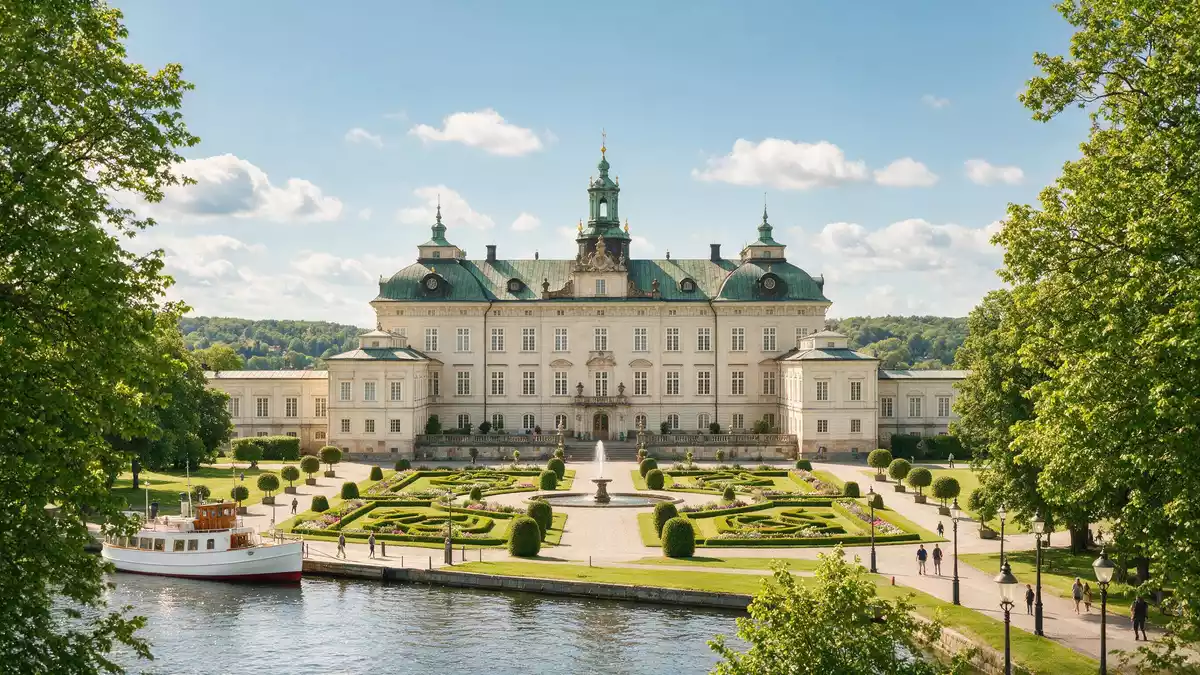
Drottningholms slott occupies Lovön, an island west of Stockholm, as a royal residence surrounded by gardens, theatre buildings and carefully arranged avenues. Its visible identity comes from the meeting of a seventeenth-century Baroque palace with a wider historic ensemble.
Drottningholms slott: a Baroque palace on Lovön
The palace began in 1662 under Queen Hedvig Eleonora, with Nicodemus Tessin the Elder as architect. His work established the principal form: a broad stone building with a central entrance, orderly façades and interiors shaped by European Baroque architecture.
Nicodemus Tessin the Younger completed the building after his father’s death. The rooms contain painted decoration, carved details, furniture and architectural ornament from several royal periods. The palace therefore presents a sequence of interiors rather than a single unchanged style.
The name Drottningholm means “Queen’s Island” and reaches back to the sixteenth century, when King Johan III established a royal residence on the site for Queen Katarina Jagellonica. The palace associated with Hedvig Eleonora belongs to a later building phase and forms the central structure of the estate.
From royal residence to historic ensemble
Drottningholms slott is part of a larger royal domain. The palace, Drottningholm Palace Theatre, the Chinese Pavilion and the surrounding parks belong to the same cultural landscape, with each element expressing a different period.
The theatre is associated with Carl Fredrik Adelcrantz and preserves an eighteenth-century stage environment. Its painted scenery, auditorium and technical features belong to the history of court theatre. The building remains a distinct counterpart to the formal palace rooms.
The Chinese Pavilion adds another architectural language. Its decoration reflects eighteenth-century European interpretations of China, while the surrounding park connects it with the palace grounds. Together, the theatre and pavilion expand the site beyond a single royal residence.
The Swedish royal family has used Drottningholms slott as a private residence since 1981. This residential function exists alongside the publicly accessible cultural parts of the domain, giving the estate a dual character.
Gardens, water and the UNESCO setting
The gardens extend the palace’s geometry into the landscape. Formal paths, clipped planting, sculptures, canals and open lawns create strong lines around the building. Farther from the palace, the park includes wooded areas and less formal scenery.
The relationship between palace, garden and water is central to the setting on Lovön. The grounds face Lake Mälaren, while avenues and planted spaces organise the approach to the main building. The landscape is not a separate decoration but one of the principal parts of the royal domain.
Drottningholm entered the UNESCO World Heritage List in 1991. The designation covers the palace environment, including the theatre, Chinese Pavilion and parks, as an exceptionally preserved example of European royal architecture from the seventeenth and eighteenth centuries.
The estate brings together the names Hedvig Eleonora, Nicodemus Tessin the Elder, Nicodemus Tessin the Younger and Carl Fredrik Adelcrantz. Their work appears across the buildings and grounds, from the Baroque palace to the theatre and the Chinese Pavilion.
Visiting Drottningholms slott: what travellers from Western Europe should know
- Drottningholms slott stands on Lovön, west of Stockholm. Road connections link the island with Stockholm, and scheduled boats connect central Stockholm with the palace area during the boating season.
- The grounds combine formal avenues, lawns, wooded paths and waterfront views. Comfortable walking footwear suits the varied surfaces across the palace domain.
- The palace area includes several separate buildings. The theatre and Chinese Pavilion are distinct destinations within the same historic landscape.
- The official language is Swedish and the currency is the Swedish krona.
Searching for Drottningholms slott on social platforms
These links open searches for Drottningholms slott on each platform.Frequently asked questions about Drottningholms slott
Where is Drottningholms slott?
Drottningholms slott is on Lovön, an island in Lake Mälaren west of Stockholm. The royal domain occupies a landscaped setting outside the Swedish capital.
What can visitors see at Drottningholms slott?
The domain includes the palace, formal gardens, Drottningholm Palace Theatre, the Chinese Pavilion and wooded parkland. The buildings represent seventeenth- and eighteenth-century royal architecture.
What makes Drottningholms slott distinctive?
The site combines a Baroque palace, an eighteenth-century theatre, a Chinese Pavilion and historic gardens in one UNESCO-listed royal environment.


