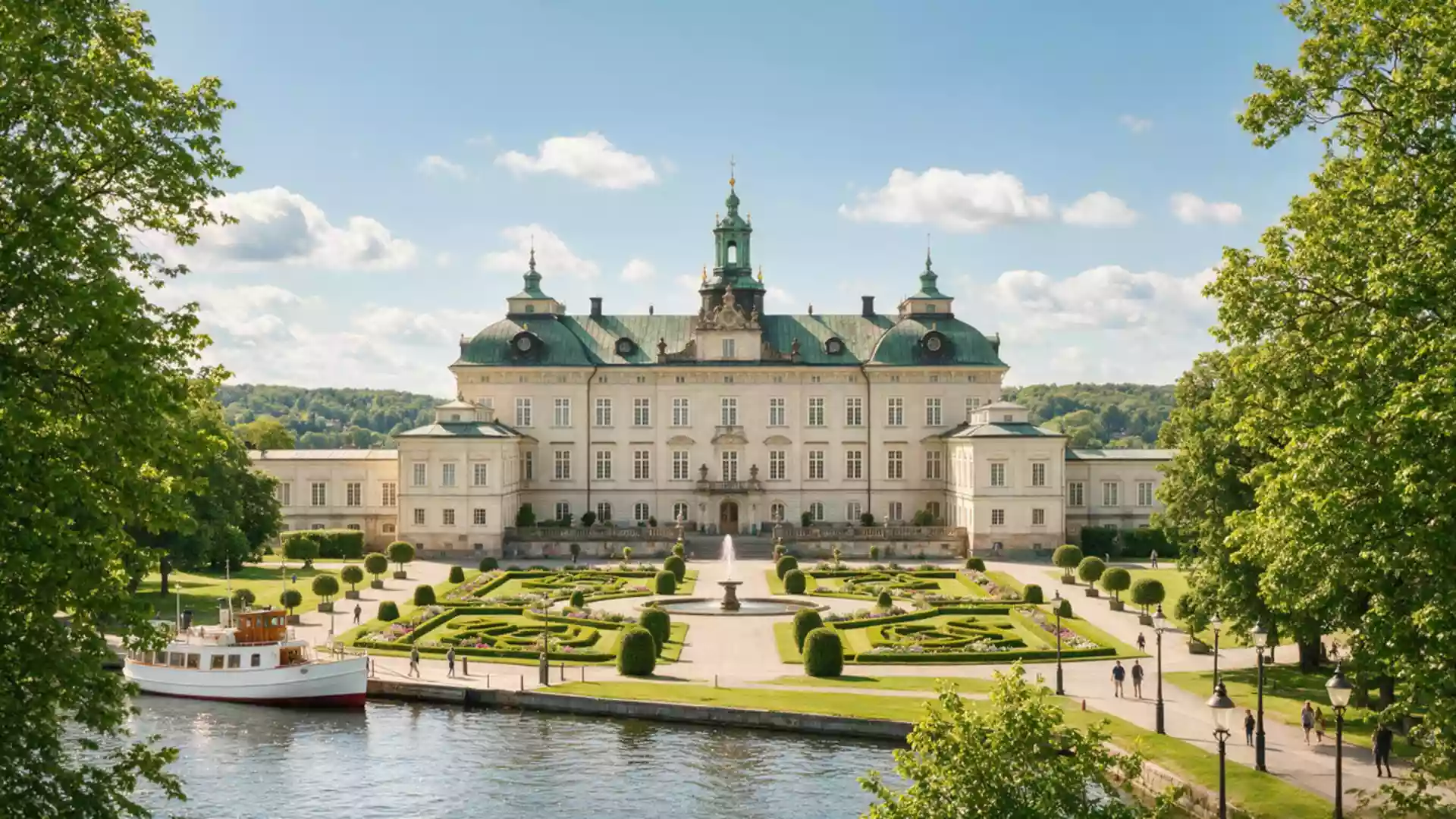
Drottningholms slott, a royal island residence shaped by theatre and gardens
Published on 09/02/2026 at 14:53 | Editorial responsibility: Rafael Müller, Editor-in-Chief AD HOC NEWS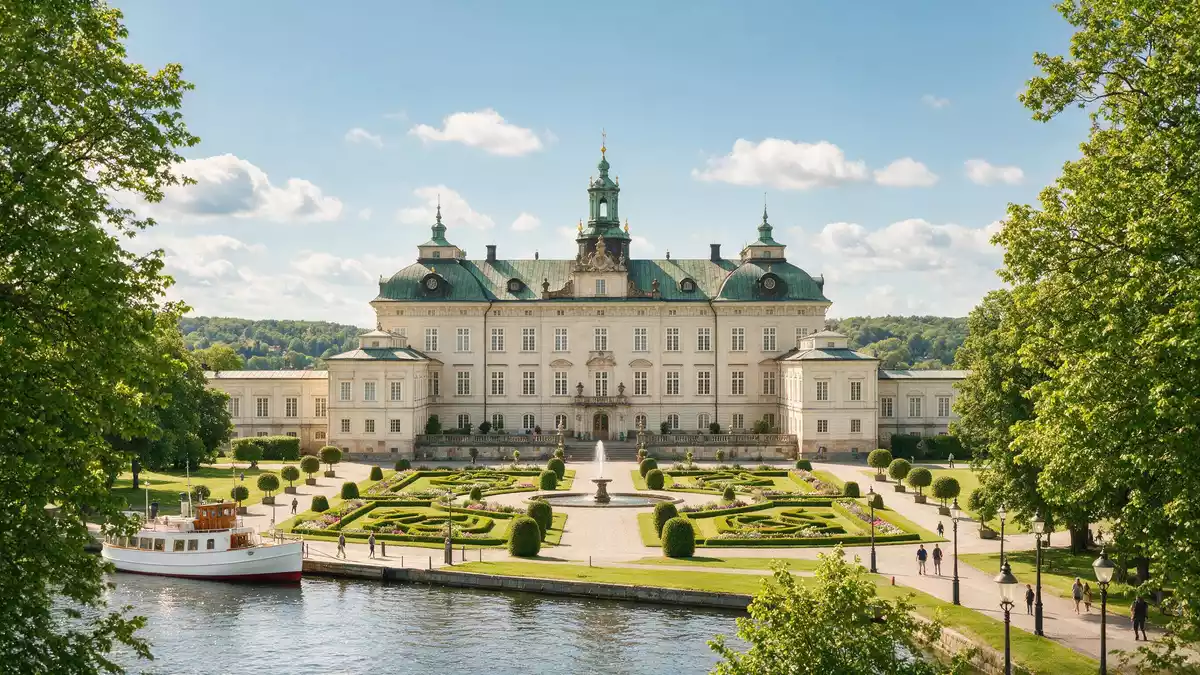
Drottningholms slott, known in English as Drottningholm Palace, occupies an island in Lake Mälaren west of Stockholm and brings together palace, theatre and gardens into one royal landscape. Built as a Baroque residence in the seventeenth century and redesigned inside during the eighteenth century, it stands within a royal domain recognised as a UNESCO World Heritage Site since 1991 for the way its architecture and gardens preserve a northern European courtly world.
An island palace in Lake Mälaren
Drottningholms slott stands on Lovön, an island in Lake Mälaren that forms part of the municipality of Ekerö to the west of Stockholm. The palace complex belongs to the Royal Domain of Drottningholm, an ensemble of buildings and gardens that occupies much of the island’s northern shore and has been formally inscribed on the UNESCO World Heritage List as the Royal Domain of Drottningholm.Royal Domain of Drottningholm
The name Drottningholm goes back to a late sixteenth?century summer residence commissioned by King John III of Sweden for his consort Queen Katarina Jagellonika, designed by the Flemish architect Willem Boy, which gave the place its identity as a queen’s island residence.the name Drottningholm dates back That earlier building was destroyed by fire in 1661, and the land, including the island setting in Lake Mälaren, became the foundation for the palace that visitors see.
Seventeenth?century Baroque architecture and later interiors
The present Drottningholms slott is a seventeenth?century Baroque palace created after the 1661 fire, when Queen Dowager Hedvig Eleonora purchased the estate and commissioned architect Nicodemus Tessin the Elder to design a new residence.architect Nikodemus Tessin the Elder Construction began in 1662 and produced a multi?storey stone palace with a clearly articulated central corps de logis and symmetrical wings, drawing on contemporary French and Italian Baroque models in its massing and facade composition.new palace in its place
Inside, Tessin’s reception halls display rich Baroque interiors from the 1660s and 1670s, with stucco work, painted ceilings and grand ceremonial rooms that reinforced Drottningholms slott as a residence for Sweden’s royal women.interiors from the early Baroque During the eighteenth century, Princess Lovisa Ulrika of Prussia, who received Drottningholm as a wedding gift in 1744 when she married the future King Adolf Fredrik, brought new tastes to the palace, engaging architects such as Carl Hårleman, Jean Eric Rehn and Carl Fredrik Adelcrantz to remodel suites in Rococo and neoclassical styles.wedding gift to Princess Lovisa Ulrika
The palace theatre and Chinese Pavilion
Within the royal domain at Drottningholms slott, two eighteenth?century buildings give the place a distinctive character: the Drottningholm Palace Theatre and the Chinese Pavilion. The theatre, built in 1766 for Queen Lovisa Ulrika after an earlier theatre burned down in 1762, stands beside the palace and retains its original stage machinery and painted scenery, forming one of Europe’s most intact court theatres from the era.built in 1766 in a neoclassical style
The Chinese Pavilion, known in Swedish as Kina slott, occupies a corner of the formal park and reflects the eighteenth?century taste for chinoiserie. The present pavilion was built between 1763 and 1769, replacing an earlier structure created as a birthday surprise for Lovisa Ulrika in 1752, and it combines a compact plan with exuberant decorative details inspired by East Asian motifs.Kina Slott in Drottningholm Park Both the theatre and the pavilion are central reasons why the Royal Domain of Drottningholm gained World Heritage status, as they preserve an eighteenth?century court culture of performance and exotic fantasy within a coherent landscape.two buildings of worldwide interest
Gardens from Baroque formality to landscape park
The grounds around Drottningholms slott are laid out in distinct garden styles that reflect changing tastes from the seventeenth to the late eighteenth century. To the east of the palace, Tessin planned a formal Baroque garden with straight axes, parterres and water features radiating from the main facade, creating a geometric setting typical of the period.large pleasure gardens that surround Drottningholm Palace This area still presents clipped greenery, aligned statues and long views framed by rows of trees.
Beyond the formal core, later additions introduced a more naturalistic landscape garden. After Drottningholm passed to the Swedish state in 1777, Gustav III ordered expansive parkland to be laid out around the Baroque composition, with meadows, groves and serpentine paths complementing the stricter geometry near the palace.extensive landscaped gardens The combination of formal and informal garden areas, together with subsidiary elements such as Canton Village, gives the island domain a layered landscape in which architecture and planting are closely interwoven.gardens and Canton Village
Visiting Drottningholms slott: what travellers from Western Europe should know
- Drottningholms slott lies on the island of Lovön in Lake Mälaren, west of central Stockholm, and is reached by road connections through the municipality of Ekerö.
- The palace complex and gardens extend over gently undulating terrain with formal avenues, long straight walks and outdoor staircases linking terraces and different garden levels.
- The surroundings include Lake Mälaren’s shoreline, smaller buildings such as the palace theatre and the Chinese Pavilion, and views across water and parkland towards Stockholm’s outer districts.
- The official language is Swedish and the currency is the Swedish krona.
- Entry requirements depend on your nationality; UK travellers can check the FCDO travel advice at gov.uk/foreign-travel-advice, Irish travellers the Department of Foreign Affairs at ireland.ie.
Searching for Drottningholms slott on social platforms
These links open searches for Drottningholms slott on each platform.
Frequently asked questions about Drottningholms slott
Where is Drottningholms slott located?
Drottningholms slott is situated on the island of Lovön in Lake Mälaren, within Ekerö municipality to the west of Stockholm.
What should visitors expect at Drottningholms slott?
Visitors encounter a seventeenth?century Baroque palace, an eighteenth?century court theatre, the Chinese Pavilion and extensive gardens combining formal avenues with landscaped parkland.
What makes Drottningholms slott distinctive among royal residences?
Drottningholms slott is distinctive for its combination of intact Baroque architecture, historic theatre machinery, chinoiserie pavilion and World Heritage?listed royal domain occupying an island landscape.