
Drakensberg near Winterton, South Africa’s basalt escarpment
Published on 09/15/2026 at 10:12 | Editorial responsibility: Rafael Müller, Editor-in-Chief AD HOC NEWS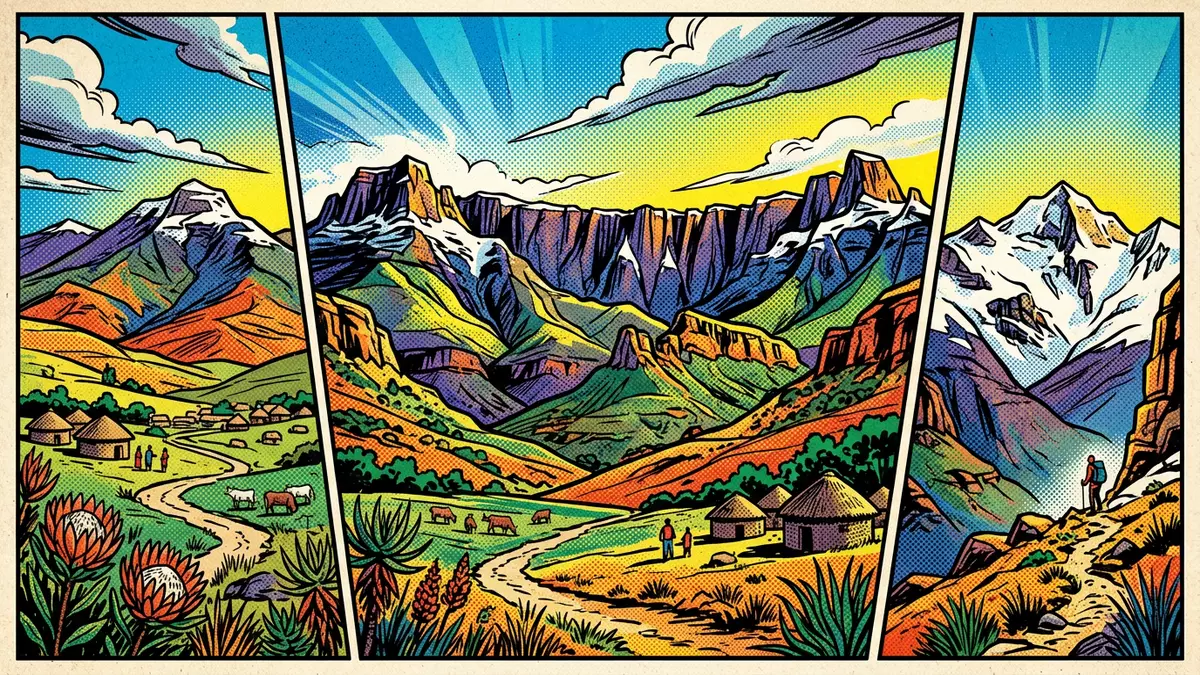
South Africa’s Drakensberg near Winterton is a high mountain escarpment where dark basalt cliffs, grassland plateaux and river valleys meet along the country’s eastern interior. Set in KwaZulu-Natal, this central stretch of the range forms part of the uKhahlamba-Drakensberg Park, a protected landscape recognised as a World Heritage Site in the early twenty-first century.
Basalt walls, river valleys and the central escarpment
The Drakensberg above Winterton forms part of the long mountain range that runs across eastern South Africa, marking the edge of the interior plateau before the land drops towards the coastal plain. From the countryside around Winterton, the skyline is dominated by cliffs and high ground where basalt rock forms an escarpment with steep faces and rolling summit plateaux.Drakensberg near Winterton in South Africa In this central section of the range, rivers cut deep valleys between buttresses of rock, with cultivated foothills giving way to rougher grassland as the ground rises.
Winterton itself is described as a small town in South Africa’s KwaZulu-Natal province, lying on or near the banks of the Tugela and Little Thukela rivers in the foothills below the central escarpment.Winterton is a small town The surrounding fields, farm roads and riverbanks sit beneath the basalt wall, which forms a continuous barrier of high ground along the horizon. This relationship between cultivated lowlands and steep mountain faces is one of the defining visual contrasts of the Drakensberg near Winterton.
The Amphitheatre and Tugela Falls in the northern Drakensberg
Further north along the range, the Drakensberg escarpment takes on the striking form of the Amphitheatre, a rock wall in Royal Natal National Park that is frequently associated with the broader Drakensberg landscape. The Amphitheatre is described as a crescent cliff face of basalt, about 5 km in length, forming one of the major geological features of the northern Drakensberg.The Amphitheatre in the Drakensberg Its precipitious cliffs rise roughly 1,200 m from the valley floor, presenting a near-vertical wall of dark rock.
From the top of this escarpment, the Tugela River drops in a complex of cascades known as Tugela Falls, which are recorded with a total height of around 948 m, making them among the highest waterfalls globally and the highest in Africa.Tugela Falls are located in Royal Natal National Park The falls are part of Royal Natal National Park in the northern Drakensberg, where trails lead towards the foot of the cliff and, via high passes and ladders, up to the escarpment top. Although this northern section lies at some distance from Winterton’s central foothills, it forms part of the same mountain system and contributes to the wider image of the Drakensberg as a wall of basalt and water.
uKhahlamba-Drakensberg Park and cultural landscape
The mountains around Winterton belong to the broader uKhahlamba-Drakensberg Park, a protected area that has been recognised by UNESCO as both a natural and cultural World Heritage Site. In this designation, the park’s dramatic escarpment, high-altitude grasslands and river valleys are considered alongside rock art sites associated with San hunter-gatherer communities, giving the range a dual significance as a landscape and as a record of human presence.uKhahlamba-Drakensberg Park The World Heritage status reflects both the geology of the basalt escarpment and the long-term cultural history preserved in its shelters.
Through the central Drakensberg near Winterton, valleys lead towards well-known summits and passes in different parts of the range. Champagne Castle and Cathedral Peak are cited among the notable summits accessible from routes that begin in the foothill towns and drive into the mountains.Champagne Castle and Cathedral Peak The relationship between Winterton and these higher summits illustrates how the central Drakensberg is experienced: cultivated riverbanks and small settlements at lower elevations, then a transition to steeper valleys, cliffs and trailheads deeper within the protected area.
Visiting Drakensberg: what travellers from Western Europe should know
- Drakensberg near Winterton lies in South Africa’s KwaZulu-Natal province, with Winterton in the foothills below the central escarpment and rivers such as the Tugela flowing through the area.
- The terrain rises from cultivated valleys to steeper slopes and high basalt cliffs, with approaches on foot often involving uneven ground and paths that gain considerable elevation.
- Winterton is used as a gateway town for routes leading towards central Drakensberg valleys and well-known peaks such as Champagne Castle and Cathedral Peak.
- The official language in this part of South Africa is primarily English alongside other national languages, and the currency is the South African rand.
- Entry requirements depend on your nationality; UK travellers can check the FCDO travel advice at gov.uk/foreign-travel-advice, Irish travellers the Department of Foreign Affairs at ireland.ie.
Searching for Drakensberg on social platforms
These links open searches for Drakensberg on each platform.
Frequently asked questions about Drakensberg
Where is the Drakensberg near Winterton located?
Drakensberg near Winterton lies in South Africa’s KwaZulu-Natal province, with Winterton in the foothills below the central escarpment and river valleys.
What should travellers expect on a visit?
Travellers encounter cultivated lowlands giving way to steeper slopes, high basalt cliffs, river valleys and routes leading deeper into the protected uKhahlamba-Drakensberg Park.
What makes this stretch of the Drakensberg distinctive?
The combination of basalt escarpment, grassland plateaux, deep river valleys and the proximity of foothill towns such as Winterton gives this central section its character.


