

Douz, oasis town facing the Tunisian Sahara dunes
Published on 08/19/2026 at 18:32 | Editorial responsibility: Rafael Müller, Editor-in-Chief AD HOC NEWS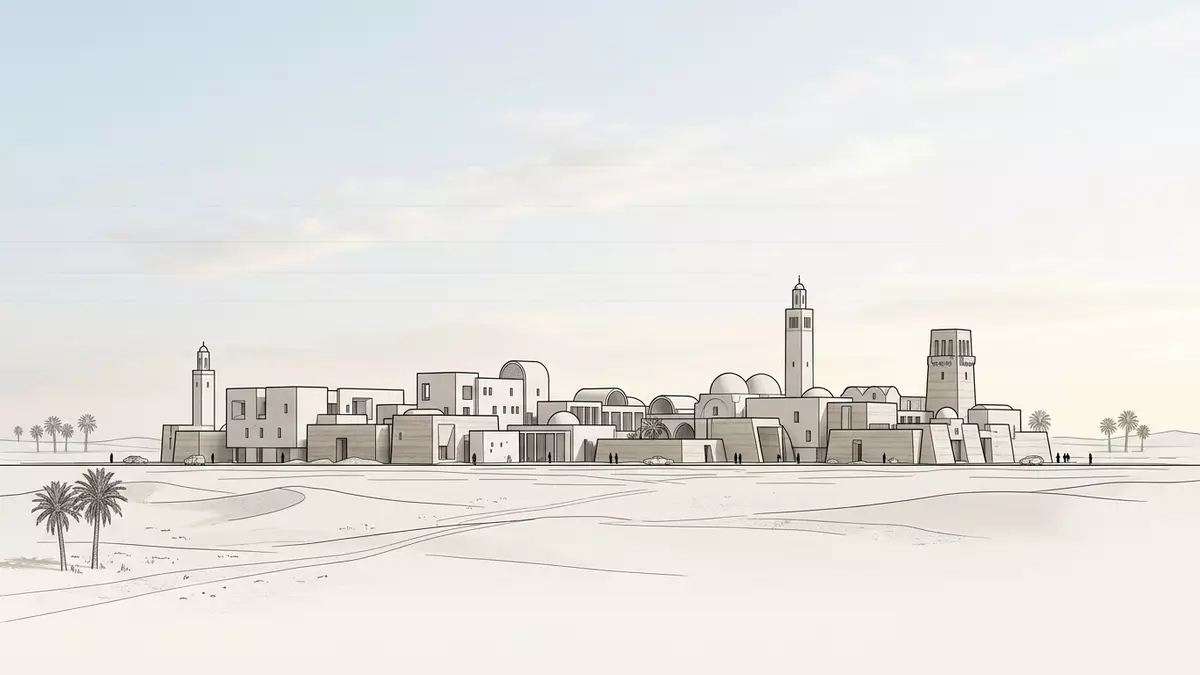
Douz in southern Tunisia is an oasis town where dense palm groves meet the first large dunes of the Sahara, marking a distinct threshold between cultivated land and desert. In the Kebili Governorate, Douz is widely known by its nickname “gateway to the Sahara”, a reputation rooted in its location beside the Grand Erg Oriental and its long role as a stop for caravans crossing the desert sands.
Douz as a palm oasis on the edge of the Sahara
Douz lies in the Nefzaoua oasis region of southern Tunisia, administratively attached to Kebili Governorate and described as a municipality of more than 30,000 inhabitants in the mid-2010s.Douz lies in the south of Tunisia within the Nefzaoua region The settlement stands south of the broad salt lake of Chott el Djerid, with roads linking it to towns such as Kebili and Tozeur across dry plains and low scrub.Douz is a town in Kebili Governorate in the south of Tunisia
The town has grown around a large palm oasis that appears as a green island against surrounding desert and semi-desert land.a large palm oasis that functions as a green island Dense groves of date palms extend beyond the built-up streets, and the cultivated plots beneath them are set out in rectangular parcels that reflect an oasis economy based on irrigation and shade. The palms themselves structurally dominate the townscape, rising above low houses and small hotels, and they support extensive date production that includes varieties associated with southern Tunisia such as deglet nour.Douz is a palm oasis and a major produce of dates
The gateway to the Grand Erg Oriental
Beyond the last palm groves, the terrain around Douz changes quickly into rolling dunes that form part of the Grand Erg Oriental, a vast sand sea occupying much of the Tunisian Sahara.Douz is attached to Kebili Governorate and lies at the edge of the Grand Erg Oriental At the edge of the town, low houses and paved streets give way to sands held back in places by barriers of dried palm fronds, set upright and woven together to slow the advance of nearby dunes.dunes held back in places by barriers of dried palm fronds This clear boundary between oasis and desert is one of the striking physical characteristics of Douz.
Historically, Douz has functioned as an important stop on caravan routes moving between the Sahara and northern Tunisia.Douz has been an important stopover for caravans on their journeys between the Sahara and northern Tunisia Camel caravans travelling into the Grand Erg Oriental depart from the outskirts of the town, crossing dunes where there are no permanent buildings and the sand runs unbroken to the horizon.caravans leave from Douz into the Grand Erg Oriental This role as a practical entrance into the sand seas underpins its common description as the gateway to the Sahara and gives Douz a distinct place among Tunisia’s southern settlements.
People, culture and desert traditions in Douz
Douz is widely associated with the Merazig, a group whose roots are traced to Arab migrants from the tribe of Banu Sulaym arriving in Tunisia in the thirteenth century.its inhabitants are essentially Merazig, linked to Banu Sulaym in the thirteenth century Families connected to this heritage settled around the oasis and maintain links with desert traditions such as camel handling and long-distance movement across the sands. The town’s identity is therefore closely tied to both its oasis agriculture and its cultural connection to nomadic and semi-nomadic life in the Sahara.
The French-origin name “Douz” has been linked to a historical military presence, with the word associated with the number twelve and a battalion of the French army stationed in the area during the period of colonisation in North Africa.the word Douz is described as French for twelve, referring to a battalion Alongside this etymology, Arabic forms are also used locally. Cultural life in Douz includes desert-themed events and markets that highlight practices such as camel riding, traditional music and crafts, and there is a Sahara museum that presents aspects of the region’s environment and human history.Douz has been home to a Sahara museum since 1997
Visiting Douz: what travellers from Western Europe should know
- Douz lies in southern Tunisia within Kebili Governorate, south of the salt lake Chott el Djerid, and is reached by road connections from towns such as Kebili, Matmata and Tozeur.
- The town stands at the junction between a cultivated palm oasis and nearby sand dunes, so short walks from the built-up area can lead onto loose desert sand with gentle but continuous gradients.
- In this part of Tunisia the climate combines Mediterranean and Saharan influences, with hot summers, limited rainfall and strong sun exposure in the open desert around Douz.
- The official language is Arabic and the currency is the Tunisian dinar.
- Entry requirements depend on your nationality; UK travellers can check the FCDO travel advice at gov.uk/foreign-travel-advice, Irish travellers the Department of Foreign Affairs at ireland.ie.
Searching for Douz on social platforms
These links open searches for Douz on each platform.
Frequently asked questions about Douz
Where is Douz in Tunisia?
Douz is an oasis town in the Kebili Governorate of southern Tunisia, lying in the Nefzaoua region south of the salt lake Chott el Djerid and linked by roads to towns such as Kebili and Tozeur.
What can visitors expect in Douz?
Visitors encounter a working oasis town dominated by dense date palm groves, with streets leading towards nearby Sahara dunes and local life tied to agriculture, camel handling and desert-linked services.
What makes Douz distinctive among Tunisian towns?
Douz stands out for its clear threshold between palm oasis and open desert, its role as a gateway to the Grand Erg Oriental and its cultural association with the Merazig community and long caravan routes.


