
Dotonbori’s canal of lights and theatre in Osaka
Published on 08/26/2026 at 18:55 | Editorial responsibility: Rafael Müller, Editor-in-Chief AD HOC NEWS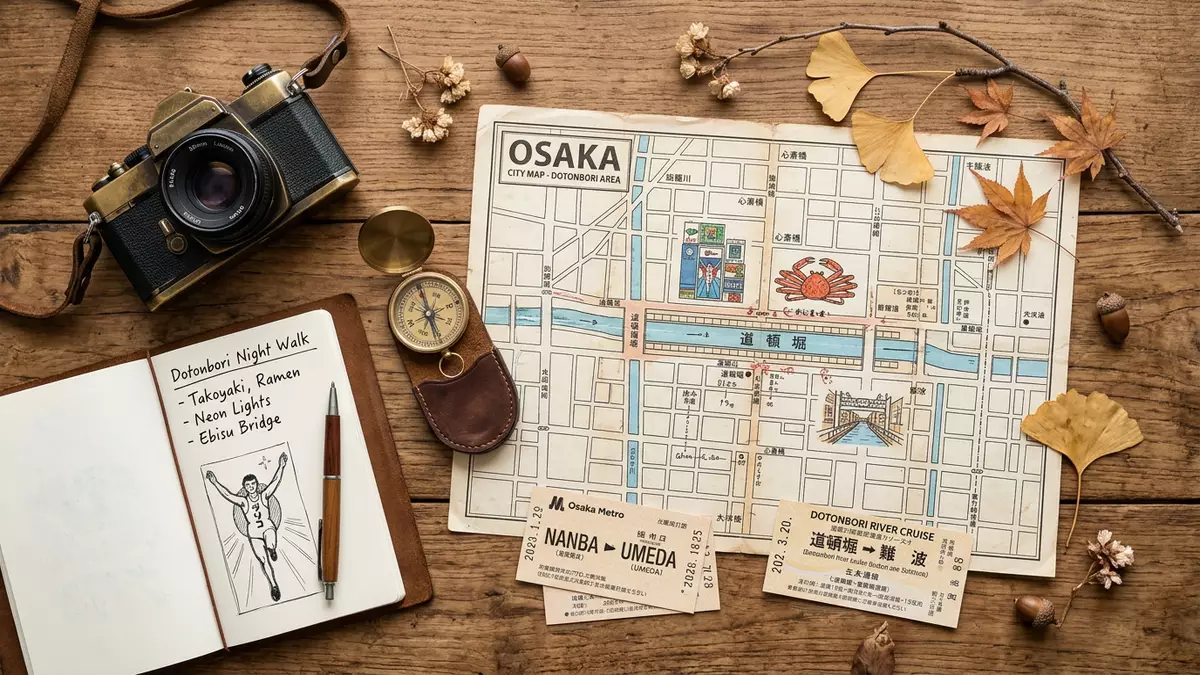
Dotonbori in Osaka is a riverside strip where an early seventeenth-century canal meets oversized billboards, bright lights and dense rows of food stalls. The area formed around the Dotonbori Canal, which opened to commerce in 1615 during the Edo period, and it still stretches along this waterway in the Minami district of central Osaka.
A canal that became Osaka’s theatre street
The story of Dotonbori begins with a water project. In 1612, a local entrepreneur named Yasui Doton started excavating a canal to link existing waterways on the southern side of Osaka.In 1612, a local entrepreneur The canal, known as Dotonborikawa, opened in 1615 and took his name, even though he died in the Osaka Summer Campaign before seeing it complete.The canal opened in 1615
Within a few decades, the south bank of this canal developed into Osaka’s main theatre district, lined with kabuki houses, bunraku puppet theatres and teahouses serving audiences before and after performances.Within a few decades the south bank By the early Edo period, several major kabuki theatres and multiple bunraku stages stood along this stretch, giving Dotonbori a reputation as an entertainment street built around performance and hospitality rather than formal civic buildings.Several major kabuki theatres
Neon, billboards and the Glico Running Man
Dotonbori’s present-day character is defined by illuminated billboards facing the canal and the pedestrian bridges that cross it. Among these signs, the Glico Running Man above Ebisubashi Bridge stands out as a landmark: an athlete raising his arms as he crosses a finish line on a stylised track.The Glico Running Man above Ebisubashi Bridge The first version of this advertisement for the Ezaki Glico confectionery company was installed in 1935, and the current display is the sixth generation.
Earlier versions of the Glico sign used neon, whereas the current version is a high-resolution LED display introduced in 2014.Earlier versions of the Glico sign The panel stands about 20 m high and 10 m wide, so it dominates its section of the canal frontage without blocking the surrounding cluster of other illuminated advertisements and mascot figures.The panel stands about 20 m high
Street food, bridges and the riverside promenade
The canal itself remains central to the experience of Dotonbori. A promenade runs along the water, with railings and steps leading down from the street level, so the reflections of the signs set the tone as much as the advertising faces themselves.A promenade runs along the water Bridges such as Ebisubashi and Dotonboribashi carry road and foot traffic across the canal, providing vantage points over the illuminated façades and the narrow strip of water framed by buildings.
Behind the canal frontage, narrow streets are lined with restaurants, casual eateries and food stalls known for dishes such as takoyaki, okonomiyaki and kushikatsu, which became associated with this district during the twentieth century.Narrow streets are lined with restaurants Large mechanical signs, including figures of seafood and other mascots, extend from the building façades towards the street, reinforcing the impression of a continuous sequence of entertainment-focused shopfronts between the canal and the parallel roads.
Visiting Dotonbori: what travellers from Western Europe should know
- Dotonbori runs along the Dotonbori Canal in the Minami area of Osaka, between Dotonboribashi and Nipponbashi bridges, and is reached on foot from nearby Namba and Shinsaibashi stations.
- The promenade beside the canal includes steps and changes in level, and the streets behind it are narrow and busy, with frequent kerbs and side alleys.
- The surrounding area belongs to Osaka’s Chuo Ward, so it connects easily with neighbouring commercial districts and covered shopping arcades.
- The official language is Japanese and the currency is the Japanese yen.
- Entry requirements depend on your nationality; UK travellers can check the FCDO travel advice at gov.uk/foreign-travel-advice, Irish travellers the Department of Foreign Affairs at ireland.ie.
Searching for Dotonbori on social platforms
These links open searches for Dotonbori on each platform.
Frequently asked questions about Dotonbori
Where is Dotonbori located?
Dotonbori is a canal-side entertainment district in central Osaka, running through the Minami area between Namba and Shinsaibashi in the city’s Chuo Ward.
What should visitors expect in Dotonbori?
Visitors encounter a dense mix of illuminated billboards, especially the Glico Running Man, a canal promenade, crowded bridges and streets filled with restaurants and snack stalls.
What makes Dotonbori distinctive among Osaka’s districts?
The combination of a seventeenth-century canal, a historic theatre quarter and large-scale illuminated advertising facing the water gives Dotonbori a character that is closely associated with Osaka’s image.


