
Dongdaemun Design Plaza, Seoul’s flowing cultural landmark
Published on 09/07/2026 at 08:54 | Editorial responsibility: Rafael Müller, Editor-in-Chief AD HOC NEWS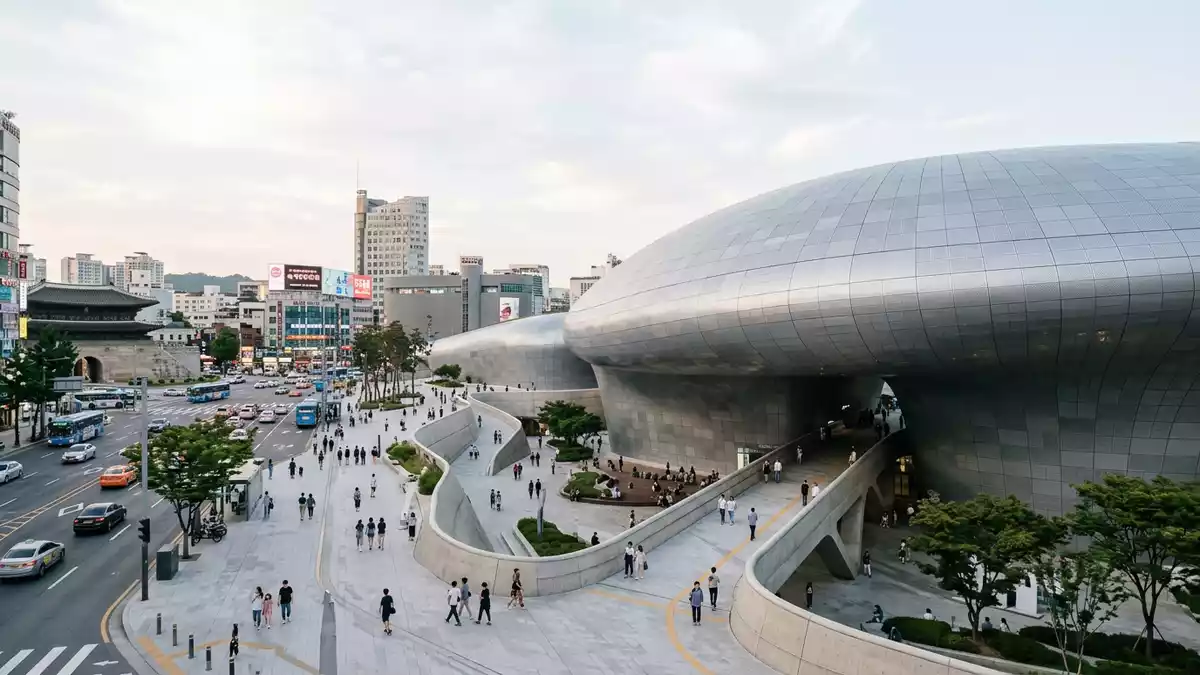
Dongdaemun Design Plaza in Seoul is a vast neo?futuristic cultural complex whose flowing aluminium skin wraps exhibition halls, design spaces and a rooftop park into a single continuous building. Designed by Zaha Hadid Architects and opened in March 2014, it stands on the former sports grounds of Dongdaemun Stadium and has become a central piece of the city’s design landscape.
A building that flows like a landscape
The most striking first impression of Dongdaemun Design Plaza is its form: rather than a conventional box, the building stretches across the site in smooth, elongated volumes whose surfaces curve in several directions at once. The exterior is clad in thousands of aluminium panels, each fabricated to a slightly different shape so that the envelope can bend and twist without visible seams, producing a continuous metallic surface that reflects light in subtle gradients.The building has a length of 280 m and rises to around 34 m at its highest point, creating an object that feels closer to topography than to a conventional facade.
The plaza occupies a site in the Dongdaemun area of central Seoul, an urban district long associated with fashion and markets.The total floor area is around 86,500 m², distributed across multiple storeys that extend both above and below ground. At roof level, planted terraces and paths form a walkable park that folds over the building, connecting down towards the surrounding streets and the broader Dongdaemun History and Culture Park.
Zaha Hadid’s neo?futuristic design in Seoul
Dongdaemun Design Plaza was commissioned by the Seoul Metropolitan Government after an international design competition, with the winning scheme by Zaha Hadid Architects and local partner Samoo Architects and Engineers.The competition concluded in the second half of the 2000s and construction began in March 2009, marking one of the most ambitious public building projects in the city at that time. The design is associated with neo?futurism and parametric architecture, using advanced digital tools to generate and coordinate the complex geometry of its shell.
Zaha Hadid, the British?Iraqi architect awarded the Pritzker Prize in 2004, had already created major cultural buildings such as the MAXXI museum in Rome before working in Seoul.Dongdaemun Design Plaza opened to the public on 21 March 2014 after several years of construction, bringing her characteristic sweeping lines and fluid forms into the dense fabric of Dongdaemun. Inside, the large contiguous spaces are organised around generous circulation routes, with exhibition halls, a design museum, seminar rooms and other cultural facilities occupying different wings of the complex.
From stadium grounds to design hub
The site of Dongdaemun Design Plaza carries a long history in Seoul’s urban development. During the twentieth century it was occupied by a major sports stadium that went through several name changes as political eras shifted.The grounds formed part of a wider complex used for athletics and football matches, with the stadium functioning as a significant venue for modern Korean sport. After the stadium ceased to host large competitions, the city decided to replace it with a cultural and design?oriented development.
Demolition of the old stadium structures paved the way for a new park and the construction of Dongdaemun Design Plaza.Work on the complex started in 2009 and was completed in 2013, with the building opening in March 2014 as a multi?purpose cultural venue. Today the grounds combine traces of the historic city wall, landscaped open space and the expansive metallic building, so that visitors encounter both heritage elements and contemporary architecture in a single walk.
Visiting Dongdaemun Design Plaza: what travellers from Western Europe should know
- Dongdaemun Design Plaza stands within the Dongdaemun History and Culture Park in central Seoul, with a major interchange station named Dongdaemun History and Culture Park on metro lines 2, 4 and 5 providing direct access from many parts of the city.
- The complex extends over several levels, including underground floors, and movement between galleries and roof terraces involves escalators, stairs and gently sloping exterior paths across the planted park.
- The immediate surroundings include busy shopping streets and fashion markets in the Dongdaemun district, so built?up urban fabric and historic remnants of Seoul’s fortress walls lie within a short walk of the building.
- The official language is Korean and the currency is the South Korean won.
- Entry requirements depend on your nationality; UK travellers can check the FCDO travel advice at gov.uk/foreign-travel-advice, Irish travellers the Department of Foreign Affairs at ireland.ie.
Searching for Dongdaemun Design Plaza on social platforms
These links open searches for Dongdaemun Design Plaza on each platform.
Frequently asked questions about Dongdaemun Design Plaza
Where in Seoul is Dongdaemun Design Plaza located?
Dongdaemun Design Plaza is situated in the Dongdaemun district of central Seoul, within the Dongdaemun History and Culture Park area above the metro interchange station of the same name.
What can visitors expect inside the complex?
Visitors encounter large exhibition halls, a design museum, seminar and convention spaces, retail areas and public circulation routes across several levels, together with access to landscaped roof terraces above the building.
What makes Dongdaemun Design Plaza distinctive among Seoul’s cultural buildings?
Its neo?futuristic, continuously curving aluminium envelope, sizeable floor area and integration of rooftop park and historic site elements distinguish it from more conventional cultural institutions in the city.


