
Dolomiti around Cortina d'Ampezzo: pale towers above green valleys
Published on 09/21/2026 at 08:51 | Editorial responsibility: Rafael Müller, Editor-in-Chief AD HOC NEWS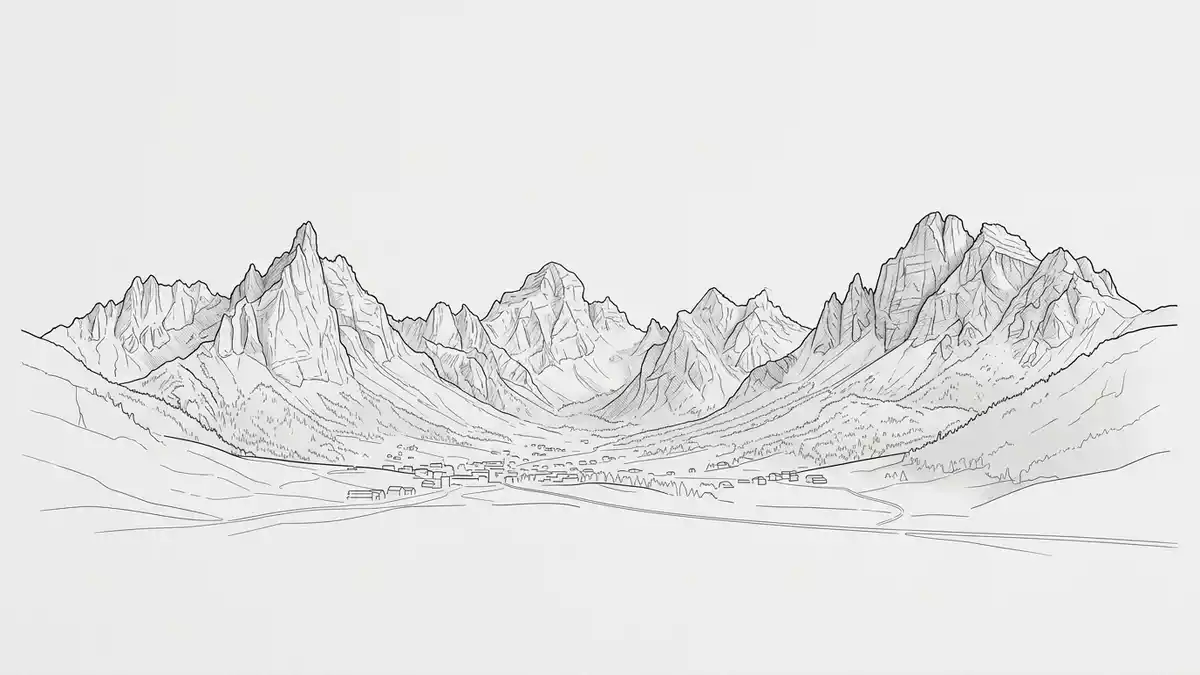
Dolomiti around Cortina d'Ampezzo form a high limestone amphitheatre, where pale crags rise above green valleys in north-eastern Italy. Inscribed on the UNESCO World Heritage List in 2009, these mountains combine jagged peaks, deep valleys and alpine pastures in a landscape that feels both dramatic and finely textured.
Pale rock and dramatic forms of Dolomiti
Dolomiti belong to the Alps in north-eastern Italy, stretching across the regions of Trentino-Alto Adige, Veneto and Friuli-Venezia Giulia between the valleys that drain towards the Danube and those that run south towards the Adriatic Sea. The mountains are built from dolomitic limestone and related carbonate rocks that give the cliffs their characteristic pale colour and their tendency to form steep ridges, towers and massive rock faces.Dolomites are formed of light-coloured dolomitic limestone The rock itself derives from ancient marine sediments laid down during the Triassic period, when coral reefs and carbonate platforms accumulated in a warm sea before being uplifted and reshaped by the Alpine orogeny.The rocks are mostly Triassic in age
Over geological time, erosion carved these carbonate layers into jagged ridges, pinnacles and broad walls separated by deep valleys and scree slopes that fan out beneath the cliffs. In many places, the cliffs rise several hundred metres above forests and meadows, creating abrupt transitions between valley floors and rock faces. The combination of pale rock, dark conifer woods and open pasture gives Dolomiti their distinct bands of colour, while the high faces expose fossil-rich strata that record the marine life of the Tethys Ocean.The UNESCO datasheet describes the craggy massifs and stratified cliff walls
Dolomiti and Cortina d'Ampezzo
Cortina d'Ampezzo sits in the Ampezzo valley in the Veneto region, surrounded by Dolomiti peaks that form a natural amphitheatre around the town. The Natural Park of the Ampezzo Dolomites extends north of Cortina over an area of about 11,200 hectares, reaching towards the border with South Tyrol and linking to the neighbouring Fanes-Senes-Braies area.The Natural Park of the Ampezzo Dolomites covers thousands of hectares north of Cortina Within this protected landscape lie mountain groups such as Tofana, Fanis, Col Bechei, Croda Rossa d’Ampezzo and Cristallo, each with its own profile and network of valleys.
The peaks around Cortina d'Ampezzo stand as part of a wider series of Dolomiti massifs that extend over roughly 150 km from east to west and about 75 km from north to south.The Dolomites consist of multiple massifs separated by deep valleys The town has long been associated with mountain tourism and is sometimes described as the “Queen of the Dolomites”, reflecting its role as one of the best-known resorts within this Alpine area.Cortina d'Ampezzo is described as the Queen of the Dolomites Around the valley floor, meadows and mixed woodland give way to slopes that rise towards the rock faces of the surrounding peaks, creating a layered landscape where settlement, forest and high mountain are all visible from many vantage points.
UNESCO recognition and the wider Dolomiti system
Dolomiti were added to the UNESCO World Heritage List in 2009 as a series of nine mountain areas recognised for their geology and their scenic value.The Dolomites were declared a UNESCO World Heritage Site in 2009 The inscription highlights both the clarity with which geological history is exposed in the rock and the visual drama of the cliffs, tower-like summits and contrasting valleys. Within this serial property, the Dolomiti around Cortina d'Ampezzo form one component of a larger system that also includes areas in South Tyrol, Trentino and Friuli-Venezia Giulia.
The UNESCO documentation notes features such as rust-coloured and grey-white peaks, massive cliff walls and extensive scree cones that stand above forests, fertile valleys and alpine pastures.The description emphasises the contrasting valleys and pastures beneath the cliffs In the area around Cortina d'Ampezzo, these contrasts can be seen where the Tofane and Cristallo groups rise above the Ampezzo valley and where the Natural Park of the Ampezzo Dolomites connects with neighbouring protected areas, creating a continuous high mountain landscape across regional boundaries.
Visiting Dolomiti: what travellers from Western Europe should know
- Dolomiti around Cortina d'Ampezzo lie in north-eastern Italy in the province of Belluno, reached by road from the Veneto plain and by regional bus connections from towns such as Belluno and Treviso.
- The terrain above Cortina d'Ampezzo rises steeply from valley floors to high cliffs, with paths and tracks that can involve sustained gradients and sections over rock and scree.
- Within the Natural Park of the Ampezzo Dolomites, waymarked trails and forest tracks link valleys such as Val Travenanzes, Val di Fanes and Alta Valle del Boite, so visitors should be prepared for routes that traverse both woodland and open high ground.
- The official language is Italian and the currency is the euro.
- Entry requirements depend on your nationality; UK travellers can check the FCDO travel advice at gov.uk/foreign-travel-advice, Irish travellers the Department of Foreign Affairs at ireland.ie.
Searching for Dolomiti on social platforms
These links open searches for Dolomiti on each platform.
Frequently asked questions about Dolomiti
Where are Dolomiti around Cortina d'Ampezzo?
Dolomiti are a mountain range in north-eastern Italy, and the peaks around Cortina d'Ampezzo lie in the Veneto region within the wider Alpine arc.
What should a visitor expect in Dolomiti near Cortina d'Ampezzo?
Visitors encounter pale limestone cliffs above green valleys, with forests, alpine meadows and high rock faces forming a landscape that shifts quickly from town to mountain.
What makes Dolomiti near Cortina d'Ampezzo distinctive?
The area combines Triassic dolomitic rock, steep towers and deep valleys, all recognised in 2009 as part of the Dolomites UNESCO World Heritage site for geology and scenery.


