
Dolomiti around Cortina d'Ampezzo, an alpine amphitheatre of pale rock
Published on 08/28/2026 at 07:48 | Editorial responsibility: Rafael Müller, Editor-in-Chief AD HOC NEWS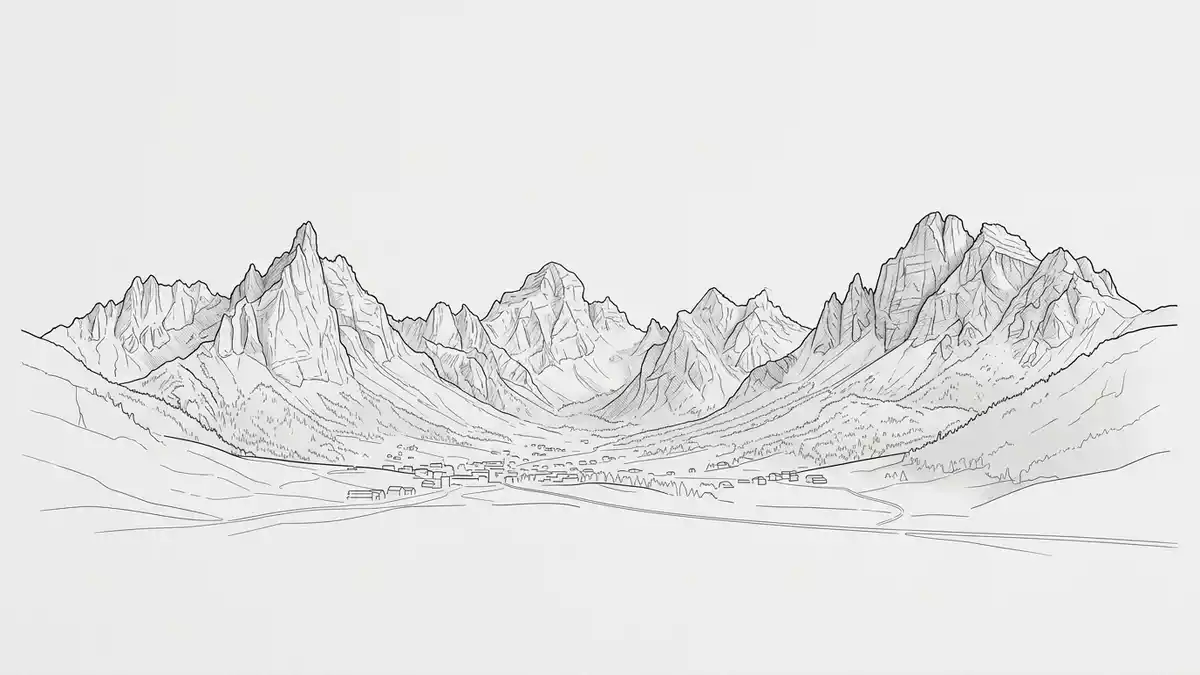
Dolomiti around Cortina d'Ampezzo form a high mountain amphitheatre in the eastern Alps, where pale limestone towers rise above a broad alpine valley in Italy. The range is part of the Dolomites, a mountain group in northern Italy recognised as a UNESCO World Heritage natural site in 2009 for its outstanding landscape and geological value.
Pale mountains above an alpine bowl
The Dolomiti landscape around Cortina d'Ampezzo is defined by pale dolomitic limestone carved into jagged ridges and steep rock faces above a wide valley floor. The municipality of Cortina d'Ampezzo occupies a roughly diamond-shaped mountain area with valley axes converging into a central basin, giving the settlement an encircling ring of peaks on all sides.diamond-shaped mountain area The lowest point of the valley lies at about 1,044 m (3,425 ft) where the Boite river meets the border with neighbouring San Vito di Cadore, while the surrounding summits climb well above 3,000 m (9,843 ft).
Tofana di Mezzo, rising to about 3,244 m (10,643 ft), forms one of the dominant massifs above Cortina d'Ampezzo and marks the highest point within the municipality’s territory.Tofana di Mezzo at 3,244 m Around it, other massifs such as Sorapìs, Cristallo and Croda Rossa carry several summits over 3,000 m (9,843 ft), creating a skyline of serrated crests and high plateaus that frame the valley. These mountains are part of the Northern Dolomites and the Ampezzo Dolomites, which together form the immediate highland setting for Cortina d'Ampezzo.
A World Heritage landscape of rock and form
Dolomiti belong to the broader Dolomites mountain group in the eastern section of the northern Italian Alps, bounded by valleys including the Isarco, Pusteria, Piave, Brenta and Adige.Dolomites in the northern Italian Alps Geologically, the mountains consist largely of light-coloured dolomitic limestone, sometimes called “pale mountains”, which weathering and erosion have cut into rocky pinnacles, saw-edged ridges, scree slopes and deep gorges.pale mountains of dolomitic limestone This distinctive rock composition and the striking landforms it produces were central reasons for the area’s inscription on the World Heritage List.
On 26 June 2009, the World Heritage Committee meeting in Seville added the Dolomites to the UNESCO World Heritage List as a natural and serial property, recognising nine Dolomite groups for their exceptional geological and landscape value.inscription of the Dolomites in 2009 These groups include the Northern Dolomites and other massifs such as Marmolada, Pale di San Martino and Dolomiti Bellunesi, together covering an area of about 142,000 hectares across the provinces of South Tyrol, Trentino, Belluno, Udine and Pordenone.142,000-hectare serial property Within this wider designation, the mountains above Cortina d'Ampezzo form part of the recognised Northern Dolomites sector.
Cortina d'Ampezzo as a gateway to Dolomiti
Cortina d'Ampezzo lies on the Boite river in an alpine valley encircled by Dolomiti peaks and serves as a main centre for visiting this part of the range.main centre of the region The town sits near the top of the Ampezzo valley, with the surrounding mountains forming a natural amphitheatre that is visible from many points in and around the settlement.Cortina d'Ampezzo in the Ampezzo valley This setting has made Cortina d'Ampezzo an established destination for mountain tourism and alpine sports, linked closely to the Dolomiti landscape.
The slopes and high valleys around Cortina d'Ampezzo form part of the Dolomiti Superski area, with local ski sectors such as Faloria-Cristallo, Lagazuoi-5 Torri and Tofane lying within the surrounding mountains.Dolomiti Superski around Cortina In warmer seasons, the same massifs provide terrain for hiking and climbing on marked paths, with access routes reaching alpine meadows and viewpoints beneath the high rock faces. Across the year, Cortina d'Ampezzo acts as a base for exploring the different massifs of the Ampezzo Dolomites and the broader Dolomiti region.
Visiting Dolomiti: what travellers from Western Europe should know
- Dolomiti around Cortina d'Ampezzo lie in north-eastern Italy, in the Dolomites section of the Alps. Cortina d'Ampezzo is reached by mountain roads connecting with main routes through Veneto and neighbouring regions.
- The surrounding terrain is high-alpine, with steep slopes, rocky paths and considerable altitude differences between valley floor and summits. Approaches to viewpoints and high plateaus often involve sustained ascents on foot or by mountain transport.
- The Dolomiti landscape near Cortina d'Ampezzo includes multiple massifs with peaks above 3,000 m (9,843 ft). Weather conditions at altitude differ markedly from those in the valley, and terrain can include exposed sections on rock or scree.
- Cortina d'Ampezzo lies within Italy, where the official language is Italian and the currency is the euro.
Searching for Dolomiti on social platforms
These links open searches for Dolomiti on each platform.
Frequently asked questions about Dolomiti
Where are Dolomiti around Cortina d'Ampezzo located?
Dolomiti in this context are the mountains surrounding Cortina d'Ampezzo in north-eastern Italy, part of the Dolomites range in the eastern Alps.
What should visitors expect when they reach Dolomiti near Cortina d'Ampezzo?
Visitors encounter pale limestone peaks, deep valleys and high plateaus, with marked differences in altitude between the valley floor and the surrounding summits.
What makes Dolomiti in the Cortina d'Ampezzo area distinctive?
This part of Dolomiti combines a wide alpine basin, encircling massifs above 3,000 m (9,843 ft) and a recognised UNESCO World Heritage landscape of pale dolomitic rock.


