
Dolomiti and the limestone towers above Cortina d'Ampezzo
Published on 09/23/2026 at 09:47 | Editorial responsibility: Rafael Müller, Editor-in-Chief AD HOC NEWS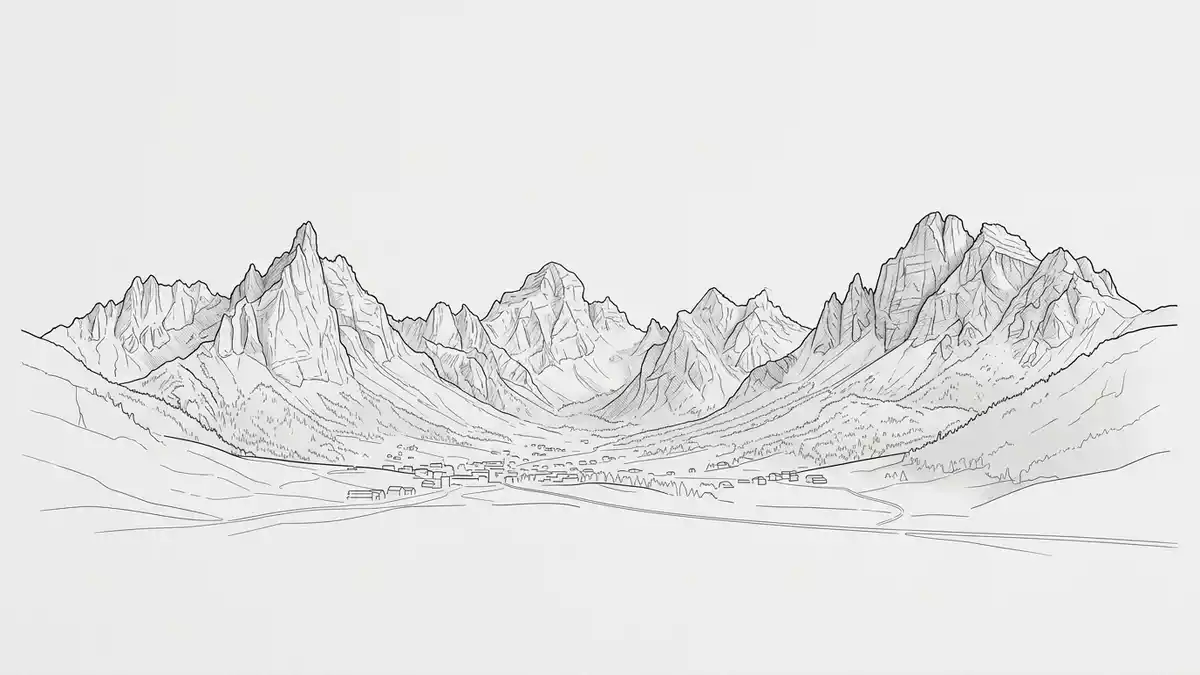
Dolomiti is a mountain landscape of pale limestone towers, sharp ridges and green valleys around Cortina d'Ampezzo in northern Italy. Its visible drama begins in the rock itself: marine deposits and ancient reefs now form pinnacles, cliffs and broad mountain walls.
The mountains belong to the eastern section of the northern Italian Alps and became a UNESCO World Heritage site in 2009. Around Cortina, the Ampezzo Dolomites place this geological story beside forests, meadows, streams and high mountain passes.
Dolomiti: reefs transformed into mountain walls
The rock of Dolomiti is dolomitic limestone, a pale material shaped by erosion into saw-edged ridges, isolated pinnacles, scree slopes and steep faces. Dolomitic limestone forms the range, giving the mountains their light colour and distinctive outlines.
The geological record reaches back around 250 million years, when shells, coral and algae accumulated in a tropical sea. The exposed strata contain evidence of changing marine environments, including reefs, volcanic landscapes and deeper sea deposits. The geological record of Dolomiti presents successive chapters of Earth history in the mountain rock.
The peaks and valleys around Cortina d'Ampezzo
Cortina d'Ampezzo lies within the Ampezzo valley, surrounded by mountain groups with vertical walls, narrow towers and broad scree fields. The Natural Park of the Ampezzo Dolomites extends north of the town across 11,200 hectares, between Veneto and South Tyrol.
The landscape includes forests, alpine meadows, streams, waterfalls, canyons and high lakes. Rock faces rise above the valley floor, while wooded slopes and pasture occupy gentler ground. The combination of pale cliffs and darker vegetation gives the area its strong visual contrast.
Several major Dolomite groups lie within the wider region. The Marmolada forms the highest point of the range at 3,342 m (10,964 ft), while the surrounding mountains present a changing sequence of towers, ridges and passes. The range contains 18 peaks above 3,050 m (10,000 ft).
A mountain landscape with protected status
Dolomiti entered the UNESCO World Heritage List on 26 June 2009. The designation covers nine mountain areas, recognising their landscape and geological importance. The Ampezzo Dolomites park forms the protected mountain setting north of Cortina.
The name comes from Déodat de Dolomieu, the French geologist who studied the characteristic rock in the eighteenth century. His name became attached both to the mineral dolomite and to the mountain region where it occurs in abundance.
Protection does not turn Dolomiti into a single monument. It is a connected cultural landscape of rock, woodland, pasture and water, with settlements and routes around Cortina d'Ampezzo. Its identity lies in the relationship between exposed geology and the living mountain environment.
Visiting Dolomiti: what travellers from Western Europe should know
- Cortina d'Ampezzo is in Veneto, in northern Italy. The town is reached by road, and regional bus routes connect it with nearby Alpine valleys.
- The Natural Park of the Ampezzo Dolomites lies north of Cortina. Mountain routes cross forest, pasture, scree and exposed rock, with steep gradients in several areas.
- The official language is Italian and the currency is the euro.
- High peaks, loose limestone debris, narrow paths and changing alpine conditions form part of the terrain around the mountain groups.
Searching for Dolomiti on social platforms
These links open searches for Dolomiti on each platform.
Frequently asked questions about Dolomiti
Where is Dolomiti?
Dolomiti is a mountain region in the eastern northern Italian Alps. Cortina d'Ampezzo lies in the Ampezzo valley, within the Veneto region.
What can travellers expect around Cortina?
The landscape includes limestone cliffs, towers, scree slopes, forests, meadows, streams and high mountain terrain. Routes range from valley landscapes to exposed Alpine ground.
What makes Dolomiti distinctive?
Its pale dolomitic limestone records ancient marine environments and forms a landscape of pinnacles, ridges and vertical walls. The mountain region has held UNESCO World Heritage status since 2009.


