
Dioklecijanova palaca, the living Roman palace of Split
Published on 08/28/2026 at 15:04 | Editorial responsibility: Rafael Müller, Editor-in-Chief AD HOC NEWS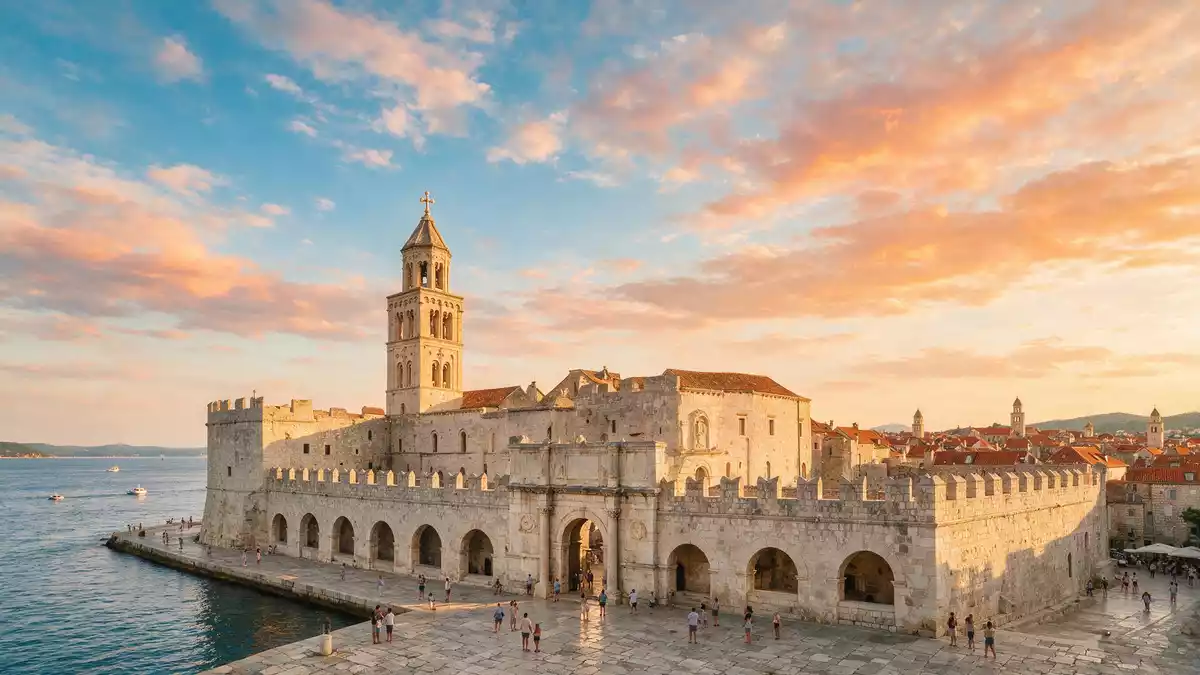
Dioklecijanova palaca in Split is an ancient Roman imperial palace that has long since become part of the city itself, with streets, houses and a cathedral threaded through its stone shell. Built for Emperor Diocletian around the turn of the fourth century AD, it combines the scale of a fortress with the layout of a town, creating a place where everyday life unfolds inside late Roman walls.
A Roman emperor’s retirement palace by the sea
Dioklecijanova palaca was commissioned by the Roman emperor Diocletian near his native region of Salona, on the coast of what is now Croatia. The palace and fortress complex is dated to the late third and early fourth centuries AD, with construction generally placed between about 295 and 305, the years in which Diocletian prepared to leave the imperial office.built between 295 and 305 Diocletian abdicated on 1 May 305 and then lived in the palace at Split until his death in the second decade of the fourth century.retirement residence of Diocletian
The palace occupies a rectangle aligned roughly with the Adriatic shore, combining elements of an imperial villa, a fortified camp and an urban grid. Its footprint covers around 30,000 m², with sides in the region of 215 m by 180 m.rectangular plan of about 30,000 m² Towers rise along the landward walls, and four larger corner towers reinforce the angles, giving the exterior a pronounced military character.
Streets, houses and a cathedral within ancient walls
The interior of Dioklecijanova palaca was laid out with a pair of main streets crossing at right angles, echoing the Roman castrum pattern and dividing the complex into four quadrants.divided into four parts with two main streets The southern sector facing the sea contained Diocletian’s residential quarters along with ceremonial and religious spaces, while the northern part accommodated the imperial guard, service buildings and storage. The palace’s basement halls extend beneath the southern apartments, mirroring the plan above and preserving the original layout in stone.
Over centuries, the fabric of the palace has been adapted into a town. From the seventh century onwards, people from nearby Salona settled inside the walls and converted the complex into a lived-in urban core, building houses, shops and churches over and around the Roman structures.from the seventh century the palace lives as Split Diocletian’s mausoleum was turned into a Christian church, and this building is associated with the cathedral now known as the Cathedral of Saint Domnius. The result is that visitors walk through a network of streets framed by Roman walls, where domestic buildings, chapels and small squares stand on foundations laid for an emperor.
UNESCO protection and the wider historic complex
Dioklecijanova palaca does not stand alone but forms the core of a wider historic ensemble in Split. The “Historical Complex of Split with the Palace of Diocletian” has been inscribed on the UNESCO World Heritage List since 1979, recognising the palace and its surrounding city fabric as a cultural property of international importance.Historical Complex of Split with the Palace of Diocletian Roman, medieval and later layers sit together within the old town, and several of the palace’s original gates still mark the transition between spaces.
The palace combines late Roman architectural language with elements drawn from Greek and early Byzantine traditions.transitional style between Greek and Byzantine Its stone walls, arcades and colonnades form a backdrop for Split’s historic centre, and the survival of substantial sections of the original structure makes it one of the best-preserved examples of a Roman imperial residence integrated into a living city.
Visiting Dioklecijanova palaca: what travellers from Western Europe should know
- Dioklecijanova palaca forms the core of Split’s historic centre on the Adriatic coast of Croatia, and is reached by walking directly from the harbourfront and nearby streets.
- The site consists of enclosed courtyards, narrow lanes and stone-built interiors, and exploring it involves walking on uneven stone surfaces and using steps within the ancient fabric.
- The official language is Croatian and the currency is the Croatian kuna.
- Entry requirements depend on your nationality; UK travellers can check the FCDO travel advice at gov.uk/foreign-travel-advice, Irish travellers the Department of Foreign Affairs at ireland.ie.
Searching for Dioklecijanova palaca on social platforms
These links open searches for Dioklecijanova palaca on each platform.Frequently asked questions about Dioklecijanova palaca
Where is Dioklecijanova palaca located?
Dioklecijanova palaca stands in the coastal city of Split in Croatia, forming a substantial part of the historic centre beside the Adriatic Sea.
What should visitors expect when exploring Dioklecijanova palaca?
Visitors move through Roman walls, gates, courtyards and vaulted spaces that have been adapted into streets, houses and churches, with stone surfaces and changes of level.
What makes Dioklecijanova palaca distinctive among Roman sites?
Dioklecijanova palaca is a large late Roman imperial residence whose stone shell has become a lived-in urban quarter, recognised within a UNESCO-listed historic complex in Split.


