
Dioklecijanova palaca: a Roman palace that became Split’s old town
Published on 09/09/2026 at 16:58 | Editorial responsibility: Rafael Müller, Editor-in-Chief AD HOC NEWS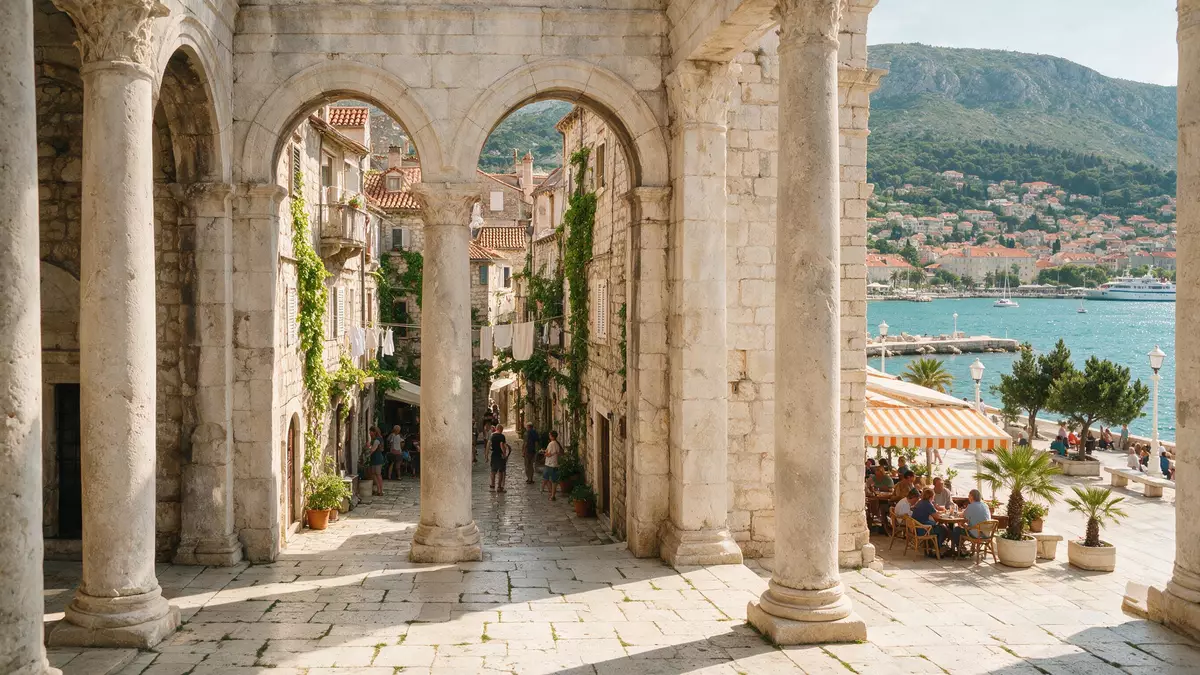
Dioklecijanova palaca in Split is an ancient Roman imperial complex whose stone walls now contain much of the city’s historic core, turning a retirement palace into a lived-in old town. Built for Emperor Diocletian in the late third and early fourth century, it combines the scale of a fortress with the layout of a formal residence facing the Adriatic.
A Roman emperor’s retirement palace on the Adriatic
Dioklecijanova palaca was constructed as the retirement residence of the Roman emperor Diocletian, who abdicated in 305 and spent his final years beside the sea at Split.retirement residence The complex is traditionally dated to construction between 295 and 305, marking the transition from the third to the fourth century in the eastern Adriatic provinces.late 3rd and early 4th centuries
Dioklecijanova palaca stands on a low peninsula south-west of the archaeological remains of Salona, the former capital of the Roman province of Dalmatia and Diocletian’s birthplace region.near Salona in Dalmatia From the sea, the palace presents long masonry walls punctuated by towers, recalling a fortified camp as much as a private villa. Inside, however, ceremonial courtyards, colonnades and a mausoleum trace the life of a retired emperor surrounded by formal architecture.
From imperial residence to UNESCO-listed city core
In medieval and later centuries, houses, churches and palaces were built into and over the Roman fabric of Dioklecijanova palaca, creating a dense urban core where ancient structures and later additions share the same narrow streets.medieval churches and palaces Twelfth- and thirteenth-century Romanesque churches, Gothic and Renaissance palaces and Baroque frontages all occupy spaces originally defined by Roman walls and gateways, making the complex an architectural palimpsest.
The historical complex of Split with Dioklecijanova palaca was inscribed on the UNESCO World Heritage List in 1979, recognising both the Roman palace and the surrounding medieval core as a single protected ensemble.UNESCO World Heritage List in 1979 Within the outline of the palace, residential buildings, shops and small squares fill spaces that once held barracks and service courtyards, so that the site functions as a neighbourhood rather than a self-contained monument.
Stone, streets and spaces inside Dioklecijanova palaca
Dioklecijanova palaca is laid out as a walled rectangle divided by two main streets, following the model of a Roman castrum while incorporating more elaborate residential quarters on the seaward side.divided by two main streets Its perimeter walls rise to substantial height and are reinforced by projecting towers, with gates on each side leading to the internal grid of passages.
The palace was built from pale limestone quarried on the nearby island of Bra?, along with imported marble and sculptural elements such as Egyptian sphinxes, giving the surviving columns and facades a varied stone palette.stone from Bra? and imported marble Within the walled rectangle, the central open court known as the Peristyle aligns key ceremonial spaces, including the former imperial mausoleum and temple structures that later became Christian ecclesiastical buildings.Peristyle and mausoleum
Visiting Dioklecijanova palaca: what travellers from Western Europe should know
- Dioklecijanova palaca occupies much of Split’s old town beside the harbour, with the palace walls and gates forming a distinct stone rectangle within the wider city.
- The historic core consists of narrow streets, uneven stone paving and staircases connecting different levels, so moving around the palace involves frequent steps rather than wide level walkways.
- Split lies on the Adriatic coast of Croatia, and Dioklecijanova palaca stands close to the waterfront just inland from the modern ferry quays and seafront promenade.
- The official language is Croatian and the currency is the Croatian kuna.
Searching for Dioklecijanova palaca on social platforms
These links open searches for Dioklecijanova palaca on each platform.
Frequently asked questions about Dioklecijanova palaca
Where is Dioklecijanova palaca located?
Dioklecijanova palaca stands in the city of Split on the Adriatic coast of Croatia, forming a walled rectangle that makes up much of the historic centre.
What can visitors expect inside the palace?
Inside the palace walls are narrow stone streets, small squares, later churches and houses integrated with Roman architecture, so the complex functions as a lived-in part of the city.
What makes Dioklecijanova palaca distinctive among Roman sites?
Dioklecijanova palaca is distinctive as a late Roman imperial residence whose rectangular walled layout and ceremonial spaces became the framework for Split’s medieval core, now protected as a UNESCO World Heritage site.


