
Dioklecijanova palaca: a lived-in Roman fortress by the Adriatic
Published on 09/16/2026 at 09:46 | Editorial responsibility: Rafael Müller, Editor-in-Chief AD HOC NEWS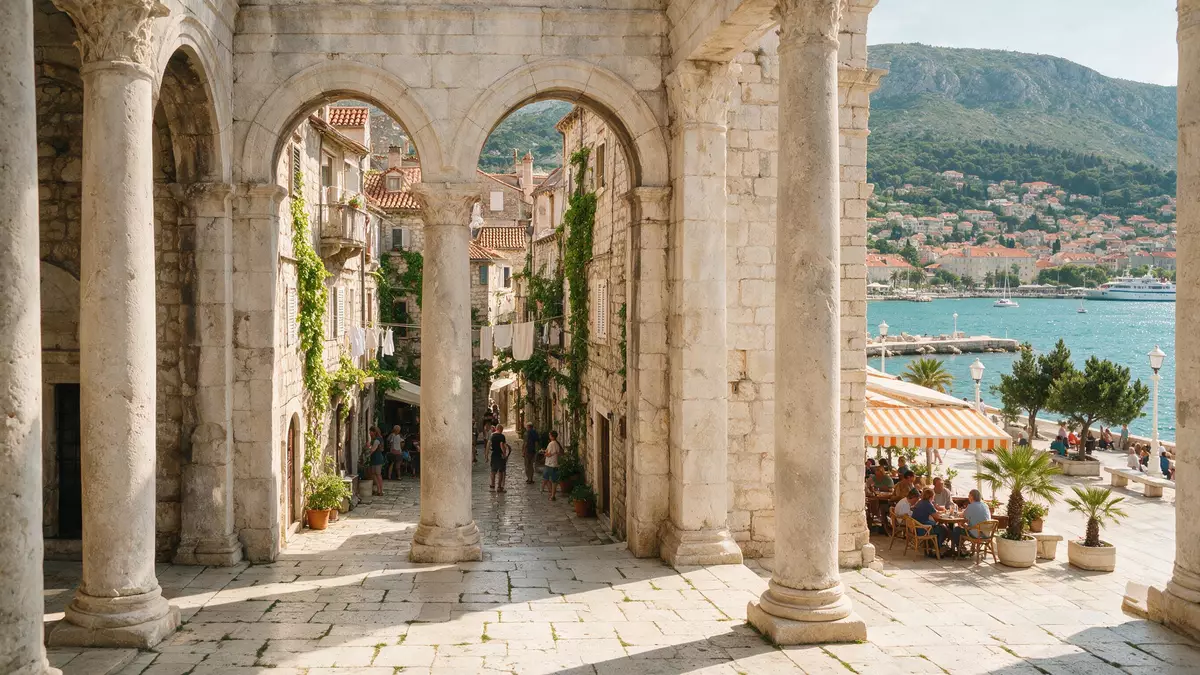
Dioklecijanova palaca, known in English as Diocletian’s Palace, is a Roman imperial fortress and residence that grew into the historic core of Split on Croatia’s Adriatic coast. Built for Emperor Diocletian in the late third and early fourth century, it remains a dense urban maze of stone streets, courtyards and houses embedded within ancient walls.
A Roman retirement palace that became a city
Dioklecijanova palaca was commissioned by the Roman Emperor Diocletian near the end of his rule, as a residence for his retirement after he stepped down from power in 305 AD.Emperor Diocletian The complex rose on the coast near the Roman city of Salona, with its sea-facing side aligned to the shoreline and its northern walls facing inland.ancient Roman palace and fortress complex
Construction is dated to around 295–305 AD, placing Dioklecijanova palaca firmly in the late Roman imperial period.c. 295–305 CE In its original form the palace combined the roles of a luxurious villa, a fortified military camp and an administrative centre, with private apartments for Diocletian in the southern section and barracks and service spaces in the north.combination of a luxury villa and a Roman military camp
Walls, streets and stone: the structure of Dioklecijanova palaca
The ground plan of Dioklecijanova palaca forms a large quadrilateral, with stout perimeter walls articulated by towers on the landward sides.irregular rectangle measuring east–west and north–south Within this outline two main axial streets divide the interior into four parts, echoing the layout of a Roman castrum and giving the complex a regular internal grid. Stone construction dominates throughout, from the walls and gates to the colonnaded courtyards and arcades.
In the southern sector, near the seafront, visitors encounter the peristyle, an open courtyard framed by columns that acts as a central gathering space and architectural focus.the peristyle Nearby stand structures that began as imperial ceremonial and religious buildings, later adapted into churches and chapels as the city’s life shifted. The northern areas, once dedicated to soldiers, storage and service functions, are now lined with houses, small squares and passages that follow the old Roman grid while reflecting mediaeval and later building phases.about half of the complex was for Diocletian's personal use, with the rest housing the military garrison
From imperial compound to UNESCO-listed urban core
When Salona was destroyed in the early seventh century, its surviving inhabitants moved into the shelter of Dioklecijanova palaca, gradually filling the former imperial compound with dwellings and public buildings.Salona razrušena, stanovnici sklonili su se u pala?u Over generations the palace shifted from a single residence into a city within walls, with mediaeval streets threaded through Roman corridors and later additions raised against ancient stone.
The historic complex of Split with Dioklecijanova palaca was inscribed as a UNESCO World Heritage Site in 1979, recognising both the palace and the surrounding old town as a single cultural ensemble.Historical Complex of Split with the Palace of Diocletian This status reflects the exceptional preservation of late antique architecture and the way Roman, mediaeval and later layers coexist in one living urban space.historical complex of Split with Dioklecijanova pala?a
Visiting Dioklecijanova palaca: what travellers from Western Europe should know
- Dioklecijanova palaca forms part of the historic centre of Split on the Adriatic coast of Croatia, reached by rail and road connections that converge on Split’s ferry and bus terminals.
- The complex consists of narrow stone streets, uneven paving and staircases inside former fortification walls, so moving around involves walking on hard surfaces and climbing steps between levels.
- The palace adjoins Split’s waterfront, with the Riva promenade running beside the southern edge, and views opening towards the Adriatic from points near the seaward walls.
- The official language is Croatian and the currency is the Croatian kuna.
Searching for Dioklecijanova palaca on social platforms
These links open searches for Dioklecijanova palaca on each platform.
Frequently asked questions about Dioklecijanova palaca
Where is Dioklecijanova palaca located?
Dioklecijanova palaca stands within the historic centre of Split on Croatia’s Adriatic coast, occupying a walled area that opens towards the sea.
What should visitors expect inside the palace complex?
Visitors encounter a compact network of stone streets, courtyards, gates and houses, where Roman walls, columns and arcades frame mediaeval and later buildings.
What makes Dioklecijanova palaca distinctive among Roman sites?
Dioklecijanova palaca is distinctive because its Roman fortress and villa plan survives as a lived-in city core, with UNESCO-listed ancient fabric integrated into everyday urban life.


