
Dinh Doc Lap, Ho-Chi-Minh-Stadt’s modernist palace of independence
Published on 09/04/2026 at 08:05 | Editorial responsibility: Rafael Müller, Editor-in-Chief AD HOC NEWS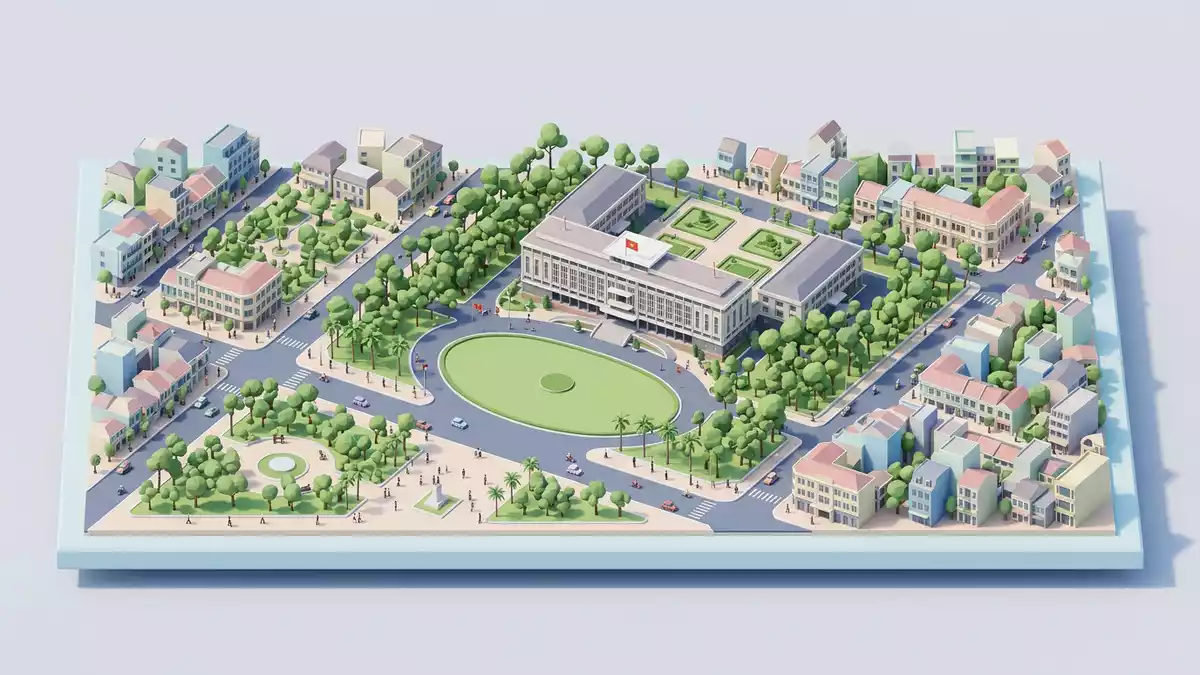
Dinh Doc Lap in Ho-Chi-Minh-Stadt, widely known in English as the Independence Palace or Reunification Palace, is a modernist presidential residence whose concrete form still carries Vietnam’s twentieth-century political history. Built in the 1960s on the site of the former Norodom Palace and recognised as a special national relic, it stands at 135 Nam Ky Khoi Nghia Street as a preserved seat of power from the era of South Vietnam.Independence Palace
From colonial residence to presidential palace
The story of Dinh Doc Lap begins in the French colonial period, when Norodom Palace was built between 1868 and 1873 as a residence for the Governors-General of French Indochina.Norodom Palace That first palace, set within a broad park in Saigon, marked the presence of French authority in the region and gave the site its role as a governmental address long before the Vietnam War.
In the early 1960s, after damage to the colonial building, President Ngo Dinh Diem ordered a complete rebuilding of the palace on the same city block.construction was begun in July 1962 Vietnamese architect Ngo Viet Thu, who had previously won the Prix de Rome in architecture, designed the new Independence Palace as a modern structure that replaced Norodom Palace while keeping the address as the centre of executive power for South Vietnam.designed by Ngo Viet Thu
Modernist architecture with Vietnamese motifs
The present Independence Palace was completed in October 1966, giving Ho-Chi-Minh-Stadt a modernist government compound at a time when the city was still widely known as Saigon.completed in October 1966 The main building rises over several floors above a large rectangular site and combines reinforced concrete with glass and decorative screens, forming an ordered façade that reflects 1960s architectural tendencies.
Descriptions of the design highlight how Ngo Viet Thu integrated traditional Asian references into a modern layout, including an overall plan described as echoing the Chinese character for “good luck”.shape of the Chinese character The complex ranges over an area quoted at around 12 hectares, with three principal floors, mezzanines, a basement and a terrace, forming a self-contained presidential compound surrounded by lawns and trees that separate it from the traffic on Nam Ky Khoi Nghia and the neighbouring streets.covering an area of 12 hectares
A site where Vietnam’s twentieth century converged
Dinh Doc Lap is closely associated with the events of 30 April 1975, when tanks entered the palace grounds and the flag of the forces from the north was raised on the balcony, marking the collapse of the Republic of Vietnam’s authority.collapse of the authority of the Republic of Vietnam In November 1975, the building hosted the Political Consultative Meeting on the reunification of north and south, and after that meeting it was renamed Reunification Palace, while remaining identified in Vietnamese as Dinh Doc Lap.renamed Reunification Palace
In 1976, the government classified the palace as a special cultural and historical relic, acknowledging the site as a key witness to Vietnam’s twentieth-century transformations.recognized as a special national relic The complex is now maintained as a government-owned public hall and museum, where state events can be held and visitors can move through former offices, meeting rooms and communication spaces arranged much as they were during the war years.government-owned public hall
Visiting Dinh Doc Lap: what travellers from Western Europe should know
- Dinh Doc Lap stands at 135 Nam Ky Khoi Nghia Street in Ben Thanh Ward, District 1, surrounded by major roads including Nam Ky Khoi Nghia, Huyen Tran Cong Chua, Nguyen Thi Minh Khai and Nguyen Du. Taxis and city buses serve this central area of Ho-Chi-Minh-Stadt.
- The palace occupies a large urban block set behind lawns and trees. Approaching the main building involves crossing open paved areas and broad external steps, and the interior includes staircases between the principal floors.
- Ho-Chi-Minh-Stadt has a tropical climate, and the palace grounds include outdoor spaces with limited shade between the trees and the façade, so conditions can be humid under the concrete and on the surrounding lawns.
- The official language is Vietnamese and the currency is the Vietnamese dong.
- Entry requirements depend on your nationality; UK travellers can check the FCDO travel advice at gov.uk/foreign-travel-advice, Irish travellers the Department of Foreign Affairs at ireland.ie.
Searching for Dinh Doc Lap on social platforms
These links open searches for Dinh Doc Lap on each platform.
Frequently asked questions about Dinh Doc Lap
Where is Dinh Doc Lap located in Ho-Chi-Minh-Stadt?
Dinh Doc Lap, or the Independence Palace, stands at 135 Nam Ky Khoi Nghia Street in Ben Thanh Ward, District 1, a central district of Ho-Chi-Minh-Stadt.135 Nam Ky Khoi Nghia Street
What can visitors expect to see inside the palace?
Visitors move through preserved meeting rooms, offices and communication areas from the period of South Vietnam, along with exhibition spaces that present the site as a museum and special national relic.Di tích l?ch s? Dinh ??c L?p
What makes Dinh Doc Lap distinctive among landmarks in Vietnam?
The palace combines a modernist 1960s design by architect Ngo Viet Thu with a role as the location of pivotal events in 1975 and a formal recognition as a special cultural and historical relic of Vietnam.historical and architectural values


