
Dendera Temple Complex and the star-filled sanctuary of Hathor
Published on 08/21/2026 at 13:53 | Editorial responsibility: Rafael Müller, Editor-in-Chief AD HOC NEWS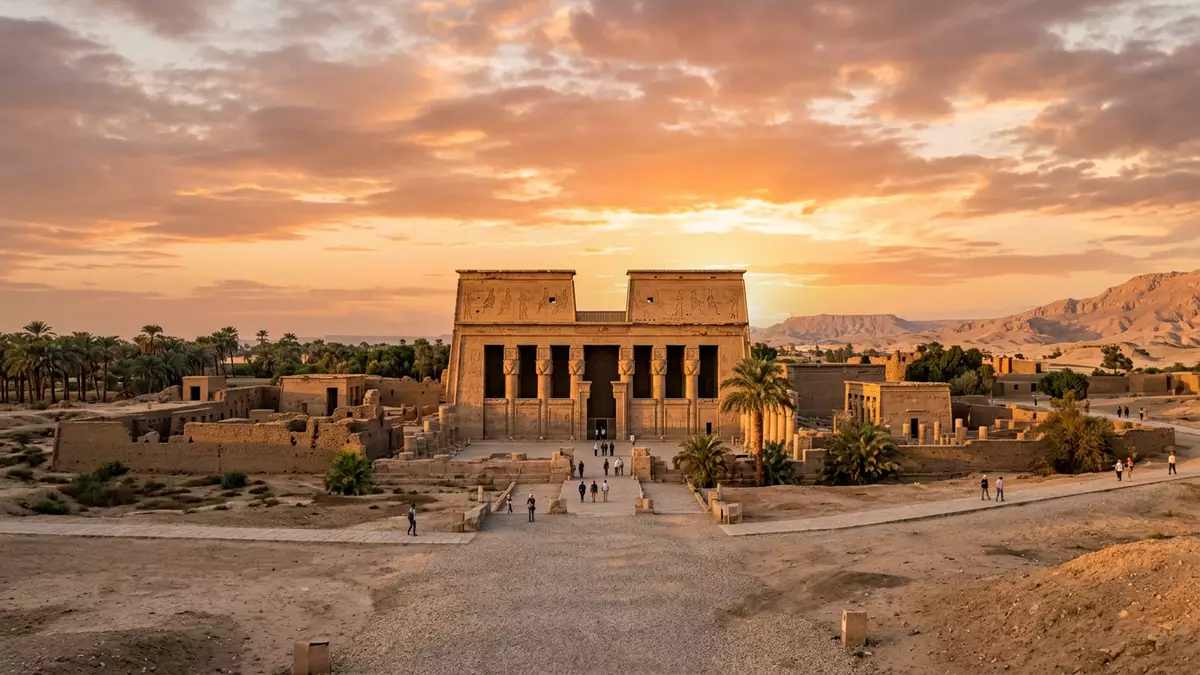
Dendera Temple Complex near Qena in Egypt is a compact landscape of stone, relief and ritual space, centred on the Temple of Hathor from the late Ptolemaic and Roman periods and framed by a massive mudbrick enclosure wall.
Sandstone architecture for a goddess of music and joy
The dominant structure at Dendera is the Temple of Hathor, dedicated to the goddess associated with music, joy and the sky and built in sandstone on a conventional Egyptian plan.The Temple of Hathor stands near the west bank of the Nile, facing the town of Dendera and enclosed within a broad walled precinct that marks the limits of the sacred complex.Dendera Temple complex The present temple belongs to the late phases of ancient Egyptian history, with construction beginning under Ptolemy XII in the first century BC and decoration continuing under Roman emperors including Tiberius and Trajan.built by Ptolemy XII
From the outside the Temple of Hathor presents a solid, rectilinear mass with a broad façade leading into a deep hypostyle hall where stone columns rise under heavy ceiling blocks carved with plant forms and astronomical figures.Greco-Roman Temple of Hathor The capitals of these columns take the form of Hathor heads, a characteristic emblem of the goddess that also appears on naos-shaped sistrums, the musical instruments used in her worship, giving the architecture a strongly sculptural character.Hathor capitals Behind the hypostyle hall, a sequence of inner chambers leads towards the sanctuary and the roof, where chapels, stairways and subsidiary rooms extend the ritual landscape vertically above the main temple body.inner apartments
A temple town with birth houses, basilica and sacred lake
Beyond the main Hathor temple, Dendera Temple Complex covers a sizeable area of around 40,000 square metres, enclosed by a mudbrick wall whose sides extend for hundreds of metres and once included monumental gateways on its northern and eastern flanks.huge area bounded by a wall Within this perimeter, the complex accommodates a variety of structures, including birth houses, a sacred lake, shrines and service buildings that reflect layer upon layer of occupation from the Middle Kingdom through the Roman period.birth houses and sacred lake
The earliest surviving building within the enclosure is a mammisi, or birth house, attributed to Nectanebo I of the thirtieth dynasty in the fourth century BC, which stands to the northwest of the main temple and marks a long tradition of cult structures at the site.mammisi of Nectanebo I Later birth houses, a basilica and other ancillary buildings expanded the complex, underlining Dendera’s role as a significant religious centre in Upper Egypt with multiple sanctuaries dedicated to deities such as Horus, Ihy and Hathor.basilica and other monuments The sacred lake, cut into the ground within the walls, provided water for ritual purification and formed part of the temple’s permanent stone-and-water setting.
The Dendera Zodiac and a carved sky in sandstone
One of the most discussed features associated with Dendera Temple Complex is the Dendera Zodiac, a circular sandstone bas-relief that once formed part of the astronomical decoration on the ceiling of a chapel dedicated to Osiris within the Hathor temple.Dendera Zodiac Measuring about 2.3 m (7.5 ft) in diameter, the relief brings together constellations of the zodiac, Egyptian deities and celestial symbols in a dense composition centred on Ra-Horakhty standing on a sacred boat.circular relief with zodiac signs Carved in the late Ptolemaic period around the middle of the first century BC, it encapsulates the intersection of Greek and Egyptian astronomical thinking in visual form.carved around 50 BCE
The circular zodiac relief was removed from the temple ceiling in the nineteenth century and transported to France, where it is housed at the Louvre, while a larger rectangular star map carved along the sanctuary ceiling remains at Dendera.relief at the Louvre Within the temple complex, astronomical motifs continue across ceilings and walls, integrating depictions of the night sky with ritual scenes and hieroglyphic inscriptions, so that a walk through the hypostyle hall and the roof chapels brings carved representations of stars, planets and deities into close proximity with structural elements such as columns and beams.temple ceilings and decoration
Visiting Dendera Temple Complex: what travellers from Western Europe should know
- Dendera Temple Complex lies near the town of Dendera on the west bank of the Nile, south of Qena in Upper Egypt, and is approached by road from Qena or Luxor.
- The complex stands within a large mudbrick enclosure, and exploring the Temple of Hathor involves walking through stone halls, climbing stairways to the roof chapels and crossing uneven ground around the ancillary buildings.
- The official language is Arabic and the currency is the Egyptian pound.
- Entry requirements depend on your nationality; UK travellers can check the FCDO travel advice at gov.uk/foreign-travel-advice, Irish travellers the Department of Foreign Affairs at ireland.ie.
Searching for Dendera Temple Complex on social platforms
These links open searches for Dendera Temple Complex on each platform.
Frequently asked questions about Dendera Temple Complex
Where is Dendera Temple Complex and what is nearby?
Dendera Temple Complex stands near the town of Dendera on the west bank of the Nile, a short distance south of Qena in Upper Egypt, with the river forming its main landscape reference.
What should visitors expect when exploring the site?
Visitors encounter the sandstone Temple of Hathor with its columned hypostyle hall, roof chapels and decorated ceilings, along with birth houses, a sacred lake and other ancillary structures within the mudbrick enclosure.
What makes Dendera Temple Complex distinctive among Egyptian temple sites?
Dendera is notable for the preservation of the Hathor temple’s architecture and reliefs, the presence of mammisi structures from the thirtieth dynasty and its association with the Dendera Zodiac, a carved astronomical relief now in the Louvre.


